The 25th anniversary of the September 11, 2001, terrorist attacks serves as a somber milestone that continues to resonate deeply within the American consciousness. A quarter-century later, the events of that Tuesday morning remain etched in the national memory, acting as a definitive generational marker. According to data released by the Pew Research Center on September 3, 2026, approximately 93% of Americans who were at least 10 years old at the time of the attacks can vividly recall their exact location or activity when they first learned of the tragedy. This high level of collective recall underscores the profound psychological and sociological impact the event had on the United States, cementing it as the most significant historical moment for the majority of the population.
A Chronology of the September 11 Attacks
The attacks of September 11, 2001, began at 8:46 a.m. Eastern Time, when American Airlines Flight 11 crashed into the North Tower of the World Trade Center in New York City. At 9:03 a.m., United Airlines Flight 175 struck the South Tower. As the nation watched in horror, a third plane, American Airlines Flight 77, hit the Pentagon in Arlington, Virginia, at 9:37 a.m. A fourth aircraft, United Airlines Flight 93, crashed into a field in Shanksville, Pennsylvania, at 10:03 a.m. after passengers and crew fought back against the hijackers, preventing the plane from reaching its intended target in Washington, D.C.
By 10:28 a.m., the North Tower of the World Trade Center collapsed, following the collapse of the South Tower at 9:59 a.m. The immediate aftermath saw the mobilization of emergency services across the country, the grounding of all commercial flights, and a rapid shift in U.S. domestic and foreign policy. The event resulted in the deaths of 2,977 victims, making it the deadliest act of terrorism in world history.
Historical Context and Long-Term Impact
The significance of 9/11 extends far beyond the day itself. For decades, it has remained the primary lens through which Americans view national security and geopolitical engagement. In a 2016 survey conducted by the Pew Research Center, nearly three-quarters of U.S. adults identified 9/11 as one of the ten most significant historical events of their lifetimes. No other event—including the fall of the Berlin Wall, the moon landing, or the invention of the internet—commanded such a consensus.
The geopolitical implications were immediate and lasting. The attacks prompted the initiation of the Global War on Terror, the invasion of Afghanistan in 2001, and the subsequent invasion of Iraq in 2003. Domestically, the creation of the Department of Homeland Security and the passage of the USA PATRIOT Act fundamentally altered the balance between civil liberties and national surveillance. Two and a half decades later, historians and sociologists continue to analyze how the "post-9/11 era" transformed American public life, surveillance technology, and the nature of global military intervention.
The Information Crisis: A Growing Disconnect
While the memory of 9/11 remains sharp, the mechanisms by which Americans receive and process information have undergone a seismic shift. In 2026, the public faces a landscape defined by an overwhelming volume of content and a declining trust in traditional news institutions. This reality is compounded by a paradoxical relationship between the importance of being informed and the actual state of public knowledge.
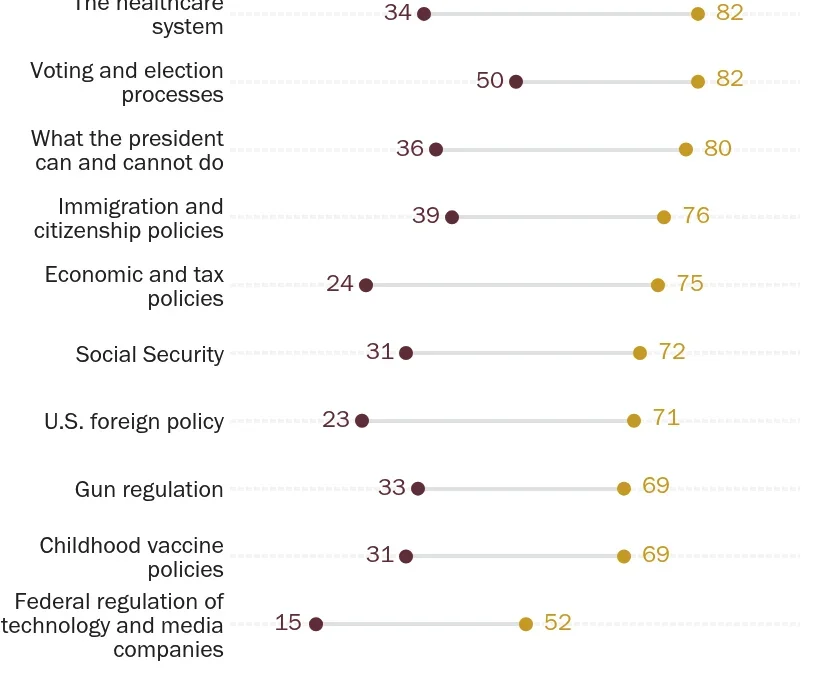
Recent survey data from March 2026 illustrates this disparity. While 82% of U.S. adults believe it is "extremely or very important" for citizens to stay informed about the healthcare system, only 34% describe themselves as being highly informed on the subject. A similar trend exists regarding fiscal policy: 75% of Americans view economic and tax policy as a critical area of knowledge, yet only 24% feel they possess a high level of understanding. This gap is even more pronounced regarding federal technology and media regulation, where 52% of the public believes it is important to be informed, but only 15% claim to be.
The Rise of Algorithmic Verification
In response to the proliferation of misinformation, the media landscape is witnessing the emergence of new technologies designed to restore a measure of accuracy to the public square. One such tool, "Arbiter," is currently being integrated by various news organizations to analyze social media trends using artificial intelligence. The goal is to provide journalists with a robust, independent mechanism to identify and debunk false narratives in real-time.
This technological pivot comes at a time when public confidence in social media as a reliable news source is at a low ebb. A 2025 report noted that only 37% of U.S. adults express any level of trust in information disseminated through social media platforms. Data from 2024 revealed that the primary grievance held by users who encounter news on platforms like X (formerly Twitter), Facebook, Instagram, and TikTok is the perceived lack of accuracy. Users frequently report encountering content that appears misleading, creating a feedback loop of skepticism that makes it increasingly difficult for verified information to gain traction.
Analytical Perspective: The Challenge of Informed Citizenship
The intersection of the 25th anniversary of 9/11 and the current crisis of information literacy presents a unique challenge for democratic discourse. In the immediate aftermath of 2001, the American public largely relied on a centralized media ecosystem to process national grief and understand policy responses. Today, that ecosystem is fragmented, decentralized, and often algorithmically skewed to prioritize engagement over accuracy.
Political scientists note that the "informed citizen" model, which assumes that voters will seek out high-quality information to make decisions, is struggling under the weight of information overload. When individuals feel they lack the knowledge necessary to navigate complex systems—such as immigration policy, where 76% see it as vital to understand but only 39% feel they do—they are more susceptible to falling back on tribal affiliations or emotionally charged, inaccurate narratives.
The development of AI-driven tools like Arbiter represents an attempt to bridge this divide, but experts caution that technology alone cannot replace the foundational need for media literacy. As the nation moves further away from the singular, unifying trauma of 9/11, the challenge for the next decade will be to foster a public sphere capable of distinguishing fact from fabrication, ensuring that the history we remember remains grounded in reality rather than distorted by the digital architecture of the modern era.
Summary of Findings
The 25-year mark of the September 11 attacks serves as both a reminder of the resilience of the American public and a catalyst for reflecting on the fragility of our information ecosystem. While the memory of the attacks remains a shared foundation, the subsequent quarter-century has seen the erosion of shared facts and a widening gap between the importance placed on civic knowledge and the actual attainment of that knowledge.
As news organizations, nonprofits, and citizens navigate this environment, the goal remains clear: to rebuild a system where essential topics—from healthcare and economics to national security—can be discussed with a baseline of accuracy. The path forward involves not just the adoption of new, sophisticated tools for monitoring the digital landscape, but a commitment to the civic duty of staying informed in an age where information is abundant, yet truth is increasingly elusive.
As we look toward the future, the lessons of 9/11—specifically the importance of clarity, vigilance, and unity in the face of crisis—remain as relevant as ever. Whether in the context of national security or the health of our digital information landscape, the ability of a nation to remember its past accurately and understand its present clearly is the most vital defense it possesses.