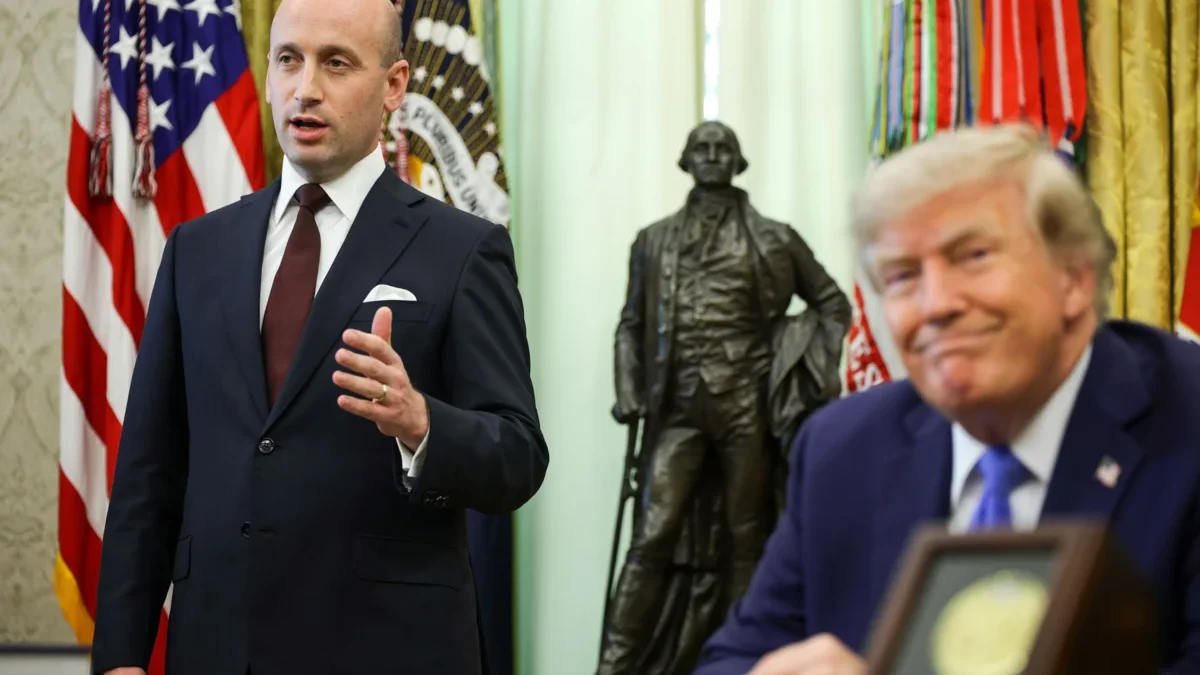
President Donald Trump announced on Friday that Stephen Miller, one of his longest-serving and most politically aggressive advisors, will assume the role of White House chief of staff. The appointment comes in the wake of disastrous results for the Republican Party in the midterm elections, which saw the GOP lose control of both the House of Representatives and the Senate in a sharp rebuke of the administration’s policy agenda.
Miller, who previously served as the deputy chief of staff for policy and homeland security adviser, will officially step into his new position on Monday. He replaces Susie Wiles, who submitted her resignation on Thursday following weeks of mounting tension and private recriminations from the president over the party’s electoral defeat. The transition marks a significant shift in West Wing dynamics, moving away from the more traditional operational style of Wiles toward an era defined by Miller’s hardline ideology and unwavering personal loyalty to the president.
The Fall of Susie Wiles and the Midterm Fallout
The departure of Susie Wiles brings a turbulent conclusion to a tenure that was once celebrated for bringing unprecedented discipline to Donald Trump’s political operations. Wiles had successfully managed Trump’s 2021 presidential campaign and maintained his confidence through the early stages of his second term, earning a reputation as one of the most effective chiefs of staff in the history of his administrations—a stark contrast to the high turnover that characterized his first term.
However, a confluence of political, personal, and professional pressures eroded her standing in recent months. The catalyst for her ouster was the Republican Party’s historic losses in the midterm elections, which stripped the GOP of its congressional majorities and opened the administration up to aggressive legislative oversight and impending congressional investigations. Sources familiar with the matter indicate that Trump privately blamed Wiles for the poor electoral performance, pointing to the party’s failure to connect with a shifting electorate and mounting public backlash against key administration policies.
Compounding these political vulnerabilities, Wiles faced severe personal and professional challenges heading into the final stretch of the year. While recovering from a successful course of chemotherapy, she was forced to weather damaging public accusations that her family had leveraged proximity to the president to secure lucrative private contracts—allegations that both Wiles and the White House strenuously denied. Furthermore, signs of her waning influence had become increasingly apparent within the West Wing. In the weeks leading up to the midterms, Trump began bypassing Wiles on critical staffing decisions, reportedly hiring press secretary Katie Zacharia without consulting his chief of staff.
With Wiles’s authority steadily undermined, speculation regarding her job security mounted until she officially tendered her resignation. Sources indicate that Wiles ultimately chose to step down after realizing her operational latitude had been effectively curtailed.
Stephen Miller: Ideological Purity and West Wing Ascendancy
To replace Wiles, President Trump considered three primary candidates: special envoy Steve Witkoff, director of national intelligence Jay Clayton, and Stephen Miller. Ultimately, the looming threat of aggressive congressional investigations starting next year tilted the decision in Miller’s favor. Trump prioritized Miller’s fierce partisan defense, deep institutional knowledge, and unwavering loyalty—qualities tested during Trump’s post-presidency political exile in 2021.
Miller has been a foundational architect of the Trump movement since the 2016 campaign, earning a reputation as a polarizing yet indispensable strategist. As the mastermind behind the administration’s most controversial domestic initiatives, Miller’s fingerprints are most visible on the aggressive immigration crackdown that has defined Trump’s second term. His dual role as a policy architect and homeland security adviser allowed him to orchestrate rigorous border enforcement measures, which have frequently drawn intense legal and public scrutiny.
Beyond domestic policy, Miller has actively expanded his portfolio into national security and foreign affairs. Last year, working in close coordination with Defense Secretary Pete Hegseth, Miller directed a controversial campaign of military strikes against maritime vessels suspected of drug trafficking off the coast of Venezuela. This partnership with Hegseth highlights the ideological alignment between Miller and key cabinet officials, suggesting that the new chief of staff will seek to purge dissenting voices while solidifying a cohesive, hardline faction within the administration.
Imminent Personnel Shifts and Administrative Restructuring
Wiles’s departure has triggered widespread anxiety among remaining West Wing staffers, who are bracing for an aggressive internal house-cleaning led by Miller. Sources close to the administration suggest that several high-profile aides are immediately vulnerable. Among them are Wiles’s top deputies, James Blair—who engineered the failing GOP midterm strategy—and Richard Walters. Both men are widely expected to be forced out or to resign preemptively to avoid termination by the incoming chief of staff.
Conversely, the transition is expected to stabilize the position of Defense Secretary Pete Hegseth. Hegseth had previously experienced a strained working relationship with Wiles, who often favored a more conventional bureaucratic approach to governance. With Miller at the helm, Hegseth’s position is expected to be significantly bolstered due to their shared history of strategic collaboration and ideological affinity.
Official Reactions and Public Statements
Following the announcement of her departure, Susie Wiles took to the social media platform X to reflect on her time in the administration.
“Serving President Trump in the White House has been the honor of a lifetime,” Wiles wrote. “I’m so proud to have been a part of what we’ve accomplished together from securing our border and cutting taxes to strengthening our economy and putting America First.”
The White House has consistently defended the administration’s record, framing the leadership transition as a natural evolution as the president pivots toward addressing the legislative challenges of a divided government. Meanwhile, critics and opposition lawmakers have pointed to the appointment of Miller as a clear signal that the administration intends to double down on its most controversial policies, setting the stage for protracted institutional conflict between the executive branch and the newly empowered congressional majority.
Broader Implications and Future Outlook
The elevation of Stephen Miller to White House chief of staff represents a watershed moment for the second Trump administration. By turning to one of his most aggressive ideological enforcers at a time of political vulnerability, President Trump has signaled a clear strategic shift. Rather than moderating his agenda in the wake of midterm losses, the administration is preparing for a period of intense partisan conflict.
As Miller assumes command of the West Wing, the immediate focus will center on managing the fallout from the congressional losses, preparing for high-stakes oversight hearings, and executing the administration’s core policy objectives without the traditional bureaucratic buffers that characterized Wiles’s tenure. Whether this hardline approach will successfully rehabilitate the administration’s standing or further polarize the electorate remains one of the most critical questions facing American politics as the country heads toward the next legislative cycle.