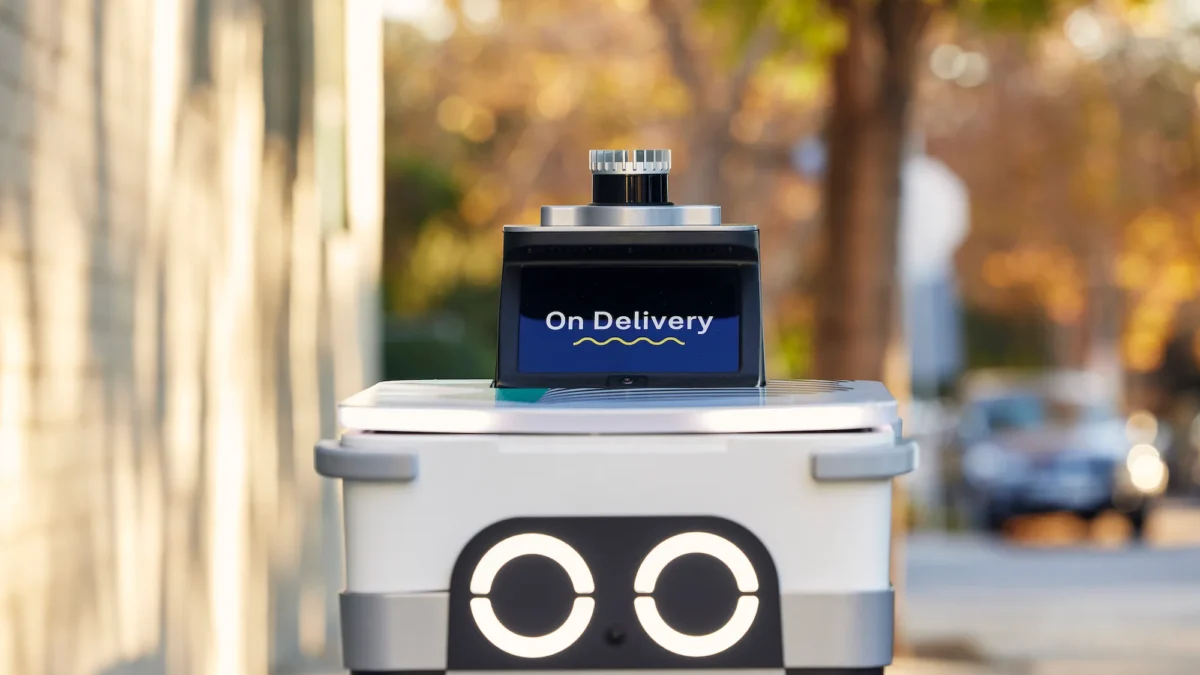
The autonomous delivery landscape is undergoing a significant strategic shift as Serve Robotics, the sidewalk delivery robot specialist that emerged from the Postmates-Uber ecosystem, transitions from a pure-play logistics operator to a foundational technology supplier. On Thursday, the company announced the launch of "Physical AI Services," a new business unit designed to provide connectivity, data, and edge-computing tools to third-party developers working in robotics, construction, and agriculture. This evolution represents a departure from the company’s initial focus on its proprietary fleet of sidewalk delivery units, signaling an ambition to become the "Amazon Web Services (AWS) of robotics."
The Chronology of Serve Robotics
The trajectory of Serve Robotics has been defined by rapid institutional evolution and high-profile partnerships. The company’s origins trace back to the 2021 acquisition of Postmates by Uber. As part of that transition, the autonomous unit was spun out to operate as an independent entity, maintaining a close strategic alliance with the ride-hailing giant. Over the subsequent three years, Serve Robotics focused on refining its hardware—the iconic, googly-eyed sidewalk robots—and securing a foothold in the competitive urban delivery market.
The company achieved a major milestone in April 2024 when it completed its transition to public markets, raising approximately $40 million. This liquidity provided the capital necessary to scale its operations and explore new product categories. In early 2026, the company further signaled its expansion by acquiring Diligent Robotics, a firm specialized in hospital assistant robots. By integrating Diligent’s technology, Serve Robotics expanded its operational footprint from outdoor, uncontrolled environments like city sidewalks to the high-stakes, indoor environments of medical facilities.
Unveiling the Physical AI Services Division
The new business line, Physical AI Services, is structured around three core pillars designed to solve the "last mile" of computing and intelligence for robotics. CEO and co-founder Ali Kashani, who has framed the move as an "AWS moment," believes that the internal infrastructure built to sustain Serve’s own fleet is now mature enough to serve as a platform for others.
- Serve Link: This connectivity tool acts as a bridge between robots in the field and high-performance data centers. As Kashani explained, the primary bottleneck for many robotics firms is maintaining consistent, low-latency communication over unreliable cellular or wireless networks. Serve Link allows developers to offload intensive computing tasks from the robot’s limited onboard hardware to centralized cloud systems, enabling more complex decision-making without increasing the weight or power consumption of the robot itself.
- Data Curator: Robotics development is notoriously data-hungry. Developers often find themselves sifting through terabytes of irrelevant footage to find the few "edge cases"—such as a rare traffic pattern or an unexpected obstacle—that cause a robot to stall. The Data Curator tool automates this process, identifying and labeling mission-critical data to accelerate the training of foundation models.
- Foundation Model Data Catalog: By leveraging years of operational data from its own sidewalk fleet, Serve is offering a library of real-world environmental data. This catalog acts as a training set for other companies, providing robots with the "intuition" needed to navigate complex, human-centric environments, such as construction sites or industrial warehouses.
Strategic Shifts and Operational Context
While the announcement marks a pivot, the company is not abandoning its original mission. Serve Robotics continues to operate its sidewalk delivery fleet, though the scope of its partnerships is broadening. Originally tied closely to Uber, the company has recently diversified its client base, establishing collaborations with major industry players like DoorDash and the delivery service Wonder. This diversification is critical for risk management; by decoupling its revenue from a single partner, Serve is positioning itself as a neutral infrastructure provider in a fragmented market.
The company’s decision to move into construction equipment, as evidenced by its work with startup Bedrock Robotics, highlights the versatility of its new software suite. Bedrock, which specializes in autonomous systems for heavy construction machinery, requires the same level of environmental intelligence and reliable connectivity as a food delivery bot. By providing these tools to Bedrock, Serve is demonstrating that its "Physical AI" stack is agnostic to the form factor of the robot.
The Role of Connectivity and T-Mobile
The success of this new business line is tethered to the company’s technical partnerships, most notably with T-Mobile. In the announcement accompanying its third-quarter earnings, Serve highlighted its work with the telecom giant to bring AI computing power closer to the "edge." By utilizing 5G infrastructure, Serve aims to reduce the latency between robots and the cloud. This partnership is essential for the "Physical AI" vision, as it ensures that robots can remain responsive even in densely populated urban areas where network congestion is high.
Analysis: The "AWS for Robotics" Model
The decision to monetize internal infrastructure is a well-trodden path in the technology sector, yet it is relatively novel in the hardware-heavy world of robotics. Historically, robotics companies have been vertically integrated, building both the robot and the software stack required to run it. However, as the industry matures, the "full-stack" approach is becoming increasingly difficult to scale.
By opening its platform, Serve Robotics is attempting to capture the value that lies in the "plumbing" of robotics—the middleware, the data pipelines, and the connectivity layers—rather than just the delivery of goods. This transition carries significant implications for the robotics sector:
- Standardization: If Serve’s tools become widely adopted, they could establish an industry standard for how robots communicate and learn.
- Barriers to Entry: The cost of entry for new robotics startups could drop significantly. Instead of building their own data infrastructure and connectivity solutions from scratch, smaller firms can lease these capabilities from providers like Serve.
- Data Aggregation: By acting as a central hub for robot data, Serve is positioned to become a dominant player in the development of "foundation models for the physical world." As more robots plug into the Serve ecosystem, the data catalog grows, creating a "flywheel effect" that makes the platform more valuable for every new user.
Financial and Market Implications
The market reaction to Serve’s pivot will likely focus on the company’s ability to balance its dual identity as an operator and a service provider. Managing a fleet of physical robots while simultaneously developing a robust SaaS (Software as a Service) platform for other developers requires distinct operational skill sets.
The company’s third-quarter earnings report, released alongside this announcement, suggests that the market is watching closely to see if this pivot can improve margins. Robotics operations are capital-intensive, characterized by high maintenance costs and regulatory friction. By shifting a portion of its revenue toward high-margin software services, Serve could theoretically achieve a more sustainable financial profile.
Looking Ahead
The challenge for Serve Robotics will be competition. While the company has a head start in terms of operational experience in urban environments, other technology giants—including Alphabet (via Google DeepMind and Waymo) and NVIDIA—are also investing heavily in robotic intelligence and physical AI.
However, Serve’s distinct advantage remains its real-world testing ground. Unlike a purely research-focused lab, Serve has been running robots in public spaces for years, dealing with the chaotic, unpredictable nature of human behavior. That "street-level" experience is, according to Kashani, the company’s most valuable asset. As the industry moves from the pilot stage to mass deployment, the ability to navigate that chaos—and to provide the tools that allow others to do the same—will be the defining factor in determining which companies dominate the next generation of autonomous infrastructure.
For now, Serve Robotics has set its sights on becoming the foundational layer for the physical AI revolution. Whether this strategy will lead to long-term profitability or serve as a distraction from its core delivery business remains a point of intense interest for analysts and investors alike. What is clear, however, is that the era of the "siloed robot" is ending, replaced by an interconnected ecosystem where the intelligence of the machine is as important as the mechanics of the frame.