As artificial intelligence fundamentally reshapes how consumers discover information online, digital marketing teams are increasingly pivoting from traditional search engine optimization to answer engine optimization, or AEO. Unlike legacy search frameworks that present users with a list of blue links, modern answer engines such as OpenAI’s ChatGPT, Anthropic’s Claude, Google Gemini, and Perplexity synthesize data into a singular, conversational response. This shift has created an urgent enterprise requirement for specialized measurement tools capable of tracking brand visibility, citation accuracy, and competitive positioning within generative text outputs. Over the past several months, digital research teams have heavily evaluated two prominent offerings leading this software category: Scrunch, a dedicated AEO pure-play platform, and Semrush, an established search marketing giant that has folded AI visibility tracking into its broader software ecosystem. Choosing between these platforms requires a nuanced analysis of engine coverage, workflow integration, citation auditability, and overall organizational strategy.

The evolution of search from keyword indexing to conversational synthesis has rendered traditional ranking reports insufficient for modern marketing attribution. When an AI answer engine generates a response, it may cite multiple verified sources, a single primary provider, or omit references entirely. Consequently, tracking visibility requires tools capable of directly parsing raw model outputs rather than monitoring static page-rank tables. While both Scrunch and Semrush address this operational need, they approach the market from fundamentally different architectural philosophies. Scrunch is engineered exclusively for deep-dive AEO monitoring, offering granular inspection capabilities and advanced edge-delivery features. Conversely, Semrush integrates AI metrics into a comprehensive SEO suite, giving marketing departments the convenience of managing traditional keyword rankings, technical site audits, backlink profiles, and AI visibility under a single login.
A thorough examination of answer engine coverage highlights the immediate architectural divergence between the two solutions. Scrunch boasts an extensive reach across nine distinct conversational engines, encompassing ChatGPT, Claude, Gemini, Perplexity, Google AI Mode, Google AI Overviews, Meta AI, Microsoft Copilot, and Grok. However, accessing the full suite requires an enterprise-tier commitment, while its core entry-level tier limits tracking to four primary platforms. Semrush approaches coverage through a blended architectural model distributed across multiple distinct reporting views, encompassing five primary engines: ChatGPT, Gemini, Perplexity, Google AI Overviews, and AI Mode. Semrush divides its operational data collection between direct daily prompt tracking and broader clickstream discovery databases, categorizing its insights as high-level directional signals. Furthermore, geographical and linguistic parameters differ significantly between the platforms. Scrunch supports localization across any global market where target engines deploy geolocation services, whereas Semrush’s structured prompt tracking officially supports more than 220 countries and territories with robust regional parameters.

Beyond sheer engine volume, the depth of citation tracking and data auditability serves as a critical differentiator for enterprise compliance and strategy teams. Effective AEO tools must not only verify whether a brand appeared in an AI-generated response, but also isolate the exact URL cited, evaluate the contextual sentiment of the mention, and benchmark the share of voice against relevant market competitors. Scrunch excels in transparent source-level attribution, automatically recording citations at both the domain and specific URL levels while categorizing them into owned, competitor, or mixed-ownership assets. Its response reader displays unedited raw engine outputs directly alongside identified competitor mentions and calculated sentiment scores. Semrush offers a similarly comprehensive split-view inspection interface, allowing analysts to examine cited external domains and flag competitive visibility gaps. However, because large language models inherently operate on probabilistic algorithms, identical prompts can yield varying citation patterns across repeated executions. This volatility necessitates rigorous validation protocols during software evaluation windows to ensure historical data consistency and minimize false-positive reporting.
Reporting mechanisms and stakeholder communication channels further separate the two platforms in daily enterprise deployment. Marketing leaders frequently require automated, white-labeled reporting loops to demonstrate campaign ROI to executive stakeholders. Semrush leverages its robust reporting infrastructure to streamline this process, utilizing a drag-and-drop dashboard builder that automatically schedules recurring daily, weekly, or monthly PDF deliveries infused with AI-generated summaries and multi-channel data sources. Scrunch handles recurring stakeholder delivery primarily through outward-facing integrations, such as its Looker Studio community connector, pre-built templates, and specialized API endpoints, prioritizing in-platform snapshot exports and real-time data querying.

Content workflow execution represents perhaps the sharpest operational contrast between the two vendors. Scrunch maintains a human-in-the-loop governance model designed to complement existing content operations. Its specialized Content Gaps view identifies prompts where competitors capture consumer attention while the host brand remains absent, subsequently generating a structured brief that marketing strategists can approve and route to human writers or AI writing assistants via advanced protocols. Semrush offers an in-suite publishing pipeline through its optional Content Toolkit add-on, allowing users to transition seamlessly from a flagged keyword or prompt gap directly into an AI-assisted article drafting editor and publish immediately via a native WordPress plugin. This structural divide forces organizations to choose between a specialist model that requires manual routing through established editorial pipelines and an all-in-one suite capable of end-to-end content production at the cost of additional recurring software subscriptions.
Evaluating integration capabilities and broader technology stack complexity is essential for preventing redundant software expenditures and operational friction. Scrunch functions as a specialized layer designed to sit gracefully atop an organization’s existing SEO and analytics infrastructure, adding sophisticated AEO depth without disrupting established keyword research or technical auditing workflows. Semrush, by contrast, consolidates these functions within its comprehensive suite, reducing vendor sprawl for teams that prefer a single billing relationship and unified login credentials. For enterprises deeply embedded in specialized marketing clouds, such as organizations utilizing HubSpot’s integrated marketing and CRM infrastructure, alternative native pathways are also emerging that connect AI visibility data directly to downstream pipeline attribution and revenue metrics.

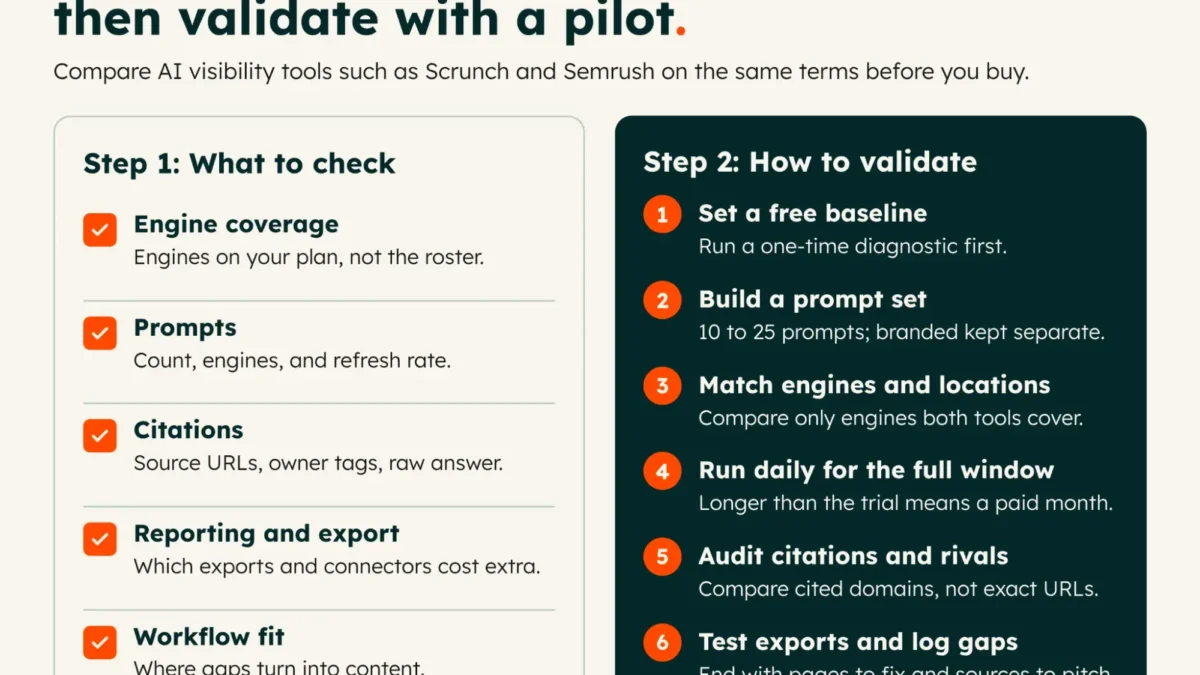
Ultimately, selecting the optimal AEO platform depends entirely on how an organization defines its digital visibility strategy. Scrunch serves as an ideal solution for brand, web, and growth teams operating a mature, well-established SEO stack who require uncompromising specialist depth, raw answer inspection, and advanced edge-delivery monitoring. Semrush remains the preferred choice for in-house SEO departments and digital agencies seeking operational consolidation, where managing AI visibility reports alongside traditional rank tracking, site audits, and backlink profiles under one subscription outweighs the need for standalone analytical granularity. By executing structured, parallel pilot programs during trial periods, digital marketing leaders can effectively measure citation accuracy, validate platform reporting claims, and align their technological investments with long-term enterprise growth objectives.