The digital marketing landscape is undergoing a profound structural shift as generative artificial intelligence transforms how consumers and business buyers discover brands. According to HubSpot’s State of AEO 2026 report, measuring success has officially become the leading challenge for Answer Engine Optimization (AEO). Among B2B marketers, 23% cite measurement as their primary hurdle, while 26% of B2C marketers report the same, trailing only the fundamental challenge of understanding how AEO mechanics operate at 29%.
As search engine results pages (SERPs) increasingly incorporate AI-generated summaries—such as Google AI Overviews, ChatGPT, Gemini, and Perplexity—traditional metrics like clicks, impressions, and standard website visits are no longer sufficient. These legacy Key Performance Indicators (KPIs) fail to reveal whether answer engines actively mention or cite a brand, or how frequently that brand appears relative to its market competitors. To navigate this evolving terrain, modern marketing organizations require a repeatable, data-driven framework for benchmarking AEO through citation rates, share of voice, platform-level normalization, and executive-ready reporting.
The Evolution of Search: Why SEO Rankings Alone Fall Short
For decades, Search Engine Optimization (SEO) relied on a straightforward premise: optimize a web page to rank high on a SERP, earn a user click, and drive traffic directly to a digital property. However, the rise of answer engines has decoupled brand visibility from direct website traffic.

Industry analysts distinguish carefully between mentions and citations in generative environments. A mention refers to an instance where an AI-generated answer names a brand without providing a linked source. Conversely, a citation involves an attributed source reference or a direct hyperlink to a brand’s domain. Measuring AEO requires tracking this second layer of digital visibility—evaluating whether and how a brand appears inside synthesized answers.
The behavioral impact of this shift is measurable. Research published by Ahrefs in December 2025 demonstrated that the presence of a Google AI Overview correlates with a 58% lower average click-through rate for the top-ranking organic search result. Users are increasingly satisfying their informational queries directly within the search interface, executing micro-conversions and research phases entirely inside the AI chat window.
At the same time, this visibility shapes buyer psychology. A separate survey of more than 200 B2B decision-makers revealed that 42% find a brand more trustworthy if it is recommended by an AI engine, under the assumption that the technology has pre-vetted the enterprise. Only 11% reported a negative trust association. Furthermore, HubSpot’s 2026 data indicates that 44% of surveyed marketers have completed a business purchase based directly on brands discovered initially through answer engines.
Data from BrightEdge further illustrates the complex relationship between traditional SEO and AI citations. Their analyses indicate that approximately 17% of sources cited in Google AI Overviews also rank within the organic top 10 search results. This means roughly five out of six AI citations originate from outside the first page of traditional organic search. While organic rankings remain crucial for baseline digital authority, the overlap varies significantly by industry—ranging from 24% in healthcare to just 11% in finance—reinforcing the necessity of dual-track measurement strategies.

Core Benchmarks for Quantifying Answer Engine Optimization
To establish a functional AEO program, marketing teams must adopt specialized metrics that evaluate performance across conversational and generative platforms. These metrics should complement, rather than replace, traditional revenue, traffic, and conversion analytics.
1. Citation Rate
Citation rate measures the frequency with which a brand or domain is explicitly cited in answer-engine responses across a defined set of test prompts.
$$textCitation Rate = left( fractextNumber of prompts where brand is citedtextTotal number of prompts right) times 100$$
This metric serves as a baseline indicator of whether attributable visibility is expanding or contracting over time.
2. Share of Voice (SOV)
Share of voice compares a brand’s total mentions and citations against a designated cohort of named competitors across the identical prompt repository.
$$textShare of Voice = left( fractextBrand mentionstextTotal mentions for brand and tracked competitors right) times 100$$
A high share of voice relative to market peers indicates robust relative dominance within a specific query category.
3. Platform-Level Visibility
Because large language models (LLMs) rely on distinct training data, retrieval-augmented generation (RAG) architectures, and web-crawling algorithms, brands often experience stark performance variances across platforms. Platform-level visibility calculates citation rates and share of voice independently for individual engines—such as ChatGPT, Gemini, and Perplexity—preventing blended averages from obscuring critical vulnerabilities.

4. Query-Set Segmentation
Grouping tracked prompts into strategic categories—such as informational queries, transactional buyer stages, specific use cases, or distinct product lines—exposes hidden performance gaps. A brand might maintain a healthy aggregate citation rate while remaining entirely absent from high-intent comparison and evaluation prompts.
Establishing a Repeatable Benchmarking Workflow
Building an effective AI search benchmark requires rigorous standardization. Industry tools, such as the public AI Search Sensor dashboard, provide broad category-level context regarding volatility, citation patterns, and visibility scores across major AI engines. However, marketers must avoid treating aggregate industry scores as direct substitutes for brand-specific performance audits.
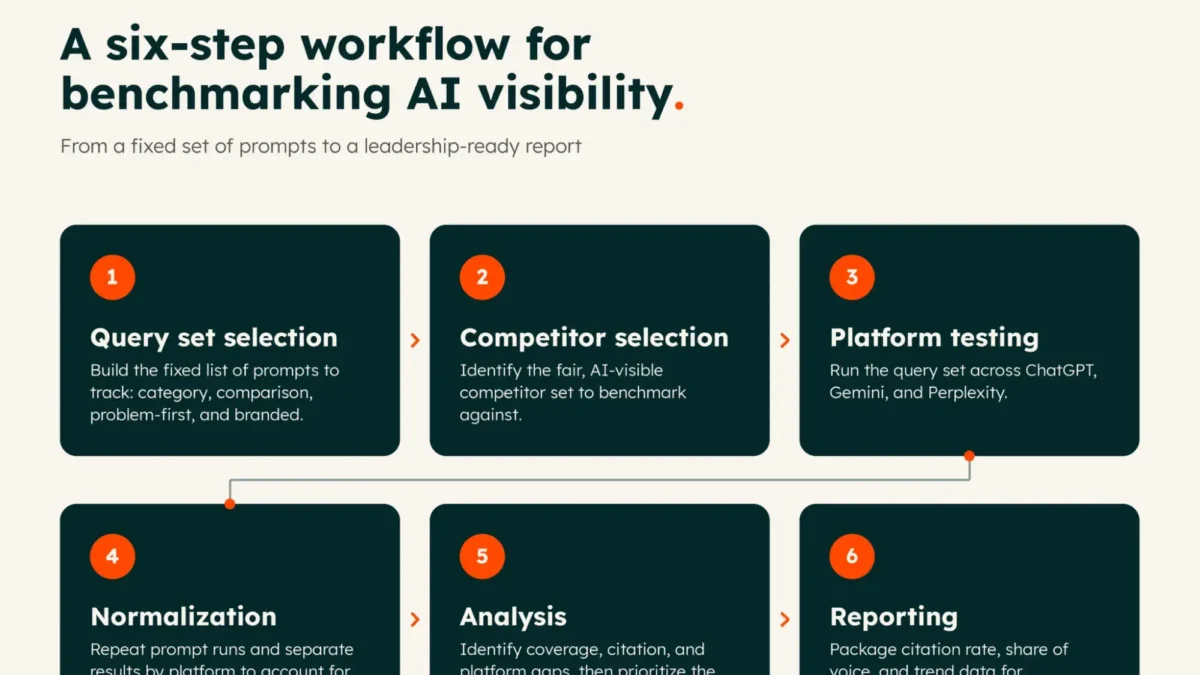
Executing a reliable internal benchmarking program follows a structured six-step methodology:
- Query Set Selection: Curate a list of 50 to 200 high-intent questions that reflect actual buyer vocabulary and search behavior within the category, rather than relying solely on internal product keywords. Include informational, navigational, comparative, and transactional prompt types.
- Competitor Identification: Run initial baseline prompts to identify which brands consistently appear in generative citations. Select a stable cohort of direct competitors and prominent market peers.
- Platform Testing: Execute the prompt repository across targeted answer engines (ChatGPT, Gemini, Perplexity) under consistent geographical and operational parameters.
- Data Normalization: Account for platform-level output variability and generative non-determinism by utilizing fixed prompt lists, standardized testing windows, and repeated collection runs.
- Detailed Analysis: Calculate citation rates, share of voice, platform breakdowns, and segment-level visibility to identify specific content and structural gaps.
- Executive Reporting: Synthesize findings into strategic insights for leadership while maintaining granular prompt logs for technical SEO and content teams.
Normalization and Methodological Challenges
A primary operational hurdle in AEO is managing the inherent variability of generative AI models. Unlike traditional search engines that return static URL rankings for fixed queries, LLMs synthesize fresh responses dynamically. This introduces two distinct forms of variance: cross-platform architectural differences and intra-platform output volatility between consecutive prompt runs.

To ensure data integrity, analysts must normalize testing environments. This involves maintaining identical prompt phrasing, locking down geographic location settings, adhering to strict testing schedules, and conducting multiple test iterations before calculating final benchmark scores. Blending scores into a single composite metric across disparate models obscures platform-specific weaknesses; consequently, teams must analyze and report engine outputs individually.
Translating Metrics into Strategic Actionable Plans
AEO measurement is only valuable if it drives operational execution. When audit data reveals specific prompt gaps—such as a competitor repeatedly capturing citations for buyer-stage comparison queries—content and SEO teams must inspect the underlying source URLs and formats favored by the AI.
Gaps generally fall into three strategic remediation categories:
- Structural Gaps: The brand lacks foundational content addressing the specific question or use case.
- Format Gaps: The existing content answers the prompt but fails to match the structural clarity, data density, or summarization-friendly formatting (such as comparative tables, clear definitions, and statistical validation) preferred by RAG algorithms.
- Authority Gaps: The brand’s digital footprint lacks sufficient third-party validation, digital PR mentions, and high-authority contextual links necessary for AI models to verify enterprise trustworthiness.
By prioritizing remediation based on business impact and systematically updating query and competitor sets on a quarterly cadence, organizations can transition AEO from an experimental novelty into a mature, programmatic marketing channel. Pairing these visibility metrics with CRM data and revenue analytics ensures that marketing leadership can clearly demonstrate the direct pipeline and valuation impact of generative search optimization to executive boards.