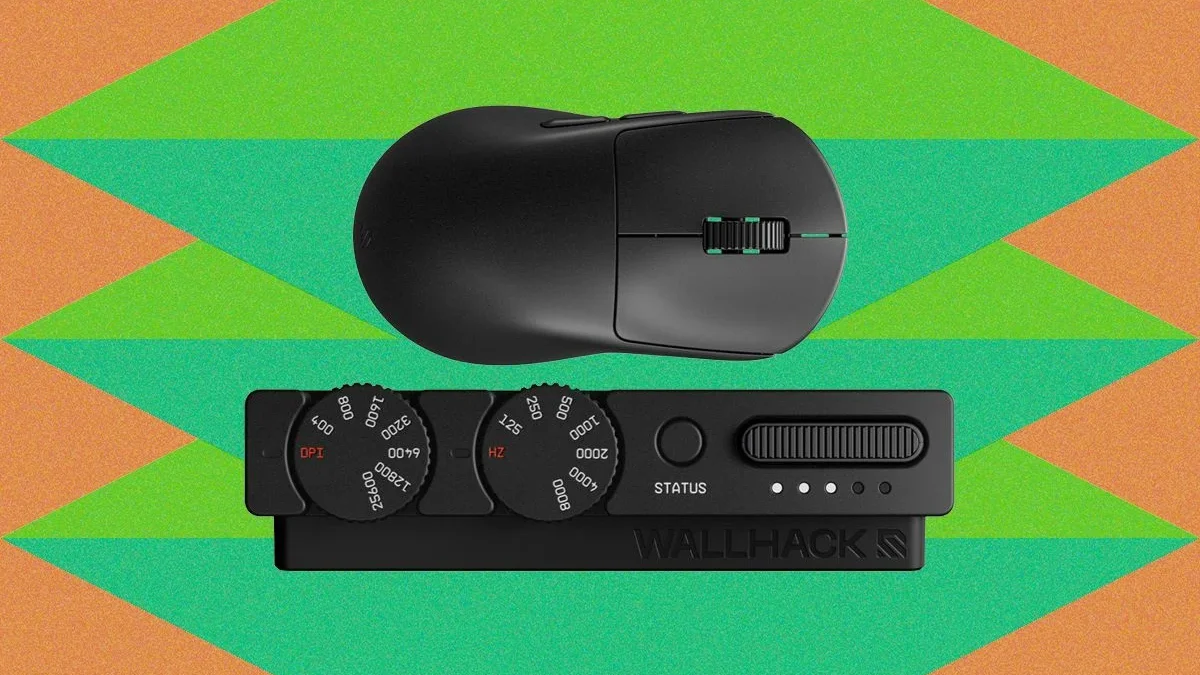
The evolution of computer gaming peripherals has long been characterized by a relentless pursuit of weight reduction and digital-only configuration software. For years, manufacturers have prioritized shaving grams off plastic chassis and burying basic hardware controls deep inside proprietary applications. However, peripheral manufacturer Wallhack has upended this convention with the release of the M-001 gaming mouse. Featuring a magnesium alloy chassis, an exposed printed circuit board (PCB) acting as a structural member, a hot-swappable battery ecosystem, and an industrial-grade desktop dongle equipped with physical adjustment dials, the M-001 reintroduces tactile hardware controls to high-end competitive gaming.
Main Facts of the Wallhack M-001

The Wallhack M-001 is a right-handed, symmetrical wireless gaming mouse constructed around a solid magnesium shell finished in a textured gunmetal gray with metallic flake. Weighing approximately 53.6 grams, it avoids the honeycomb or cut-out weight-saving patterns common among ultralight magnesium competitors. Instead, the chassis relies on a minimalist bottom frame where the internal PCB is exposed and integrated directly as a structural, stressed member to maintain rigidity—a design philosophy borrowed from automotive engineering.
Under the hood, the device is powered by the Pixart PAW3950 optical sensor, capable of scaling up to 25,600 DPI, paired with Omron optical switches for the primary clickers and low-profile mechanical switches for the side buttons. Most notably, the M-001 omits a traditional internal rechargeable battery and USB-C connection port entirely. In their place, the mouse utilizes a spring-loaded, hot-swappable battery mechanism. Users can eject and replace the power cell in seconds without turning off the mouse, while the included desktop metal dongle features an integrated secondary battery slot for continuous charging.
Chronology and Background of Hot-Swappable Power Systems

The implementation of hot-swappable batteries in computer mice marks a fascinating cyclical turn in hardware design history. In the early era of wireless peripherals, removable alkaline AA or AAA batteries were standard, requiring users to keep spares on hand. As lithium-ion internal batteries became prevalent, manufacturers transitioned to sealed units charged via micro-USB and later USB-C cables, optimizing for lower weight and structural simplicity.
By the early 2020s, the emergence of high-polling-rate technology—scaling from traditional 1,000 Hz rates up to 8,000 Hz—drastically accelerated battery drain, forcing manufacturers to choose between heavier, high-capacity internal batteries or frequent recharging sessions. Wallhack and a select group of visionary hardware developers identified an opportunity to solve this power deficit. By integrating spring-loaded mechanical ejectors similar to cartridge-loading gaming consoles or Secure Digital (SD) card slots, the company streamlined the battery-swapping process. The M-001’s development reflects a broader industry movement away from purely software-tethered management toward user-serviceable, modular hardware components.
Hardware Engineering and Structural Analysis

The structural integrity of the M-001 separates it from standard injection-molded plastic alternatives. Measuring 120 millimeters in length, 63.5 millimeters in width, and 39 millimeters in height, the mouse features an aggressive profile with a lower front end and a pronounced rear hump. This geometry encourages a forward-leaning palm or claw grip that facilitates rapid, vertical directional adjustments during intensive gaming sessions.
The choice of a magnesium shell provides superior torsional rigidity compared to traditional plastics, eliminating flex under heavy grip pressure. Furthermore, the decision to use the internal PCB as a structural component draws direct parallels to high-performance automotive chassis design, such as the engine-block load-bearing frameworks seen in Formula 1 racing and supercars like the Ferrari F50. This engineering choice optimizes internal space and saves weight without compromising the physical durability of the shell.
The elimination of the USB-C port, while unusual in contemporary peripheral design, serves a dual engineering purpose. By removing the physical port and internal wiring harness, Wallhack reduced potential points of failure and shortened the signal path between the sensor antenna and the receiver. Consequently, the M-001 operates exclusively via a 2.4 GHz wireless connection linked to its dedicated desktop transceiver.

The Multifunctional Desktop Dongle
One of the defining innovations of the M-001 package is its accompanying desktop dongle. While standard high-polling-rate receivers are typically lightweight, featureless plastic pucks prone to sliding across desk surfaces, Wallhack has engineered a substantial, wedge-shaped metal module matching the mouse’s gunmetal finish.
The dongle serves multiple critical functions: it houses the primary wireless receiver, acts as a charging station for spare hot-swappable batteries, and incorporates two physical, camera-inspired rotary dials. The front-facing dials allow users to adjust polling rates—ranging from 125 Hz to 8,000 Hz—and DPI settings—ranging from 400 to 25,600—on the fly. Each dial features a ratcheting mechanism designed to prevent accidental inputs while offering clear, tactile feedback accompanied by status indicator LEDs.

This hardware-level customization reduces reliance on background software suites. While many modern gaming mice require complex, resource-heavy desktop applications to alter core performance metrics, the M-001 supports an in-browser configuration client known as Wallhack Terminal. Built with a text-based, command-line aesthetic, the browser client provides granular control over advanced parameters such as lift-off distance measured in millimeters, sensor rotation, and customized DPI scaling.
Performance Evaluation and Technical Trade-Offs
Despite its innovative mechanical features, the M-001 relies on components that invite technical scrutiny from competitive purists. The Pixart PAW3950 sensor, while historically proven, reliable, and capable of handling rapid acceleration and deceleration during fast-paced competitive engagements, is not the absolute newest sensor iteration available on the global market. However, industry testing indicates that the sensor’s tracking fidelity and responsiveness remain well beyond the perceptual limits of the vast majority of consumers, performing capably in high-speed titles.

Similarly, the inclusion of Omron optical switches for the primary actuators ensures near-instantaneous debounce times and long-term switch durability, though the mechanical encoder used for the scroll wheel represents a more traditional component choice that may require maintenance over extended years of intensive use.
Broader Market Implications and Industry Impact
The release of the Wallhack M-001 signals a potential shift in how peripheral manufacturers approach user engagement and hardware modularity. By prioritizing tactile user experience, physical configuration dials, and a maintenance-friendly internal architecture, Wallhack has challenged the prevailing industry trend toward homogenized, sealed-unit designs.

While the high price point and the absence of Bluetooth or wired backup connectivity position the M-001 as a niche product aimed at enthusiasts rather than budget-conscious consumers, its reception highlights a growing demand for hardware that offers interactive physical engagement. As high-polling-rate technologies continue to strain standard battery life expectations, the M-001’s hot-swappable ecosystem and multi-functional dongle design may serve as a blueprint for the next generation of high-performance gaming peripherals.