A groundbreaking report from the Pew-Knight Initiative highlights a significant disparity in political knowledge among Americans, directly linking higher levels of engagement in public life to a greater understanding of political facts. Conversely, individuals who are less involved in civic and political activities are substantially more likely to admit uncertainty when questioned about current political figures, institutions, and issues. This comprehensive study provides an integrated view of how Americans participate across various public spheres and how these engagement patterns coalesce into distinct groups, each exhibiting unique demographic profiles, attitudes, and levels of civic knowledge.
The findings underscore a crucial aspect of civic health: those who actively participate in politics, community life, and news consumption are demonstrably better informed about the nation’s political landscape. The research identifies four distinct "engagement groups" within the U.S. public – Mobilizers, Connectors, Spectators, and Outsiders – revealing that the "Outsiders," the least engaged group, consistently display the lowest rates of correct answers and the highest rates of "not sure" responses to fundamental political questions. This pattern suggests that a lack of active engagement contributes not merely to misinformation, but often to a void of information and confidence in political understanding.

Unpacking the Research: Purpose and Methodology
The Pew-Knight Initiative undertook this ambitious study to move beyond siloed investigations of individual public behaviors like voting, volunteering, or news following. Traditionally, these activities are examined in isolation, making it challenging to grasp their interplay in the daily lives of Americans. By adopting an integrated approach, the initiative aimed to construct a holistic portrait of public engagement across politics, civic and community involvement, news consumption, and religious participation.
A key methodological consideration was the inherent difficulty in reaching Americans who are less inclined to participate in public life, as these same individuals are often less likely to engage in surveys. To mitigate this challenge, the researchers deployed a specially designed survey that aimed for broad reach and diverse response modes.

The analysis primarily drew from two robust Pew Research Center surveys conducted in 2025. The main data source was the Cross-Sectional Engagement Survey, fielded from July 9 to December 5, 2025, among 5,393 U.S. adults. This survey offered multiple response options—online, paper, or telephone—and included persistent follow-up attempts for non-respondents to ensure a representative sample. Additionally, data from Wave 179 of the American Trends Panel (ATP), a nationally representative panel of randomly selected U.S. adults, was utilized. This ATP survey was conducted from September 8-14, 2025, encompassing 5,195 respondents via web and phone.
To categorize Americans into the aforementioned engagement groups, a sophisticated cluster analysis was performed on the Cross-Sectional Engagement Survey data. This analysis was based on 19 distinct measures of participation across political activity, civic involvement, religious service attendance, and attention to news. Respondents in the ATP survey were then assigned to these predefined groups based on the similarity of their behavioral patterns to those identified in the cross-sectional data. The ATP survey was instrumental in assessing the engagement groups’ levels of civic knowledge and their broader attitudes toward politics and news. It is important to note that many questions in these surveys pertained to behaviors within the past 12 months, a period that, for most respondents, included the 2024 presidential election. Consequently, the observed patterns, particularly around political activity, may vary at different points in the political cycle.
The Landscape of Political Knowledge Across Engagement Groups

The study gauged U.S. adults’ knowledge of American politics through four factual multiple-choice questions designed to serve as a reliable proxy for broader political understanding, a methodology validated by prior academic research. These questions covered:
- Identifying the political party holding majority control in the U.S. Senate.
- Identifying the political party holding majority control in the U.S. House of Representatives.
- Recognizing the name and position of their state’s current governor (or mayor for D.C. residents).
- Defining a "tariff" as a U.S. government tax on imported goods.
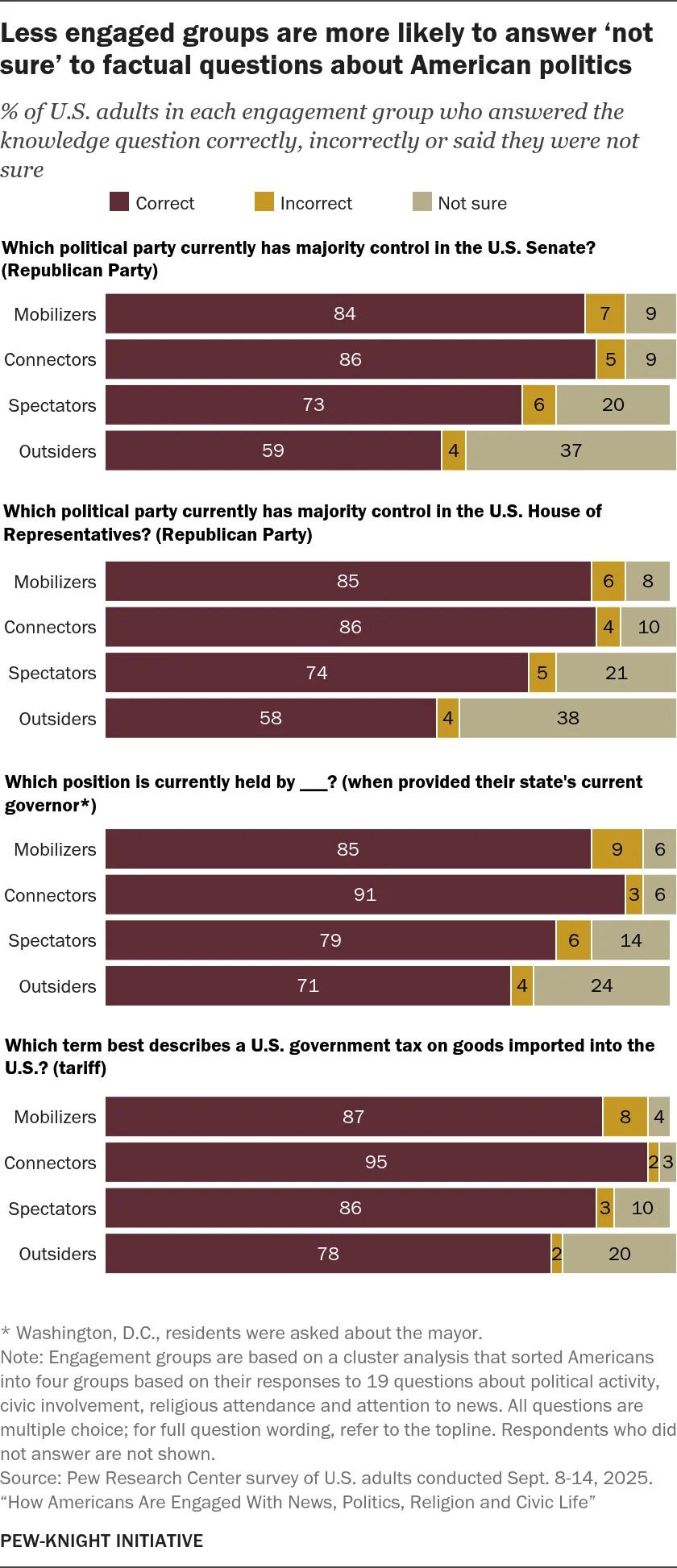
Overall, most Americans demonstrated a reasonable grasp of these facts. Approximately three-quarters (73% each) correctly identified the Republican Party as holding majority control in both the House and the Senate. Even larger majorities recognized their state’s governor (80%) and correctly defined a tariff (86%). However, a closer examination by engagement group revealed significant disparities, primarily in the willingness to state "not sure" rather than provide an incorrect answer. Across all four questions, fewer than 10% in any group selected an incorrect response, indicating that the knowledge gap is largely one of certainty and awareness.
Detailed Breakdown of Knowledge by Engagement Group:

-
Mobilizers: The Highly Informed Core
As the smallest and most active group across all domains (politics, civics, news, religion), Mobilizers consistently displayed the highest levels of political knowledge. For instance, 84% correctly identified Republican control of the Senate, 85% for the House, 85% for their state’s governor, and a striking 87% for the definition of a tariff. Crucially, their "not sure" rates were remarkably low, ranging from 4% to 9% across the questions. When considering all four questions together, only 15% of Mobilizers were unsure about at least one question, and 68% answered all four correctly. -
Connectors: Engaged and Knowledgeable, but Less Political
Connectors, a larger group highly engaged in civic activities like joining groups and making donations but less politically focused than Mobilizers, also demonstrated strong political knowledge. Their performance was often on par with, or even slightly superior to, Mobilizers in some areas (e.g., 86% for Senate and House control, 91% for governor, and an impressive 95% for tariff definition). Their "not sure" rates were similarly low, between 3% and 10%. Only 16% of Connectors reported being unsure on at least one question, with a leading 72% correctly answering all four. This suggests that broad civic engagement, even if less overtly political, contributes significantly to political awareness. -
Spectators: Observing from the Sidelines
Spectators, characterized by high news consumption but low direct participation, exhibited a noticeable drop in political knowledge compared to the more engaged groups. While majorities still answered correctly, their "not sure" rates were significantly higher. For example, 73% knew the Senate majority, 74% the House majority, 79% their governor, and 86% the tariff definition. However, their "not sure" responses climbed to 20% for the Senate, 21% for the House, 14% for governor, and 10% for tariff. Overall, 32% of Spectators were unsure about at least one question, and only 46% correctly answered all four. This highlights that passive news consumption, without active participation, may not translate into the same level of confident political knowledge.
-
Outsiders: The Least Informed Segment
The least engaged group, Outsiders, showed significantly lower levels of political knowledge across the board and were the most prone to uncertainty. Only 59% correctly identified the Senate majority, 58% the House majority, 71% their governor, and 78% the tariff definition. Their "not sure" rates were strikingly high: 37% for the Senate, 38% for the House, 24% for governor, and 20% for tariff. A stark 50% of Outsiders admitted being unsure on at least one of the four questions, and a mere 41% managed to answer all four correctly. This data underscores a profound knowledge gap in the segment of the population least involved in public life.
Intersecting Factors: Education, Age, and Gender
The study further explored how demographic factors intertwine with engagement and political knowledge, revealing consistent patterns even when controlling for these variables.

The Role of Education: Education emerged as a powerful predictor of political knowledge. Across all four engagement groups, individuals with college degrees were consistently more likely to answer all four factual questions correctly. For instance, among Spectators, 67% with a college degree got all four questions right, compared to only 46% of Spectators with only a high school diploma. This educational advantage was evident within every group:
- Mobilizers: College+ (83%), Some college (66%), HS or less (41%)
- Connectors: College+ (80%), Some college (69%), HS or less (62%)
- Spectators: College+ (67%), Some college (61%), HS or less (46%)
- Outsiders: College+ (57%), Some college (45%), HS or less (31%)
These figures illustrate that while engagement is a significant factor, educational attainment provides an additional boost to political knowledge, demonstrating a compounding effect.
The Influence of Age: Age also plays a critical role, with older adults in each engagement group demonstrating higher levels of political knowledge. Similar patterns by age were observed across all groups. For example, 83% of Mobilizers aged 50 and older correctly answered all four questions, a stark contrast to just 49% of Mobilizers under 30. The "oldest-youngest difference" highlights these significant gaps:
- Mobilizers: Ages 18-29 (49%), 30-49 (58%), 50+ (83%) – a +34 difference
- Connectors: Ages 18-29 (52%), 30-49 (69%), 50+ (77%) – a +25 difference
- Spectators: Ages 18-29 (45%), 30-49 (55%), 50+ (69%) – a +24 difference
- Outsiders: Ages 18-29 (20%), 30-49 (37%), 50+ (53%) – a +33 difference
This consistent trend suggests that life experience, accumulated exposure to news and political cycles, and potentially different educational backgrounds contribute to higher political knowledge among older demographics, irrespective of their specific engagement group.
The Gender Gap in Political Knowledge Responses: The study also identified a notable gender gap, particularly concerning the "not sure" responses. Women were generally more likely than men to indicate uncertainty when faced with factual political questions, a finding consistent with long-standing research suggesting that men tend to guess answers more often than women. However, this gap varied significantly across the engagement groups:

- Mobilizers: The most engaged group showed a negligible gender gap, with 13% of men and 15% of women responding "not sure" to one or more questions.
- Connectors: The gap widened, with 11% of men compared to 21% of women saying "not sure."
- Spectators: The disparity became more pronounced, with 24% of men versus 41% of women indicating uncertainty.
- Outsiders: The least engaged group exhibited the largest gender gap, as 38% of men but a significant 59% of women reported being unsure on at least one of the four questions.
This pattern suggests that while a general tendency for men to guess might exist, the confidence in political knowledge—or willingness to admit uncertainty—is exacerbated for women in less engaged segments of the population.
Broader Implications for Democracy and Civic Health
The findings from the Pew-Knight Initiative carry substantial implications for the health of American democracy and civic society. A citizenry with varying degrees of political knowledge presents challenges for informed decision-making, effective public discourse, and the overall functioning of representative government.
The clear link between engagement and knowledge suggests that efforts to boost civic participation could concurrently enhance political literacy. When a significant portion of the population, particularly the "Outsiders," is unsure about basic political facts, it raises concerns about their ability to critically evaluate political information, discern truth from misinformation, and make well-reasoned choices at the ballot box. This knowledge deficit could contribute to political apathy, disengagement, and even susceptibility to sensationalism or demagoguery.

For educators, these findings highlight the enduring importance of civic education not just in formal schooling but throughout adulthood. Strategies to foster greater engagement in community life, news consumption, and political processes could be crucial in building a more knowledgeable populace. Policymakers and civic organizations might consider targeted initiatives to reach less engaged groups, understanding that overcoming a lack of participation may also mean addressing fundamental knowledge gaps.
Furthermore, the nuanced role of news consumption is illuminated by the "Spectators" group. While they follow the news at high rates, their lower direct participation and higher "not sure" responses compared to Mobilizers and Connectors suggest that passive consumption alone might not be sufficient for deep political understanding or confident knowledge recall. This implies a need for more interactive or critical engagement with news, moving beyond mere exposure to active processing and discussion.
The study’s integrated approach to engagement offers a valuable framework for understanding the complex tapestry of American public life. Recognizing that engagement is not a monolithic concept but rather a spectrum of behaviors across different domains allows for a more targeted and effective approach to strengthening civic participation and, by extension, political knowledge. As the nation navigates complex political cycles and societal challenges, understanding the drivers and consequences of these engagement and knowledge gaps will be paramount for fostering a more informed and resilient democracy. The Pew-Knight Initiative’s ongoing work will undoubtedly continue to shed light on these critical dynamics, providing essential data for academics, practitioners, and the public alike.