The modern digital landscape is undergoing its most profound structural transformation since the inception of organic search engines. As artificial intelligence models fundamentally alter how consumers discover brands, products, and services, traditional search engine optimization (SEO) tactics are no longer sufficient to guarantee market visibility. Industry analysts and marketing strategists are increasingly turning their attention toward Answer Engine Optimization (AEO) and, specifically, the concept of the AEO keyword gap.
Unlike traditional keyword gaps that reveal terms a company fails to rank for compared to its rivals, an AEO keyword gap identifies the specific prompts, questions, and conversational queries where a brand is omitted from AI-generated responses while competitors secure valuable citations. With generative AI rapidly reshaping consumer behavior, understanding, auditing, and closing these gaps has become an existential priority for enterprise and mid-market organizations alike.
The Evolution of Search and the Rise of AI Answer Engines

For decades, the standard paradigm of online discovery involved entering a string of keywords into a search engine, receiving a results page littered with blue links, and independently browsing multiple web properties to compile information. Today, conversational agents and generative AI engines—such as OpenAI’s ChatGPT, Google’s Gemini, Perplexity, and embedded AI Overviews—have streamlined that friction-heavy process. When modern buyers seek recommendations, they receive synthesized answers, direct paraphrased summaries, and concise shortlists directly from the model.
This behavioral shift carries immense commercial consequences. Recent proprietary research conducted among thousands of software and enterprise technology decision-makers reveals that over 40% of prospective buyers now incorporate AI search engines into their preliminary vendor evaluation phases. Furthermore, data compiled across multiple
analytics platforms over the last year indicates that referral traffic originating from large language models (LLMs) has tripled, demonstrating a steady, compounding upward trajectory in consumer reliance on conversational search tools.
When an AI engine constructs a response recommending a solution, it bypasses the traditional user journey of evaluating page-one organic results. If a brand is missing from the underlying data citations that feed these models, it is effectively excluded from the shortlist before a potential buyer ever visits an official corporate website.

AEO Gaps vs. Traditional SEO Gaps: Understanding the Divergence
A common misconception among marketing professionals is that achieving high traditional SEO rankings naturally translates into successful visibility within AI answer engines. However, empirical analysis of search behavior and citation patterns disproves this assumption.
Industry studies analyzing Google’s AI Overviews demonstrate that only a small fraction—roughly 17%—of sources cited within AI summaries also occupy the top ten organic ranking positions. This statistical reality underscores a critical division: roughly five out of six AI citations draw from content that does not appear on page one of conventional search results.
A traditional SEO gap report answers a singular structural question: Which terms does a competitor rank for that my brand does not? Conversely, AEO keyword research must evaluate a much more complex matrix of variables, including conversational phrasing, semantic entities, structural formatting, and direct citation potential. A web page can comfortably hold a top-three ranking on Google for a core product category while simultaneously being completely ignored by an LLM attempting to answer a natural language buyer prompt.

Conducting a Comprehensive AEO Keyword Gap Audit
To remain competitive, digital marketers must adopt a systematic framework for auditing and resolving their AEO keyword deficiencies. Industry experts recommend a four-stage audit process designed to uncover blind spots and align content strategies with generative engine architectures.
-
Inspect Search Console and SERP Patterns
While Google Search Console (GSC) remains fundamentally an SEO tool, its query data provides invaluable insights for Generative Engine Optimization (GEO). By exporting performance reports and analyzing multi-word queries, marketers can identify thematic challenges and informational needs expressed by their target audience. Reviewing the search engine results pages (SERPs) manually for these target terms helps reveal whether featured snippets, Reddit threads, or third-party review aggregators dominate the real estate. -
Collect First-Party Customer Questions
The precise phrasing utilized by buyers when interacting with sales teams, customer support channels, and community forums often mirrors the exact prompts they input into AI answer engines. Mining these first-party sources surfaces nuanced questions that standard keyword research tools routinely overlook. Ensuring that existing corporate content directly answers these localized, conversational inquiries is an efficient method for closing early-stage citation gaps.
-
Study Competitor Coverage in AI Ecosystems
The competitive landscape within AI search frequently diverges from traditional SERP competitors. Marketers must actively input category-level prompts—such as queries a prospective client might use before identifying a specific vendor—into multiple AI engines like ChatGPT, Gemini, and Perplexity. By cataloging the domains cited, the frequency of competitor mentions, and the underlying page formats (such as head-to-head comparisons, pricing tables, or forum discussions), organizations can pinpoint where market authority currently resides. -
Review and Refine Current Content Assets
An inventory of existing digital assets must be evaluated not just for topical completeness, but for structural extraction readiness. Many corporate web pages cover a topic thoroughly while "talking around" the core question without providing a concise, definitive answer that an LLM can easily lift and cite.
Prioritizing Gaps Based on Revenue Impact and Business Relevance
Because organizations cannot realistically optimize for every minor variation of a natural language query, strategic prioritization is essential. Not all discovered gaps align with a company’s ideal customer profile (ICP) or revenue goals. Marketing teams must evaluate identified keyword gaps through the lens of business value, mapping potential prompts to high-intent stages of the buyer journey.

Tools such as specialized AI search graders and visibility tracking dashboards allow marketing departments to benchmark their brand recognition, market position, and share of voice against competitors across multiple dimensions, including sentiment and presence quality.
Transforming Gaps into Answer-Ready Content
Once high-priority gaps are identified and validated, content production must shift from traditional keyword-stuffed publishing toward "answer-ready" structures designed for algorithmic extraction.
Effective content engineering for AEO relies on several core disciplines:

- Format Alignment: Selecting the appropriate vehicle for the query, whether it be an in-depth product comparison, an objective review, or a concise FAQ page.
- Direct Answer Positioning: Leading immediately with a clear, definitive response to the heading’s implied question within the first one or two sentences, reserving nuance and elaboration for subsequent paragraphs.
- Semantic Clustering: Building out related sub-questions and contextual pillars that allow a single authoritative page to capture a broad constellation of related prompts.
- Intent-Driven Internal Linking: Connecting optimized pages to robust supporting evidence, product specifications, and validated case studies.
Broader Implications and Strategic Measurement
As enterprise reliance on AI search deepens, digital marketing leadership must adapt how campaign performance is measured. Relying solely on legacy metrics like organic traffic and static keyword positions creates a dangerously incomplete picture of market health.
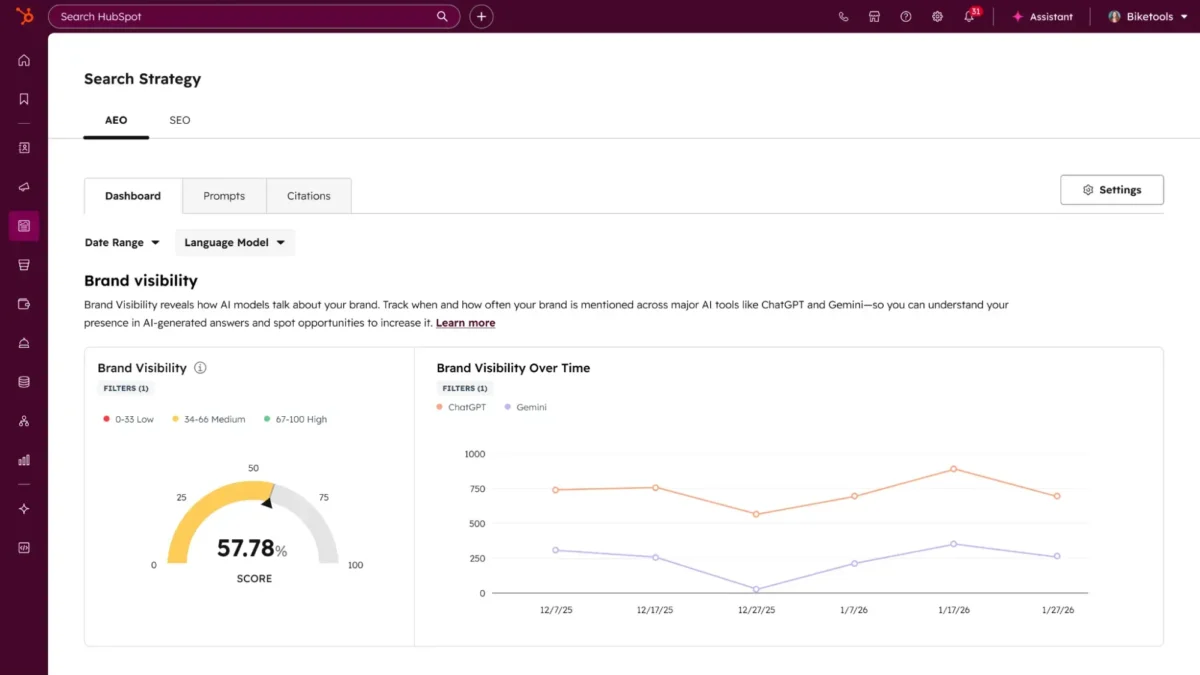
Forward-thinking organizations are increasingly utilizing continuous tracking platforms—such as dedicated AEO tracking software and automated search sensors—to monitor brand visibility, prompt coverage, and competitor share of voice on a daily basis. By observing these metrics as continuous trends rather than quarterly snapshots, marketing teams can detect dips in AI citations, evaluate industry-wide volatility, and adjust their content strategies proactively.
Ultimately, the commercial success of AEO optimization must be tied directly to pipeline generation and attributed revenue. While visibility scores and citation frequencies serve as critical leading indicators, the true measure of an effective AEO keyword gap strategy lies in its ability to influence high-value enterprise deals originating from conversational AI platforms. Organizations that fail to adapt their optimization strategies risk seeing their market share quietly eroded by competitors who have successfully positioned themselves as the definitive answers in the AI-driven economy.