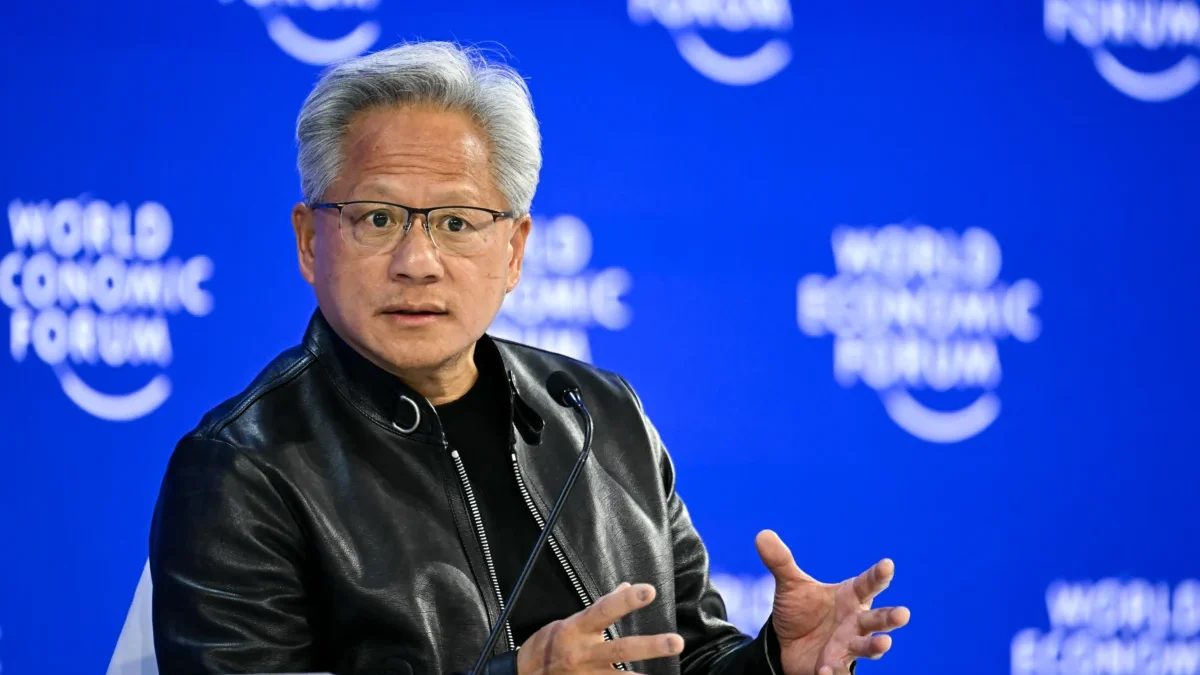
In a moment that blurred the lines between private sector innovation and public policy, Nvidia CEO Jensen Huang received an unscheduled telephone call from President Donald Trump while appearing live on stage at the All-In Summit in Los Angeles this past Monday. The interaction, which was broadcast to a packed auditorium of investors and tech industry leaders, served as a high-stakes demonstration of the current administration’s alignment with the semiconductor giant on the necessity of aggressive AI development.
The summit, hosted by venture capitalists Chamath Palihapitiya, Jason Calacanis, and White House advisers David Friedberg and David Sacks, had been deep in a panel discussion regarding the future of artificial intelligence. The conversation had previously focused on the cautionary stance recently adopted by Anthropic CEO Dario Amodei, who has publicly advocated for slowing the pace of frontier AI development to ensure safety and ethical alignment. The public intervention from the President signaled a definitive shift in the administration’s posture, framing the movement to decelerate AI progress as an existential threat to American economic hegemony.
A Public Display of Political Alignment
As Huang fielded the call in front of a live audience, he offered a brief introduction to the President, acknowledging the presence of the summit’s hosts. In a moment of technical improvisation, Huang sought assistance from stage personnel to amplify the call, a move that drew a dryly humorous observation from the President regarding the complexities of speakerphone technology.
The substance of the conversation moved rapidly from pleasantries to geopolitical strategy. When the topic of slowing AI progress was broached—a sentiment echoed by other industry titans like Elon Musk and Sam Altman—President Trump dismissed the caution as a manufactured concern. “They’re just playing right in the hands of a lot of people that don’t want to see it happen,” Trump stated. “That could be political people. It could also be China. And we’re not going to let that happen. It’s a hoax.”
Huang’s immediate concurrence—“You’re right. We’re not going to let that happen, sir”—was met with a sustained ovation from the audience, highlighting the clear divide between the "accelerationist" faction of Silicon Valley and those advocating for a more measured, safety-first approach to machine intelligence.
The Geopolitical Context of the AI Arms Race
The conversation at the All-In Summit did not occur in a vacuum. For months, the United States has been locked in a competitive technological struggle, primarily with China, to secure dominance in the manufacturing of high-end GPUs and the training of large-scale models. Nvidia, as the primary supplier of the hardware that powers modern AI, finds itself at the center of this geopolitical tension.
President Trump’s rhetoric regarding the "hoax" of AI safety concerns mirrors arguments made by figures like Y Combinator CEO Garry Tan. Tan has frequently suggested that the growing local opposition to the construction of massive data centers is not a grassroots environmental movement, but rather an "international psyop" designed to cripple the American technological infrastructure. By framing the push for regulation as a foreign-led sabotage attempt, the administration is signaling that the rapid scaling of data centers and compute capacity is now a matter of national security.
Data Center Backlash and Public Sentiment
While industry leaders and the White House emphasize the need for unfettered growth, the reality on the ground presents a different challenge. Recent data from Gallup indicates a significant disconnect between the ambitions of the tech sector and the concerns of the American public.
According to recent polling, approximately 70% of Americans express opposition to the construction of large-scale data centers in their immediate vicinity. The reasons for this resistance are multifaceted:
- Environmental Impact: More than 50% of respondents identified the strain on environmental resources—specifically water consumption for cooling systems and the massive electrical load required to operate server clusters—as their primary concern.
- Quality of Life: Roughly 20% of the public cited concerns regarding increased costs of living, noise pollution, and the aesthetic degradation of local communities.
- Grid Stability: Independent energy analysts have noted that the projected power requirements for the next generation of AI data centers threaten to destabilize local electrical grids, leading to higher utility costs for residential ratepayers.
The administration’s challenge, therefore, is to balance the strategic mandate to outpace global competitors with a domestic population that is increasingly weary of the physical and economic footprint left by the AI boom.
Chronology of the Accelerationist Shift
The tension surrounding AI development has followed a distinct timeline throughout the past year:
- Early 2026: Leading AI labs, including Anthropic and OpenAI, begin lobbying for stricter oversight, citing the potential for catastrophic failure in unaligned models.
- Mid-2026: Public resistance to "data center sprawl" begins to manifest in local zoning boards across the United States, particularly in Virginia and the Pacific Northwest.
- Late 2026: White House advisers, including David Sacks and David Friedberg, begin framing infrastructure roadblocks as obstacles to American AI sovereignty.
- Current Date: President Trump’s intervention at the All-In Summit formalizes the administration’s stance, officially labeling calls for "pacing" as politically motivated interference.
Implications for the Tech Industry
The public alignment between the White House and Nvidia suggests that the federal government is prepared to bypass local regulatory hurdles to ensure that the "compute-first" strategy remains viable. For developers and investors, this is a clear signal that the administration will likely prioritize expedited permitting for power-intensive infrastructure.
However, the strategy carries inherent risks. By dismissing legitimate public concerns about water, power, and land use as a "hoax," the administration may alienate local municipalities that have the legal authority to block construction. Furthermore, the polarization of the AI safety debate creates a binary choice for companies: align with the administration’s aggressive growth schedule or risk being labeled as an impediment to national progress.
Industry analysts suggest that the coming months will be critical. As the demand for electricity to power AI models grows, the White House will likely need to propose a national policy framework that addresses the grid capacity issue without relying solely on the rhetoric of foreign interference. If the administration continues to frame the debate as a binary conflict between American progress and external sabotage, it may find itself facing a growing "NIMBY" (Not In My Backyard) coalition that is as politically potent as the tech lobby itself.
Conclusion
The phone call at the All-In Summit was more than a PR spectacle; it was a defining moment for the future of artificial intelligence in the United States. Jensen Huang’s commitment to "not letting it happen" in response to the President’s directive underscores a pivot toward a high-velocity development model that prioritizes competitive advantage over social or environmental consensus. As the United States moves into the next phase of the AI era, the success of this strategy will depend on whether the government can navigate the growing friction between national strategic goals and the local impact of the technology that powers them.
For now, the message from the top is clear: the race for AI supremacy will be won at the speed of silicon, and the administration intends to clear the path for the industry to move as fast as possible. Whether this acceleration will satisfy the public, or further entrench the opposition, remains one of the most pressing domestic policy questions of the decade.