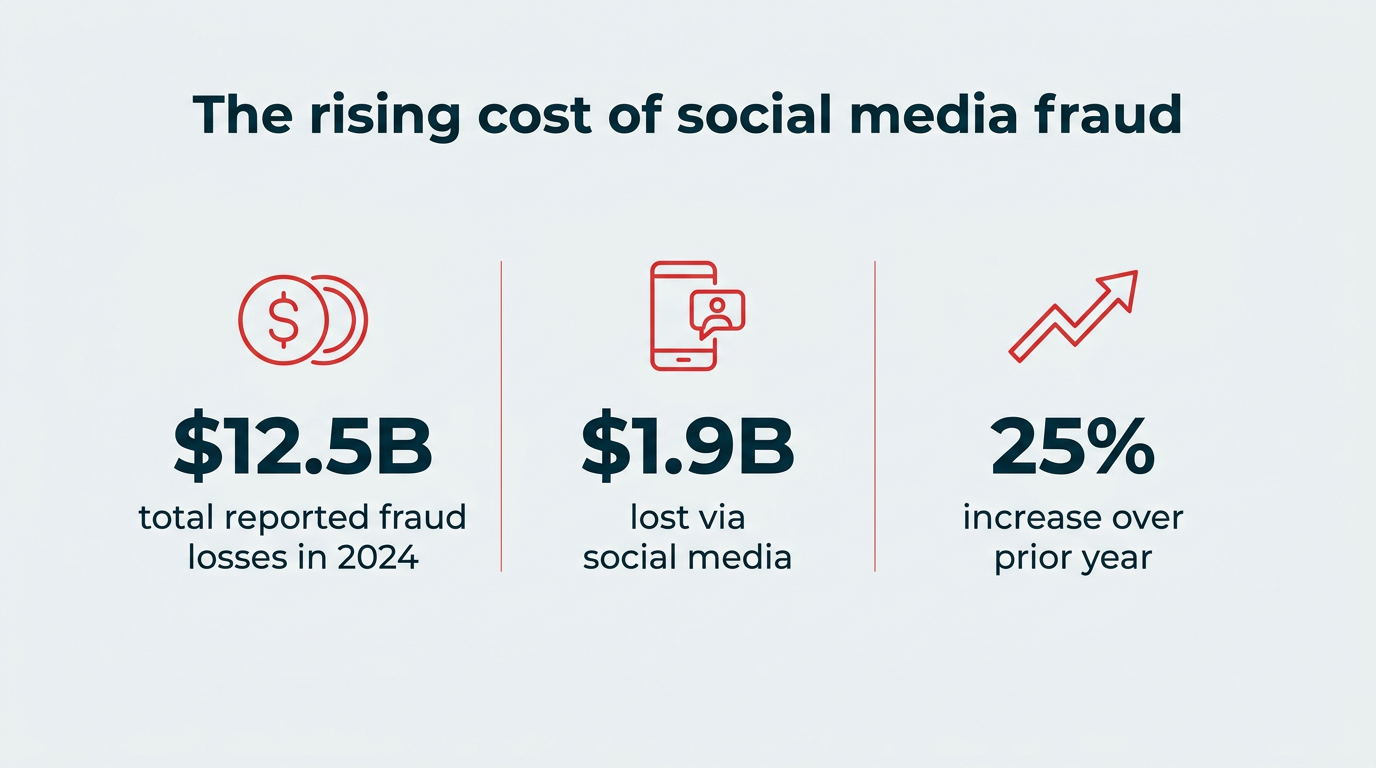
As digital communication channels continue to evolve, organizational social media security has transitioned from a routine digital marketing task into a critical enterprise cybersecurity imperative. Modern organizations face a sophisticated and automated threat landscape driven by artificial intelligence, deepfakes, and highly targeted phishing schemes. According to recent data from the Federal Trade Commission, consumers reported staggering losses of $12.5 billion to fraud in 2024, representing a 25% increase over the previous year. Within this broader landscape of financial cybercrime, social media platforms remain primary vectors for exploitation, accounting for $1.9 billion in reported losses. For enterprise leadership, marketing directors, and chief information security officers, treating social media accounts as isolated endpoints is no longer viable. Instead, these profiles must be integrated into comprehensive, organization-wide risk management frameworks.

The shifting nature of digital threats requires a granular understanding of how modern social engineering operates. Historically, malicious actors relied on opportunistic, easily identifiable scams that targeted naive users. Today, cybercriminal syndicates utilize automated tools and machine learning algorithms to harvest publicly available information from corporate networks and employee profiles. This aggregated data enables threat actors to deploy convincing spear-phishing attacks, mimic executive leadership via deepfakes, and establish intricate network imposter accounts at an unprecedented scale. Consequently, businesses must adopt rigorous operational protocols—such as passkey implementation, strict role-based access control, quarterly third-party app audits, and real-time monitoring—to protect their brand equity, customer trust, and financial assets.
The Escalating Threat Matrix: Phishing, Imposter Accounts, and AI Integration
The contemporary threat environment is characterized by organized, high-volume campaigns designed to bypass traditional defensive perimeters. Chief among these concerns are advanced phishing and social media scams. Cybercriminals frequently target working-age adults and corporate employees through direct messaging, fake customer support channels, and fraudulent ad campaigns. Because social networks link personal relationships, professional connections, and financial transaction mechanisms, a successful breach can immediately cascade across multiple business verticals.

Parallel to direct phishing attempts is the proliferation of imposter and fake accounts. Major platform transparency reports underscore the sheer volume of fraudulent profiles attempting to establish legitimacy. For instance, LinkedIn’s Community Report details that automated defenses block the vast majority of fake accounts at registration, yet a fraction manages to slip through, requiring manual user reports and brand monitoring. Similarly, Meta reports actioning hundreds of millions of fake accounts on Facebook each quarter, with estimates suggesting that up to 5% of monthly active users are inauthentic. These fake profiles are frequently weaponized to deceive consumers, solicit confidential credentials from unwary employees, and distribute malware.
Compounding these traditional risks is the integration of generative artificial intelligence into the hacker’s toolkit. AI has transformed social engineering from a manual, time-intensive craft into an automated, highly personalized operation. Deepfake technology, in particular, has moved past theoretical discussions into executive boardrooms. A recent Gartner survey revealed that 62% of organizations experienced a deepfake attack over the past year. High-profile incidents—such as a finance employee in Hong Kong transferring approximately $25 million during a video conference populated entirely by deepfake simulations of senior colleagues—demonstrate the tangible financial dangers associated with synthetic media. Furthermore, general audiences continue to struggle with verifying digital authenticity; studies indicate that significant percentages of Gen X, Millennials, and Gen Z find it challenging to distinguish between genuine online content and sophisticated AI-generated fabrications.
Account Takeovers, Malware, and Third-Party Vulnerabilities
Beyond external impersonation, direct account takeover (ATO) remains a persistent and high-impact threat. When malicious actors gain direct administrative control over corporate social profiles, the consequences are immediate. A prominent historical example occurred when the U.S. Securities and Exchange Commission’s official X account was compromised in January 2024, leading to unauthorized market-moving statements that reverberated across global financial exchanges.
Furthermore, threat groups increasingly target enterprise advertising accounts. By hijacking business accounts with active payment methods attached, hackers can covertly run fraudulent advertisements that appear to originate from trusted corporate entities, ultimately directing consumers toward malware distribution networks or sophisticated financial scams.
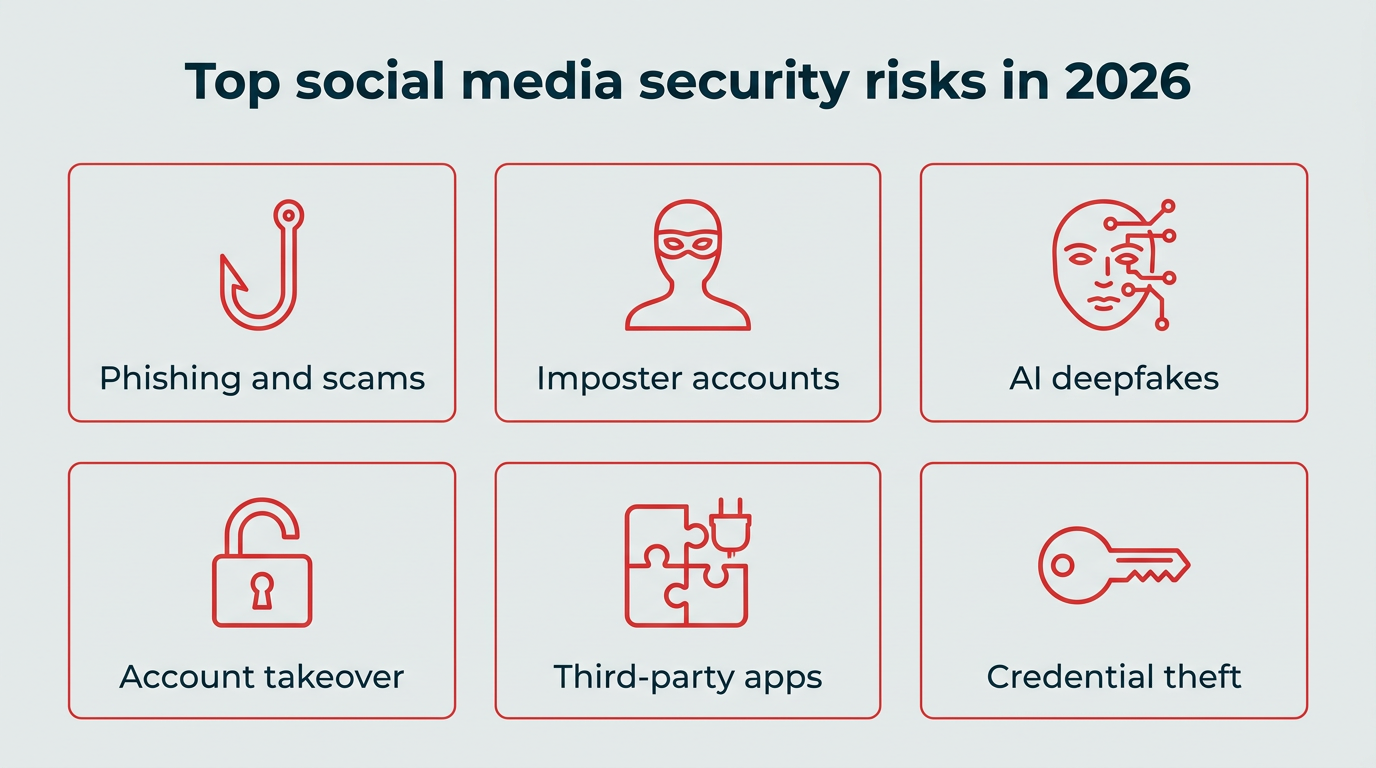
Vulnerable third-party applications represent another hidden entry point for malicious actors. Organizations frequently authorize external analytics, scheduling, and engagement tools to streamline social media management. However, unvetted or abandoned applications can retain expansive permissions to read private messages, access follower lists, and publish unauthorized content. Security analysts emphasize that every active integration functions as an open door into the core infrastructure of a social media profile, necessitating stringent quarterly audits to revoke access for unused or unrecognized tools.
Credential theft further exacerbates these vulnerabilities. Verizon’s Data Breach Investigations Report highlights that stolen credentials remain involved in a significant portion of all security breaches, with password reuse compounding the risk across multiple enterprise systems. Practices such as engaging in casual online quizzes that prompt users to reveal childhood details or pet names—often used as security question answers—inadvertently supply threat actors with the precise data needed to bypass account recovery protocols.

The 2026 Enterprise Security Checklist: Eight Essential Practices
To counteract these escalating risks, organizations must institutionalize a comprehensive security framework. The following eight foundational practices form the core of a robust 2026 social media security posture:
- Mandatory Password Hygiene and Password Managers: Every corporate social media profile must utilize a long, complex, and entirely unique password generated and stored via an enterprise-grade password manager. Reusing passwords across internal operational systems and external social networks is strictly prohibited.
- Two-Factor Authentication and Passkey Adoption: Multi-factor authentication must be enabled across all accounts. Where supported by platforms like Meta, X, LinkedIn, and Instagram, organizations should transition to cryptographic passkeys or dedicated authenticator applications, avoiding SMS-based verification codes which remain vulnerable to SIM-swapping attacks.
- Strict Role-Based Access Control (RBAC): Adhering to the principle of least privilege ensures that employees possess only the minimum level of access required to execute their specific job functions. Centralized social media management platforms, such as Hootsuite Social OS, allow teams to collaborate and publish content through structured approval workflows without sharing raw account passwords.
- Comprehensive Employee Security Awareness Training: Security training must be integrated into onboarding protocols and refreshed at least twice annually. Employees must be educated on recognizing spear-phishing attempts, avoiding social media quizzes that harvest personal data, and reporting suspicious direct messages immediately.
- Real-Time Monitoring and Threat Detection: Organizations must deploy continuous listening and monitoring tools to track brand mentions, trademark usage, and keyword spikes. Early detection of emerging impostor accounts or coordinated disinformation campaigns allows security and communications teams to mitigate reputational damage before customer trust is eroded.
- Regular Privacy and Settings Audits: Platform privacy configurations drift as networks introduce new features. Security teams must schedule recurring quarterly reviews of public visibility settings, employee biography disclosures, and data-sharing permissions across all brand and official personal profiles.
- Mobile Device and Connection Security: Because a significant volume of social publishing occurs via mobile devices, endpoint security is paramount. Organizations must mandate screen locks, automatic software updates, remote-wipe capabilities, and virtual private network (VPN) usage when accessing corporate accounts over untrusted public Wi-Fi networks.
- Quarterly Security and Policy Audits: Security measures must be continuously evaluated against emerging threat vectors. Quarterly audits should comprehensively review access permissions, connected third-party applications, incident response playbooks, and organizational social media policies.
Developing and Enforcing a Comprehensive Social Media Policy
A resilient security posture requires a formalized social media security policy that bridges technical controls and human behavior. This governing document must explicitly define account ownership, delineate authorized publishing activities, establish clear escalation pathways for suspected security breaches, and outline compliance mandates tailored to the organization’s specific industry.

Ownership of the policy typically resides within communications or social media management teams, co-signed by IT security and legal counsel. In highly regulated sectors such as finance, healthcare, and government contracting, compliance officers must be actively involved to ensure that archiving, record-keeping, and publishing rules satisfy federal and international regulatory standards. Furthermore, enterprise governance must be operationalized through centralized permissions and auditable approval workflows. By maintaining a clear audit trail of who approved and published specific content, compliance teams can rapidly address regulatory inquiries and mitigate potential liability following an incident.
Comparative Overview of Enterprise Security Tools
Managing social media security at scale requires specialized software solutions that combine internal governance with external threat intelligence. Organizations typically deploy a mix of publishing platforms, threat monitoring services, and credential vaults to secure their digital footprint:

- Hootsuite Social OS: Ideal for enterprise teams requiring unified governance, monitoring, and publishing capabilities. Key security features include role-based access control, governed approval workflows, Lumen listening and insight tools, comprehensive compliance controls, and immutable audit trails. Pricing models range from baseline user subscriptions to custom enterprise tiers.
- ZeroFOX: Tailored for external threat intelligence and proactive brand impersonation takedowns. The platform provides automated alerts regarding fake accounts, malicious domains, and phishing links, supporting rapid remediation requests across global networks.
- 1Password Business: Essential for centralized credential management. It offers shared vaults with granular access controls, breach monitoring, passkey integration, and the ability to instantly revoke departing employee access, ensuring raw passwords are never shared via unsecured messaging channels.
Frequently Asked Questions
What are the most effective methods for securing organizational social media accounts?
Securing social accounts requires enforcing two-factor authentication (preferably via authenticator apps or passkeys), utilizing unique passwords managed through enterprise vaults, implementing role-based access controls to restrict direct credential sharing, and conducting rigorous quarterly audits of connected third-party applications and user permissions.
What constitutes the greatest social media security risks for businesses?
The most prevalent risks include targeted phishing scams, credential theft leading to account takeovers, fake brand impersonation profiles, AI-driven deepfake attacks, malware distributed through compromised advertising accounts, and vulnerabilities introduced by unvetted third-party software integrations.

How do malicious actors leverage artificial intelligence against social media profiles?
AI enables threat actors to scale social engineering operations significantly. Attackers use machine learning to gather disparate data points from public employee profiles, generating hyper-personalized spear-phishing messages, synthesizing executive voices or video via deepfakes for financial fraud, and deploying automated chatbot interactions that mimic legitimate customer support channels.
What components must be included in a robust social media security policy?
A comprehensive policy must outline mandatory password and authentication standards, role-based access guidelines, approved versus prohibited publishing activities, step-by-step incident response procedures, designated account ownership structures, and a fixed schedule for recurring quarterly security audits.
How frequently should enterprise security teams audit their social media infrastructure?
Organizations should conduct formal security audits at least once per quarter to review access permissions, remove abandoned third-party app integrations, and verify platform privacy settings. Off-cycle reviews must be triggered immediately following staff departures, structural role changes, or major platform authentication updates.