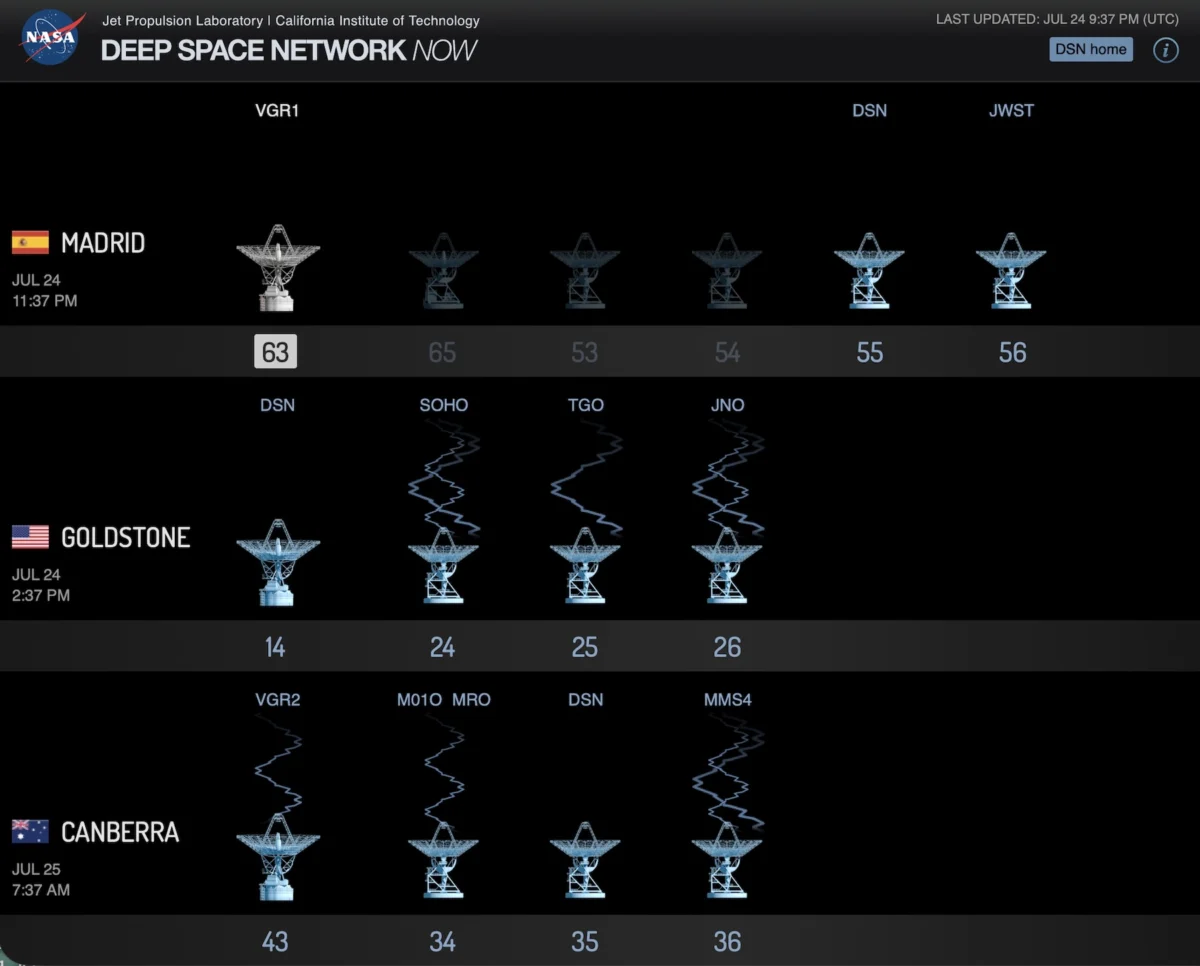
The Madrid Deep Space Communications Complex, a critical node in NASA’s global network for communicating with spacecraft, has ceased operations due to the encroaching wildfires west of the Spanish capital. As of Friday afternoon, NASA’s official status updates revealed no activity at the Madrid site. In stark contrast, antennas at NASA’s California and Australian facilities remain operational, maintaining vital contact with a suite of deep-space explorers, including the pioneering Voyager 2, currently venturing into interstellar space, and the Juno probe, diligently studying Jupiter.
This disruption at the Madrid facility, a cornerstone of NASA’s Deep Space Network (DSN) for decades, raises significant concerns about the network’s ability to simultaneously track and command multiple missions across the solar system and beyond. The DSN, a vast system of large radio antennas strategically positioned around the globe, is indispensable for receiving scientific data, transmitting commands, and maintaining the health of an array of spacecraft, from lunar orbiters to probes journeying to the outer planets and interstellar medium. The Madrid complex, located in Robledo de Chavela, has been a vital link, working in concert with its counterparts in Goldstone, California, and Canberra, Australia, to ensure continuous communication coverage as the Earth rotates.
Wildfires Rage West of Madrid, Forcing Evacuations and Disrupting Critical Infrastructure
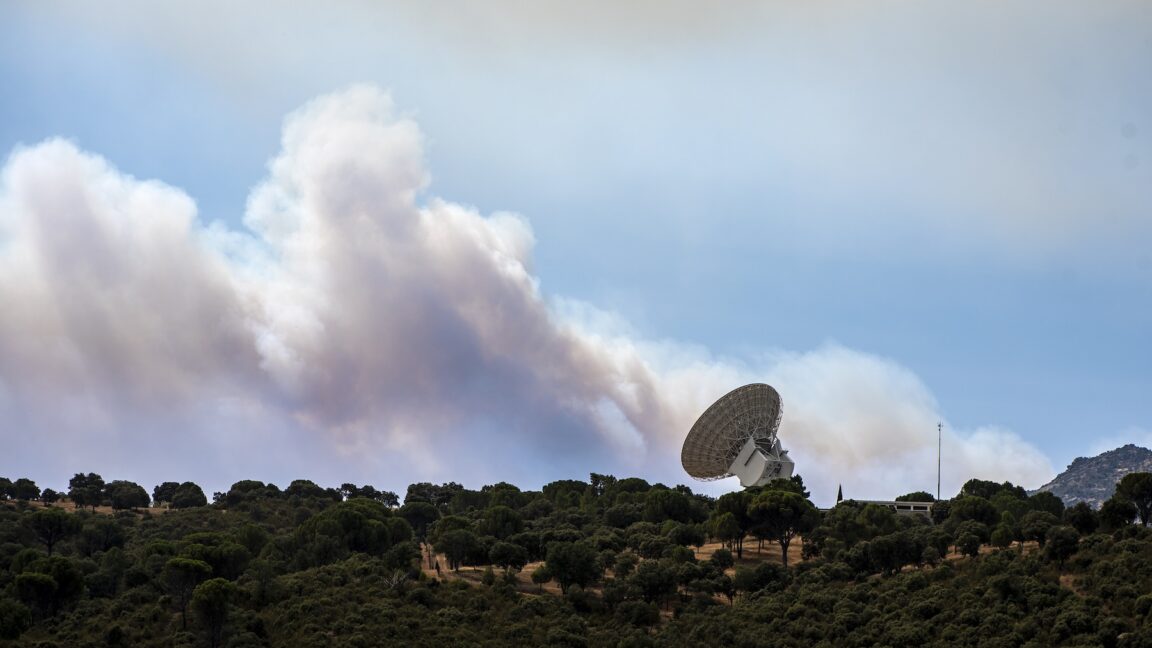
The immediate cause of the Madrid DSN complex’s inactivity is a series of escalating wildfires that have engulfed vast swathes of forest and scrubland in the mountainous regions west of Madrid. These fires, exacerbated by a prolonged summer heatwave and persistent drought conditions that have gripped Spain and much of southern Europe, have proven particularly tenacious. Spanish authorities have been compelled to issue urgent evacuation orders for thousands of residents in affected towns. Reports indicate that over 19,000 individuals have been displaced from their homes, seeking refuge from the advancing flames.
The scale of the response to combat these infernos is substantial, with more than 2,000 personnel and 10 aircraft actively engaged in firefighting efforts. Despite these considerable resources, the challenging terrain and dry vegetation have made containment an arduous task. The proximity of the Madrid DSN facility to these fire-ravaged areas has necessitated its temporary shutdown to ensure the safety of its personnel.
A Ripple Effect: Impact on Space Missions and Scientific Endeavors
The operational status of the Deep Space Network is paramount for the continuity of numerous scientific missions. The DSN’s three major complexes – Madrid, Goldstone, and Canberra – operate in a synchronized manner, allowing for near-constant communication with spacecraft. Each complex is equipped with powerful antennas, including large 70-meter dishes, capable of transmitting and receiving faint signals from billions of miles away. The Madrid site’s closure effectively creates a significant gap in this global communication grid.
While the California and Australian sites are currently handling the workload, their capacity is finite. The loss of an entire complex places increased demand on the remaining facilities. This can lead to scheduling conflicts, potentially delaying critical data downlinks or command uplinks for certain missions. For probes like Voyager 2, which is now in the heliosheath and beyond, communication windows are meticulously planned and depend on the consistent availability of these powerful antennas. Similarly, Juno’s ongoing scientific investigations of Jupiter’s atmosphere, magnetic field, and internal structure require regular data transmission and command updates.
Broader Implications for NASA’s Deep Space Network
The incident underscores the inherent vulnerabilities of critical infrastructure, even those operating in the remote reaches of space exploration. The DSN, a testament to decades of technological advancement, relies on a global network of ground stations. The closure of one of these vital links, even temporarily, has tangible consequences.
"The safety and well-being of our personnel is our highest priority, and our thoughts are with the families and neighbors who are also experiencing the impact of the wildfires in the surrounding communities," NASA stated in its release. "We will provide updates as conditions evolve." This statement highlights the agency’s dual commitment to both its operational integrity and the welfare of its staff.
Adding to the DSN’s current challenges, another significant tracking facility in the vicinity, the Cebreros tracking station, owned and operated by the Spanish government and the European Space Agency (ESA), has also been evacuated due to the wildfires. Cebreros is a key component of ESA’s Estrack network, a sister system to NASA’s DSN. Its closure further constrains the available tracking resources for European space missions and potentially for collaborative international efforts.
A Pre-Existing Strain on the Deep Space Network
The current situation at the Madrid DSN complex occurs against a backdrop of existing challenges for NASA’s deep-space tracking capabilities. The 70-meter antenna at the Goldstone facility in California has been offline since last year. This extended outage was the result of an accident where the antenna structure "over-rotated," causing significant damage to internal cables and water lines. The incident resulted in the flooding of the antenna’s base with approximately 200,000 gallons of water contaminated with glycol, an environmental hazard that required extensive cleanup.
The projected cost for the repair and cleanup of the Goldstone antenna is substantial, estimated to be between $4.1 million and $4.6 million. NASA officials are strategically integrating these necessary repairs with already planned upgrades to the facility, aiming to maximize efficiency. However, this comprehensive work is expected to keep the antenna out of service until sometime in 2028, further reducing the DSN’s overall antenna capacity.
The Artemis Program and Future Demands on the DSN
The current strain on the Deep Space Network is particularly noteworthy when considering the upcoming demands of NASA’s ambitious Artemis program. The Artemis missions, aimed at returning humans to the Moon and establishing a sustainable lunar presence, place exceptionally high requirements on the DSN. These missions necessitate extensive telemetry data downlinks and high-resolution imagery to support human spaceflight operations and scientific exploration.
Fortunately for the DSN, the next major Artemis mission, Artemis III, is still several years away. The original target for Artemis III was a lunar landing, but the program has undergone revisions. Artemis III will now focus on testing the Orion capsule in low-Earth orbit in conjunction with commercial lunar landers developed by SpaceX and Blue Origin. The first planned lunar landing with astronauts, Artemis IV, is now targeted for no earlier than 2028. This revised timeline provides a crucial buffer, allowing NASA time to address the current disruptions and complete necessary repairs to the DSN infrastructure before the full demands of crewed lunar missions are placed upon it.
Historical Context of the Deep Space Network
Established in the late 1950s, the Deep Space Network was conceived to provide a robust communication system for America’s nascent space exploration efforts. The initial network comprised a few ground stations, but it rapidly expanded to meet the increasing complexity and distance of interplanetary missions. The strategic placement of the DSN complexes – in North America, Europe (via Spain), and Australia – was designed to exploit the Earth’s rotation, ensuring that at least one antenna was always in view of a distant spacecraft as the planet turned.
The Madrid complex, established in 1964, has played an instrumental role in countless historic missions. From the early days of the Mariner program exploring Venus and Mars, to the Viking missions that landed on Mars, and the ongoing journeys of the Pioneer and Voyager probes, the antennas in Robledo de Chavela have been a constant conduit of information and command. Its ability to handle highly sensitive signals, often weaker than a whisper from billions of miles away, is a testament to advanced engineering and meticulous operational procedures.
The Science of Communication Across Vast Distances
The challenges faced by the DSN are rooted in the fundamental physics of radio wave propagation. As signals travel through the vacuum of space, they weaken considerably according to the inverse square law. By the time they reach Earth, they are incredibly faint and susceptible to interference from terrestrial sources. The large parabolic antennas of the DSN are designed to collect these minuscule signals with extreme precision. They employ sophisticated receivers and signal processing techniques to amplify and decode the data.
Similarly, transmitting commands back to spacecraft requires powerful transmitters to overcome the vast distances. The DSN’s ability to maintain two-way communication is essential for mission control to monitor spacecraft health, adjust trajectories, and initiate scientific observations. The loss of the Madrid site represents a reduction in the network’s overall gain and sensitivity, potentially impacting the quality and quantity of data that can be exchanged with deep-space assets.
Looking Ahead: Resilience and Recovery
The current situation highlights the need for continued investment in the resilience and redundancy of NASA’s deep-space communication infrastructure. While the DSN is a marvel of engineering, reliance on a limited number of geographically dispersed ground stations inherently carries risk. Events like natural disasters, equipment failures, or even geopolitical instability can impact operations.
NASA’s proactive approach to integrating repairs with upgrades on the Goldstone antenna demonstrates a commitment to long-term network health. The ongoing efforts to bring that crucial 70-meter dish back online will be critical in mitigating the impact of the Madrid closure. In the interim, mission operators will undoubtedly be working closely with their counterparts at the remaining DSN sites to optimize scheduling and ensure that the most critical scientific objectives can still be met. The successful navigation of this challenge will depend on the expertise of the DSN operators, the flexibility of mission teams, and the continued robustness of the remaining operational antennas. The coming days and weeks will be crucial in assessing the full extent of the impact and the progress made in resolving this critical situation.