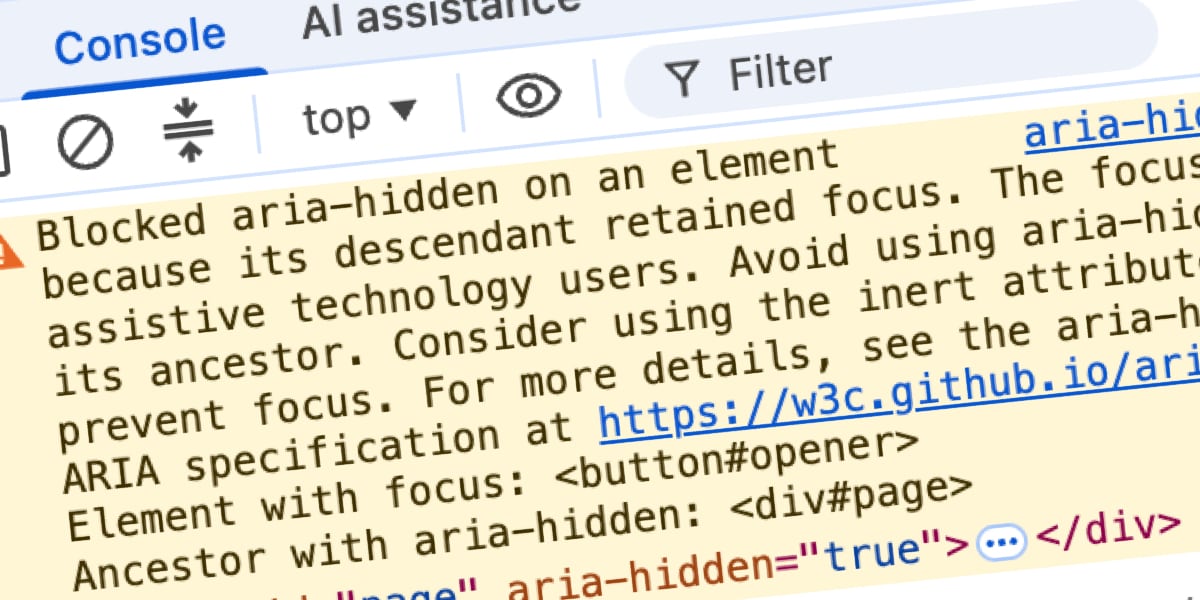
Modern web development has long relied on component libraries and front-end frameworks to streamline user interface design, yet a persistent accessibility challenge continues to disrupt deployment pipelines across the industry. When developers close a dialog box in applications built on frameworks ranging from Angular and Bootstrap to Ionic and phpMyAdmin, modern Chromium-based browsers frequently generate an unmissable yellow console warning. While commonly dismissed as a non-blocking advisory message, this specific warning signals a critical breakdown in web accessibility architecture, highlighting a widespread disconnect between visual DOM states and assistive technology APIs.
Anatomy of the Ghost Focus Phenomenon
At the core of the issue is a fundamental paradox within WAI-ARIA specifications regarding the aria-hidden attribute. The attribute is designed to remove content from the accessibility tree, rendering it imperceptible to screen readers. However, it does not inherently remove elements from the keyboard focus order. Consequently, an element can be simultaneously focusable by a keyboard user while being completely invisible to assistive technologies.
When a user interacts with a modal overlay, focus often remains trapped on a closing button or control that resides within a subtree the application has marked as hidden. Chromium-based browsers identify this state—referred to by accessibility engineers as "ghost focus"—and issue a warning to alert developers that a focused node exists within a hidden region. Left unmanaged, screen readers encountering this state experience total silence, failing to announce the control or its context. The user is left disoriented, often forced to tab blindly from the top of the entire document to regain their place.
To protect users from this failure, modern rendering engines like Chromium overrule the developer’s markup, dynamically exposing focusable nodes within hidden subtrees to ensure screen readers receive some output. This background intervention explains why the console warning appears: the browser is actively correcting an invalid accessibility state generated by improper component teardown sequencing.
Chronology and Industry-Wide Impact
The visibility of this issue escalated sharply following updates to Chromium engines throughout 2024.
- Summer 2024 (Chrome 127): The open-time warning variant emerged across major open-source repositories, clustering in bug trackers for Material-UI (MUI #43106), Ant Design (#50170), and Flowbite (#943). These reports highlighted issues where focus was directed to inputs or elements inside components that had not finished revealing themselves.
- Late 2024 (Chrome 131): The close-time variant, identifying retained focus during modal dismissals, arrived in stable builds. Issues filed in Bootstrap (#41005) and Angular (#30187) demonstrated that the problem was systemic across virtually all major design systems that relied on
aria-hiddento obscure background content during modal transitions. - 2025–2026: As React 19 introduced updated unmount timing protocols, nested component architectures—such as a native selection menu inside a modal dialog—began to suffer from catastrophic focus freezes, rendering pages entirely unnavigable via keyboards (Radix #3701, shadcn-ui #10074).
The Danger of Popular Folk Remedies
Under pressure from strict continuous integration rules and zero-console-warning mandates, development teams frequently adopt quick fixes that inadvertently exacerbate the underlying accessibility failure.
The most common shortcut involves calling .blur() on the active element within a close handler. While this immediately silences the console warning by clearing the active focus element, it leaves focus stranded on the document body. For keyboard and screen reader users, this violates WCAG 2.4.3 (Focus Order), forcing them to restart navigation from the beginning of the page. Similarly, timing hacks utilizing setTimeout or requestAnimationFrame attempt to delay focus restoration until after a render pass. These solutions remain inherently flaky, succeeding on high-performance development hardware while failing intermittently under heavy CPU load or concurrent rendering schedules.
Other teams have attempted to strip aria-hidden attributes entirely or utilize non-modal escape hatches (modal=false). While these methods suppress warnings, they systematically dismantle focus traps, allowing users to inadvertently interact with background elements while a modal claims to be active.
The Correct Architectural Teardown Contract
Resolving the issue requires shifting the focus from simply silencing the console to adhering to a strict execution order. Accessibility experts and standards organizations emphasize that focus must leave a closing region before that region becomes hidden or inert.
A robust modal teardown contract follows a four-step sequence:
- Un-inert the background: If the document background was marked as
inert, remove the attribute prior to shifting focus, ensuring target elements can receive focus. - Restore focus synchronously: Move focus back to the triggering element immediately, before any visual hide-state or opacity transition commits to the DOM.
- Inert the closing shell: Apply the
inertattribute (rather thanaria-hidden) to the closing modal wrapper. This ensures the fading element remains entirely unreachable by keyboard navigation and invisible to assistive technologies throughout its exit animation. - Unmount on completion: Safely remove the element from the DOM only after CSS transition events have fully concluded.
Furthermore, engineering teams are increasingly migrating toward native HTML <dialog> elements and leveraging the browser’s top layer via .showModal(). This native approach manages the entire focus dance and background inertness automatically, effectively eliminating this class of bug without requiring complex JavaScript orchestration.
Implications for Future Web Standards
The persistent friction between browser engines and component libraries underscores a broader philosophical shift in web development. Browser vendors are increasingly unwilling to allow developers to ship declarative code that results in inaccessible user experiences, even if it conforms to legacy specifications.
As standards bodies like the W3C Web Accessibility Initiative continue to refine specifications for modal dialogues and inertness, the onus falls on design system maintainers and application developers to update their lifecycle management. Addressing these warnings is no longer a matter of cosmetic console cleanliness; it is an essential architectural requirement to ensure the web remains navigable for millions of assistive technology users.