The modern digital marketplace is undergoing a profound structural evolution, shifting away from traditional keyword-based search engines and toward conversational artificial intelligence models. As platforms like OpenAI’s ChatGPT, Google’s Gemini, and Perplexity become the primary gateways for consumer discovery, digital marketing strategies are pivoting rapidly. Central to this new era of Answer Engine Optimization (AEO) is a critical distinction that many enterprises overlook: the operational divergence between branded and unbranded queries.
To understand the core mechanics of AI search visibility, one must examine consumer intent. Consider two distinct shoppers. The first user inputs a specific query into an AI interface, asking, "Are Nikes good shoes for marathon runners?" The second user submits a broader prompt: "What is the best running shoe?" Both individuals are high-intent consumers in the market for premium athletic footwear. However, the first shopper possesses pre-existing brand awareness, actively seeking validation or comparative data on a known entity. The second shopper is a blank slate, relying entirely on the artificial intelligence engine to curate a list of viable market options.
This behavioral divide dictates how brands must measure, track, and optimize their digital presence. Neglecting to separate these two categories of inquiries leads to flawed data analytics, misallocated marketing budgets, and an incomplete understanding of how a company performs in conversational search results.
Background Context and the Evolution of Search Metrics

The operational separation of branded and unbranded search traffic is not an entirely novel concept, but its application within generative artificial intelligence has introduced unprecedented complexities. For decades, traditional search engine optimization (SEO) relied heavily on keyword tracking to differentiate between users searching for a company name directly versus those searching for industry categories.
The urgency of this segmentation was recently underscored in the broader search ecosystem. In November 2025, Google officially integrated a dedicated branded queries filter into Search Console. This tool was designed to automatically segregate branded search queries from unbranded keywords, giving webmasters a clearer picture of their organic traffic composition. Industry analysts quickly recognized that conversational AI search requires an identical methodology. Because generative engines synthesize answers dynamically rather than presenting a static list of blue links, measuring visibility requires a nuanced framework that accounts for probabilistic outputs and semantic prompts.
Prompt Engineering Versus Traditional Queries: Terminology and Definitions
Navigating the landscape of Answer Engine Optimization requires precise definitions. In traditional search architectures, users typically type short, transactional phrases—often referred to as queries—such as "best running shoes" or "Nike store." Conversely, conversational AI users compose longer, highly contextual strings of text known as prompts.
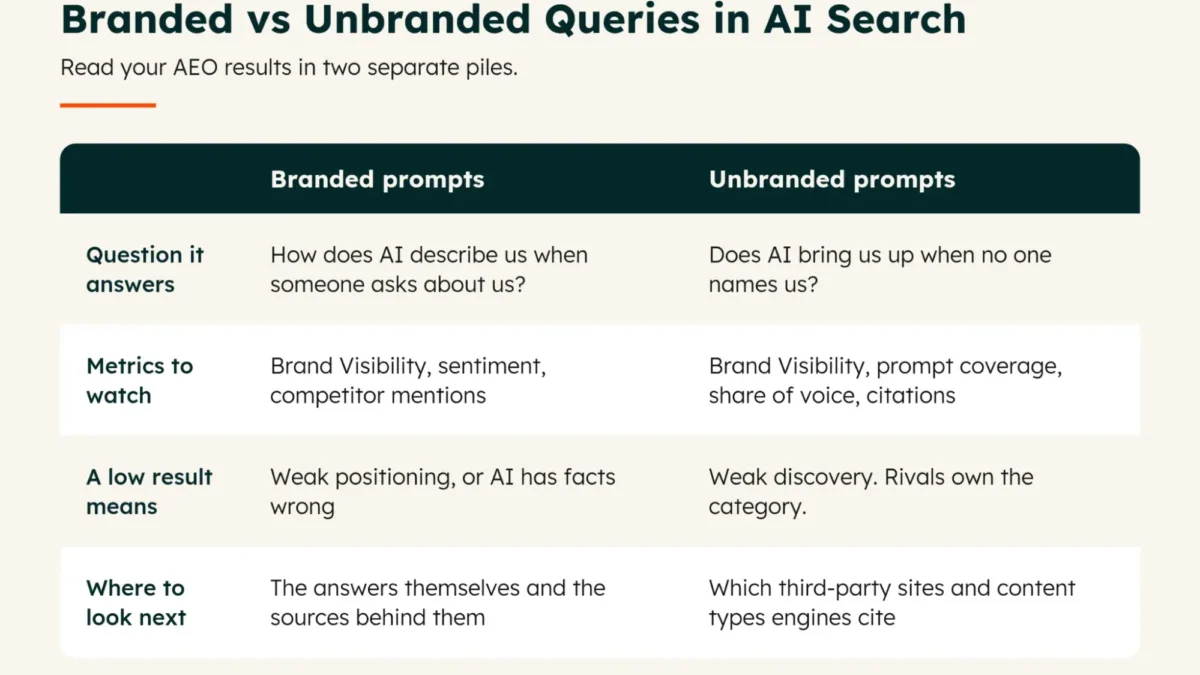
Within AEO protocols, a query represents the overarching strategic concept, while a prompt represents the exact textual input tracked within an AI platform. Furthermore, these inputs are formally categorized into distinct operational buckets:

- Branded Prompts: These explicitly name a company, a close linguistic variation, a common misspelling, or a specific proprietary product line. An example includes inquiring whether Air Force 1s are suitable for long-distance running. These indicate existing brand familiarity.
- Category-Level Unbranded Prompts: These describe an entire product class or industry without naming specific providers, such as requesting the top-rated software for enterprise resource planning.
- Problem-Solving Unbranded Prompts: These focus on a specific pain point or operational challenge, asking the AI to recommend solutions without brand constraints.
- Use-Case Unbranded Prompts: These evaluate how a product or service performs under specific real-world conditions or scenarios.
Digital marketing experts caution that competitor-specific queries—such as searching for alternatives to a rival brand—must be tracked independently. Treating competitor inquiries as unbranded traffic can heavily distort analytical models and lead to strategic miscalculations.
The Methodology of Prompt Tracking: Overcoming AI Inconsistency
Unlike deterministic algorithms that yield identical results for identical inputs over short periods, generative artificial intelligence systems are inherently probabilistic. Asking the exact same prompt to an AI model twice can yield noticeably different recommendations and brand mentions.
Recent empirical research conducted by digital analytics firms SparkToro and Gumshoe.ai highlights this volatility. Their studies revealed that the statistical probability of receiving the exact same list of recommended brands on consecutive queries in ChatGPT is less than one percent. When factoring in the specific ranking order of those brands, the probability drops to approximately one in one thousand.
Consequently, marketing teams cannot rely on sporadic manual checks. Robust AEO strategies demand automated daily prompt tracking coupled with a disciplined weekly review cadence. Enterprises utilize specialized tools—such as HubSpot’s AEO suite—to run tracked prompts continuously across multiple models, including ChatGPT, Gemini, and Perplexity. Analysts then aggregate these data points over multi-week periods to identify genuine performance trends rather than reacting to daily algorithmic fluctuations.

Calculating Share of Visibility and Avoiding the Blended-Score Trap
The most pervasive analytical error observed among digital marketing teams is the utilization of a blended visibility score. A blended score aggregates branded and unbranded prompt performances into a single, overarching percentage.
While a blended score may look impressive on an executive dashboard, it fundamentally misrepresents market penetration. Because branded prompts explicitly name the enterprise, the underlying AI model will almost universally include that brand in the generated response. Conversely, unbranded prompts force the engine to independently evaluate market authority and decide whether the enterprise warrants inclusion.
To illustrate this statistical trap, consider an enterprise tracking a combined pool of 500 prompts:
- 100 branded prompts yielding 90 successful mentions, resulting in a 90% branded visibility rate.
- 400 unbranded prompts yielding 80 successful mentions, resulting in a 20% unbranded visibility rate.
- The blended score calculates out to 170 total mentions across 500 prompts, reflecting a seemingly healthy 34% visibility rate.
A superficial review of the 34% blended score might lead leadership to conclude that market acquisition is stable. However, a granular, separated analysis reveals the underlying reality: while loyal consumers who already know the brand can easily find it, prospective buyers who are unfamiliar with the enterprise are only encountering the brand in two out of every ten relevant searches. Furthermore, if a marketing team aggressively increases its volume of branded prompts while top-of-funnel brand awareness remains stagnant, the blended score will climb artificially, masking a complete failure in new customer acquisition.

To rectify this, analytics professionals rely on the branded-to-unbranded ratio:
$$textBranded-to-Unbranded Ratio = fractextBranded Visibility RatetextUnbranded Visibility Rate$$
A high ratio indicates that the enterprise relies heavily on existing brand equity for its AI search traffic, whereas a declining ratio signals successful organic discovery among new audiences. Industry standards suggest prioritizing the unbranded visibility rate as the primary key performance indicator (KPI) for growth, as it represents the true acquisition vector of conversational search engines.
Strategic Implications and Corrective Actions
When performance metrics reveal deficiencies in AI search visibility, the remedial actions required differ drastically depending on the query type.
Weak performance in branded prompts typically indicates messaging inconsistencies, factual inaccuracies across the web, or unmanaged brand reputation issues. Because the user already knows the entity, the AI model is often simply reflecting public sentiment, customer reviews, or official corporate data. Corrective measures involve strengthening public relations, optimizing structured data, and ensuring that knowledge graphs accurately reflect current product specifications.

Conversely, weak performance in unbranded prompts signals a deficit in broader topical authority. If an enterprise fails to appear when an AI engine is asked to solve a generic industry problem, it means the broader digital ecosystem does not sufficiently connect that enterprise to the underlying subject matter.
Case studies from early adopters of AEO frameworks demonstrate how unbranded gaps can be systematically closed. For instance, digital teams that identify weak awareness-stage visibility frequently deploy comprehensive educational assets, such as top-of-funnel FAQ glossaries and industry-specific knowledge hubs. When generative crawlers index these authoritative, neutral resources, the probability of algorithmic citation for category-level prompts increases substantially. Documented enterprise experiments have shown double-digit percentage gains in awareness-stage visibility following the targeted deployment of structured, problem-solving content.
Future Outlook for Digital Marketing and Answer Engine Optimization
As artificial intelligence deepens its integration into daily consumer decision-making, the optimization of search visibility will continue to mature. Enterprises that fail to decouple branded and unbranded data streams will find themselves flying blind, unable to distinguish between loyal repeat customers and genuine organic market expansion.
Adopting a rigorous, structured tracking methodology is no longer an experimental luxury; it is a fundamental operational necessity. By establishing clear prompt-naming conventions, maintaining a disciplined weekly review cadence, and interpreting data through the lens of the branded-to-unbranded ratio, organizations can safeguard their brand equity while capturing the next generation of consumers who are actively asking artificial intelligence to guide their purchasing journeys.