A federal judge this week issued a temporary restraining order on Paramount’s proposed acquisition of Warner Bros. Discovery (WBD), marking a significant intervention in an increasingly consolidated media landscape. The judicial action, taken on July 23, 2026, stems from a formidable lawsuit filed by a coalition of 12 U.S. states, alleging that the gargantuan deal would violate federal antitrust laws, stifle competition, and diminish media diversity. This legal blockade throws a wrench into what was anticipated to be one of the largest media mergers of the decade, with profound implications for content production, distribution, and the very fabric of news dissemination in the United States.
The Antitrust Blockade: Paramount-WBD Merger Saga
The proposed merger between Paramount Global and Warner Bros. Discovery represented a colossal consolidation effort, aiming to combine vast portfolios of film studios, television networks, streaming services, and news operations under a single corporate umbrella. Paramount Global, a powerhouse owning CBS, Paramount Pictures, Showtime, Comedy Central, MTV, and the Paramount+ streaming service, sought to merge with Warner Bros. Discovery, which controls iconic brands like Warner Bros. Entertainment, HBO, CNN, TNT, TBS, Discovery Channel, and the Max streaming platform. The strategic rationale for the merger, articulated by executives from both companies in prior statements, centered on achieving greater scale to compete more effectively against dominant tech and media giants like Netflix, Disney, and Amazon in the fiercely competitive streaming market, as well as realizing significant cost synergies and enhancing global content reach.
However, the ambition of this synergy collided directly with regulatory concerns over market concentration. The lawsuit brought by the 12 state attorneys general specifically highlighted the potential for the combined entity to exert undue control across multiple critical segments of the media industry. If the merger were to proceed, Paramount would not only command a substantial portion of theatrical film distribution from two major Hollywood studios but would also control dozens of popular cable channels, significantly reducing choices for consumers and leverage for independent content creators.
A particularly contentious point raised by the plaintiffs concerns the implications for news media. The merger threatened to bring two of the most prominent news brands in the U.S. under common ownership: CNN, currently a flagship asset of Warner Bros. Discovery, and CBS News, a cornerstone of Paramount Global. According to a 2025 Pew Research Center survey, one-third of U.S. adults regularly get news from CNN, while three-in-ten regularly rely on CBS News. Such a merger, critics argue, could lead to a reduction in independent journalistic voices, potential editorial alignment, and decreased diversity of perspectives, ultimately harming public discourse and the democratic process. Consumer advocacy groups and media watchdogs have consistently warned that fewer independent news sources could result in a less informed populace and a diminished ability to hold power accountable.
The temporary restraining order issued by the federal judge is an initial victory for the antitrust plaintiffs. It signals that the court views the states’ allegations as serious enough to warrant immediate preventative action, pausing the merger process until further legal proceedings can determine its legality. The next steps will likely involve a hearing for a preliminary injunction, where the court will delve deeper into the merits of the antitrust claims and assess the potential irreparable harm should the merger be allowed to proceed. Legal experts suggest that this initial ruling sets a challenging precedent for large-scale media mergers, indicating a renewed and robust scrutiny from regulatory bodies and the judiciary.
A History of Consolidation and Antitrust Scrutiny
The media industry has been characterized by waves of consolidation over the past few decades, driven by technological shifts, the rise of new distribution platforms, and the relentless pursuit of scale. From the merger of Time Warner and AOL at the turn of the millennium to Disney’s acquisition of 21st Century Fox, and AT&T’s controversial takeover of Time Warner (later spun off as Warner Bros. Discovery), the trend has been towards fewer, larger players.
Historically, antitrust enforcement in the media sector has ebbed and flowed. While some mega-mergers sailed through with minimal conditions, others faced significant challenges. The Department of Justice (DOJ) famously sued to block AT&T’s acquisition of Time Warner in 2017, arguing it would harm competition and consumers. Although the DOJ ultimately lost that case on appeal, the legal battle highlighted persistent concerns about vertical and horizontal integration in media. The current climate, however, appears to signal a more aggressive stance from antitrust regulators under the Biden administration, which has expressed a commitment to tackling corporate concentration across various industries. This judicial intervention in the Paramount-WBD deal aligns with a broader governmental push to re-evaluate the impact of unchecked corporate growth on market fairness and consumer welfare.
Industry Reactions and Future Outlook
The immediate reaction from Paramount Global and Warner Bros. Discovery was one of disappointment. Both companies are expected to issue formal statements expressing their confidence in the legality of the merger and their intent to vigorously defend it in court, exploring all available legal avenues. For investors, the restraining order introduces significant uncertainty, likely leading to fluctuations in their stock values and prompting questions about strategic alternatives should the merger ultimately fail. Analysts are already weighing the potential for break-up fees, alternative partnership discussions, or a renewed focus on organic growth strategies.
Conversely, the state attorneys general involved in the lawsuit lauded the judge’s decision. Their spokespersons emphasized the importance of protecting consumers from potential price hikes, preserving diverse content offerings, and ensuring a competitive marketplace for advertisers and content creators. Consumer advocacy groups echoed these sentiments, expressing relief that the judiciary is taking a firm stance against what they perceive as an ongoing trend towards media monopolization. These groups argue that fewer media owners inevitably lead to less innovation, reduced quality, and a narrower range of perspectives, particularly in critical areas like news and public affairs. The outcome of this case could significantly influence the future appetite for mega-mergers across the entertainment and news industries for years to come.
The Evolving Landscape of News Consumption: A Video-First Future?
In parallel with these high-stakes corporate battles, the broader media industry continues to navigate profound shifts in how audiences consume news. Media observers have recently noted a distinct and accelerating trend: news organizations, including venerable institutions like The New York Times and The Wall Street Journal, are allocating significantly more resources toward creating video content. This strategic pivot aims to capture and engage audiences increasingly migrating to visual platforms.
This development, however, evokes a sense of déjà vu for many industry veterans, recalling the "pivot to video" phenomenon of roughly a decade ago. That earlier shift, often characterized by widespread layoffs of print journalists in favor of video teams, proved largely unsuccessful for many publishers, failing to generate anticipated revenue or sustainable audience engagement. The dynamics and underlying platforms involved have, however, shifted markedly since that era.

Lessons from the Past: The First "Pivot to Video" and its Pitfalls
The initial "pivot to video" of the mid-2010s was largely driven by a misinterpretation of social media algorithms, particularly Facebook’s, which at the time prioritized video content in users’ feeds. Many news outlets, desperate for reach and new revenue streams, invested heavily in video production, often at the expense of their core text-based journalism. The pitfalls were numerous:
- Misleading Metrics: Initial engagement metrics for video were often inflated by "autoplay" features, not necessarily indicating active user choice or deep consumption.
- Lack of Monetization: Ad revenue from short-form social video often failed to materialize at levels that could sustain the investment.
- Inauthentic Content: Many newsrooms struggled to adapt their storytelling for video, often producing static, text-heavy videos that lacked genuine appeal.
- Audience Alienation: Loyal readers of text-based journalism felt neglected as resources were reallocated.
- Platform Dependence: Publishers became overly reliant on social media platforms, whose algorithmic changes could, and often did, swiftly undermine their video strategies.
This Time, It’s Different: Platforms, Audiences, and Monetization
Today’s "pivot to video" is unfolding under fundamentally different circumstances, suggesting it may prove more sustainable and successful. The primary drivers now are explicit audience demand and the maturation of dedicated video platforms. A growing share of Americans, particularly younger demographics, regularly get their news on video-focused social media sites such as YouTube, TikTok, and Instagram. For instance, a Pew Research Center fact sheet revealed that 35% of U.S. adults reported regularly getting news on YouTube in 2025, a significant increase from 23% in 2020. This indicates a clear, organic shift in user behavior rather than an algorithmically engineered one.
Furthermore, overall preferences for news consumption underscore this trend. An August 2025 survey found that watching news remains the most common preference among Americans, with 44% favoring it over reading (37%) or listening (19%). These numbers have remained remarkably steady since 2016, indicating a consistent, long-term preference for visual news consumption. The current ecosystem also offers more robust monetization opportunities, from direct ad revenue on YouTube to brand partnerships on TikTok and Instagram, providing more diverse and potentially stable income streams for publishers. News organizations are also investing in higher-quality, platform-native video content, moving beyond simple repurposing of text to create compelling visual narratives that resonate with digital audiences.
Pew Research Center’s Deep Dive into American Engagement
Amidst these shifts in media consumption and corporate structures, understanding how Americans engage with public life has become paramount. The Pew-Knight Initiative, a collaborative effort exploring the intersections of journalism and civic life, recently released a comprehensive report on July 16, 2026, titled "How Americans Are Engaged With News, Politics, Religion and Civic Life." This study delves into the multifaceted ways individuals participate in their communities and democracy, providing critical insights for policymakers, civic organizations, and news outlets alike.
Unpacking the "Engagement Groups": Mobilizers, Connectors, Spectators, and Outsiders
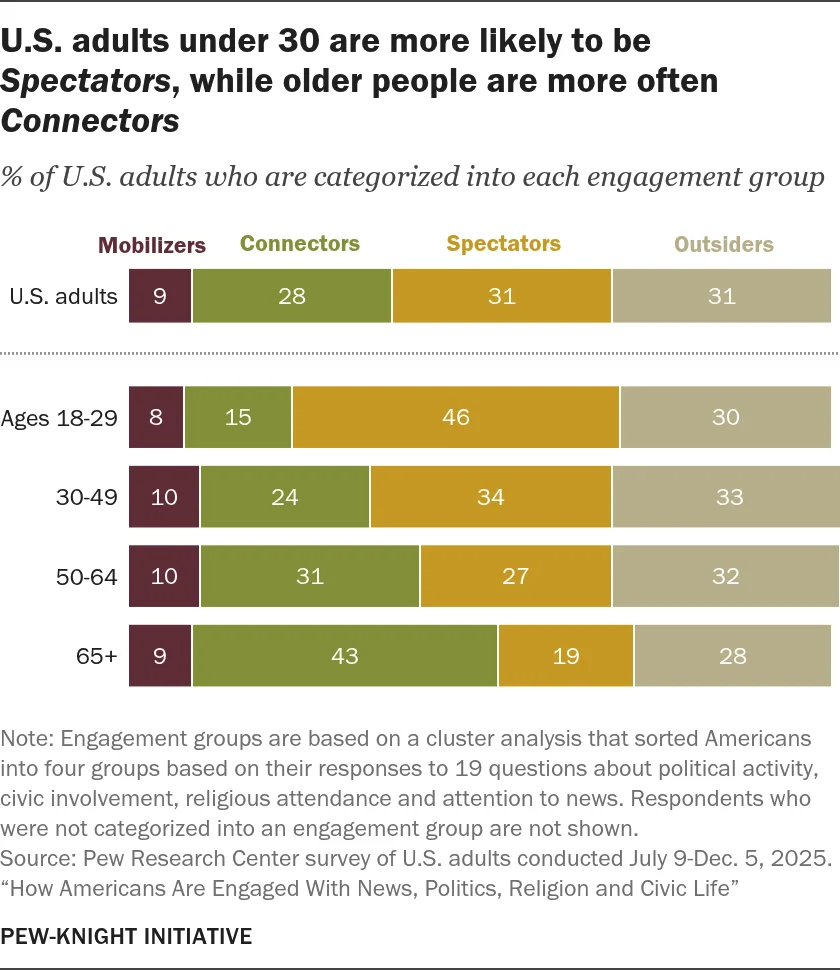
The report’s most significant contribution is its identification of four distinct "engagement groups" within the U.S. public, categorized based on their patterns of participation across various civic activities. These groups were derived from a sophisticated cluster analysis of responses to 19 detailed questions covering political activity (e.g., voting, campaigning), civic involvement (e.g., volunteering, joining community groups), religious attendance, and attention to news.
- Mobilizers: Representing approximately 9% of the U.S. adult population, Mobilizers are highly engaged across all dimensions of public life. They are active voters, frequent news consumers, often participate in political campaigns, and regularly contribute to civic and religious organizations. They are the bedrock of civic participation and often drive community initiatives.
- Connectors: Comprising 28% of U.S. adults, Connectors are characterized by strong participation in civic and community life, often through local organizations, volunteering, and religious services. While they follow the news, their engagement might be less politically intense than Mobilizers, focusing more on community cohesion and local issues.
- Spectators: Making up the largest group at 31% of the adult population, Spectators are distinguished by their online engagement with news and public affairs. They follow current events, interact with content on social media, and are aware of political developments, but they are less likely to participate in traditional civic activities like voting, volunteering, or joining community groups. Their engagement is largely observational and digital.
- Outsiders: Also a substantial group at 31% of the U.S. adult population, Outsiders exhibit minimal engagement across all measured dimensions of public life. They are less likely to follow the news, participate in politics, or engage in civic or religious activities. This group often feels disconnected from political and civic institutions.
Generational Divides in Civic Life
A particularly illuminating finding from the Pew-Knight report, highlighted in its "Chart of the Week," underscores a significant generational divide in these engagement patterns. The analysis reveals that older Americans are considerably more likely than younger adults to be categorized as Connectors. For instance, 43% of adults aged 65 and older are Connectors, compared to just 15% of those aged 18-29. This suggests that older generations remain more deeply embedded in traditional community and civic structures.
Conversely, younger Americans are disproportionately represented among Spectators. A striking 46% of U.S. adults under 30 fall into the Spectator group, compared to only 19% of those aged 65 and older. This statistic paints a vivid picture of a generation that is digitally savvy and attentive to online news and discussions but less inclined towards offline, organized civic participation. This trend raises important questions about the future of civic engagement and the evolution of community bonds in an increasingly digital world. While Spectators are informed, their mode of engagement may not translate into traditional forms of collective action or community building.
Connecting the Threads: Media, Engagement, and Democracy
The confluence of these major trends – the intense scrutiny over media consolidation, the industry’s renewed commitment to video content, and the shifting patterns of civic engagement across generations – paints a complex and dynamic picture of the contemporary media landscape. The federal judge’s injunction against the Paramount-WBD merger is a potent reminder that the concentration of media power remains a critical concern, particularly given the vital role news organizations play in a healthy democracy. Should the merger be ultimately blocked, it would preserve a greater diversity of ownership, at least for now, impacting the competitive environment for both content and advertising.
Simultaneously, the "pivot to video" underscores that news organizations must adapt to evolving audience preferences to remain relevant. If younger Americans are predominantly "Spectators" who prefer to consume news visually on social media, then the industry’s investment in video is not merely a trend but a strategic imperative to reach and inform a crucial demographic. The challenge lies in converting this online "spectatorship" into more active and diverse forms of civic engagement, bridging the gap between digital awareness and tangible participation.
Ultimately, the future of media will be shaped by a delicate balance between market forces driving consolidation, regulatory efforts to ensure competition, and the evolving habits of a diverse public. Understanding these interconnected dynamics is essential for navigating the complex terrain of news, information, and civic life in the coming years.