A federal judge issued a landmark ruling on September 24, 2026, ordering the Trump administration to immediately and temporarily restore press credentials to journalists from CNN, MS NOW, and Politico. The order follows a swift legal challenge brought by the three news organizations after their reporters were barred from White House grounds last week. The injunction serves as a significant check on executive authority regarding media access, reigniting a long-standing national debate over the boundaries of press freedom and the nature of the adversarial relationship between the presidency and the mainstream media.
The conflict began on September 17, 2026, when the White House revoked the hard passes of specific reporters from the aforementioned outlets, citing what the administration described as a history of hostile and biased coverage. By September 19, the affected news organizations filed a joint lawsuit in the U.S. District Court for the District of Columbia, arguing that the revocation of credentials without due process violated the First and Fifth Amendment rights of the journalists and their respective organizations. The court’s decision on September 24 mandates that the status quo ante must be maintained while the case proceeds through the judicial system, emphasizing that the White House cannot arbitrarily terminate access to public officials for the press.
Chronology of the Dispute
The roots of this week’s legal confrontation stretch back to the start of the current administration’s second term. The administration has frequently characterized mainstream news coverage as being intentionally detrimental to its policy objectives.
- September 15, 2026: White House press officials issued warnings to several bureaus regarding what they termed "inaccurate reporting" and "bad-faith questioning" during daily briefings.
- September 17, 2026: The press credentials of select correspondents from CNN, MS NOW, and Politico were officially revoked. The administration stated the move was based on "two years of unfair and negative coverage."
- September 19, 2026: Legal teams representing the media organizations filed a complaint seeking a temporary restraining order and a preliminary injunction, arguing that the denial of access constituted an unconstitutional form of retaliation.
- September 24, 2026: The federal judiciary sided with the plaintiffs, granting the motion for a temporary restoration of access, citing the vital role of the press in maintaining a transparent government.
The Partisan Divide on Press Freedom
The legal battle arrives at a moment of deep skepticism regarding the media’s role in American society. According to a comprehensive survey conducted in June 2026 by the Pew-Knight Initiative, public perception of press freedom is sharply polarized along party lines. Approximately 44% of U.S. adults believe that the press has become less free during the current administration, while 12% suggest it has become more free, and 26% perceive no shift in the status quo.
The partisan chasm is stark: 72% of Democrats contend that the environment for journalism has deteriorated since the return of the Trump administration, compared to only 15% of Republicans. This divergence is mirrored in how the public interacts with news sources. Data from March 2025 indicated that a majority of Republicans express deep-seated distrust toward major outlets, with 58% specifically citing CNN as a source they distrust. This systemic distrust has provided the political cover for the administration’s aggressive stance toward the media, framing the revocation of passes not as a censorship issue, but as a response to what the administration views as "activist journalism."
Corporate Consolidation and the Media Landscape
Parallel to the White House press room controversy is a massive shift in the media business landscape that promises to reshape the dissemination of information. Paramount has successfully reached a settlement with a coalition of states in an antitrust lawsuit, clearing the path for its acquisition of Warner Bros. Discovery. This merger consolidates two of the most influential news networks in the United States: CNN and CBS News.

The acquisition has significant implications for media accountability. As a condition of the regulatory settlement, Paramount has agreed to the creation of an independent editorial board tasked with overseeing the journalistic integrity and editorial independence of both networks. This move is a direct response to concerns that the consolidation of major news outlets under a single corporate umbrella could stifle diverse viewpoints or lead to homogenized reporting. Given that nearly half of all Americans (46%) rely on at least one of these two networks as a primary source of information, the oversight board’s function will be heavily scrutinized by both regulators and the public.
Public Concern Regarding Constitutional Rights
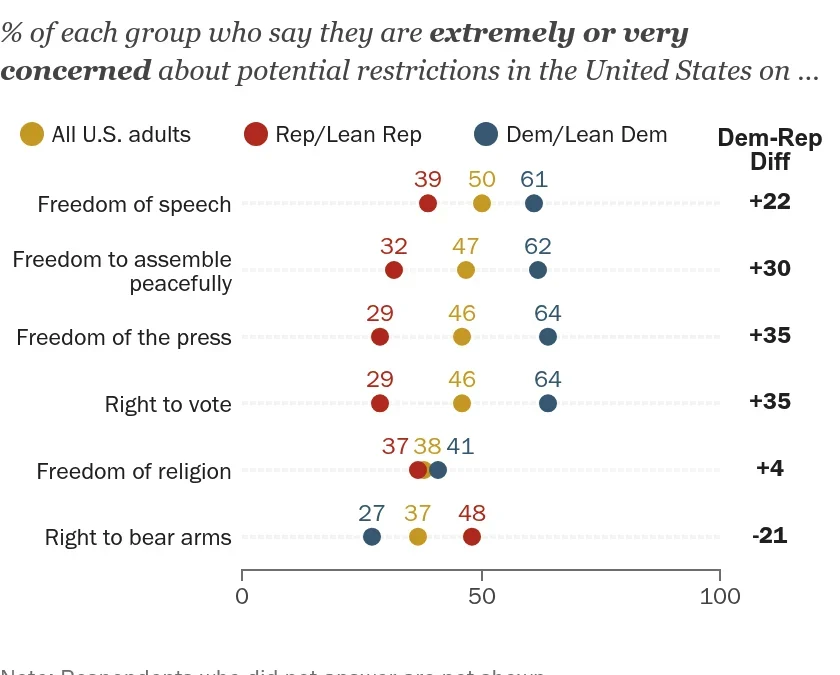
While the battle for press access dominates headlines, broader data suggests that the public’s anxiety about press freedom is tied to a larger unease regarding the state of democratic institutions. The June 2026 Pew-Knight Initiative report highlights that 46% of Americans are "extremely or very concerned" about potential restrictions on press freedom. This level of concern is nearly identical to public anxiety regarding the right to vote (46%) and the freedom to assemble peacefully (47%).
The data reveals that Democrats are consistently more concerned than Republicans about potential government restrictions on these specific civil liberties. Conversely, Republicans express higher levels of concern regarding potential limits on the right to bear arms. This data suggests that the ongoing legal skirmish over White House access is not an isolated event, but a reflection of a society where constitutional rights are increasingly viewed through a partisan lens.
Broader Implications and Future Outlook
The federal court’s decision to restore press access sets a precedent for how future administrations may handle media relations. Legal scholars note that while the White House has broad discretion over its own grounds, that discretion is not absolute when it infringes upon the public’s right to be informed. By preventing the administration from using credentials as a tool of punishment, the court has reinforced the principle that the White House is a public institution and the press serves as a conduit for public accountability.
However, the ruling is only temporary. The case will move to a more thorough review of whether the specific conduct of the reporters in question justified a disciplinary measure or if the administration’s actions were purely punitive. Legal experts anticipate a protracted battle that may eventually reach the appellate courts.
As the administration continues to challenge the legitimacy of traditional news outlets, the role of the independent editorial board at the new Paramount-Warner entity will become a focal point of debate. If this board is successful in maintaining objective standards, it may help rebuild trust among skeptical segments of the population. If it fails, or if it is perceived as partisan, it will likely serve to further erode the public’s confidence in the media.
Ultimately, the events of this week highlight a fundamental tension in American democracy: the need for a press that is free to challenge power, and the reality of a political environment where that same press is viewed by a significant portion of the electorate as a political adversary. The coming months will determine whether the judiciary will continue to prioritize the protection of the press as a democratic necessity, or if the executive branch will find new, legally permissible ways to restrict access to those it deems unfavorable. For now, the reporters from CNN, MS NOW, and Politico are returning to their posts, but the atmosphere within the West Wing remains charged, with both sides preparing for a long and difficult legal and rhetorical struggle.