The modern marketing ecosystem finds itself at a paradoxical crossroads where technological sophistication meets persistent operational friction. According to HubSpot’s latest State of Marketing Report, an overwhelming 86.4% of marketing teams now integrate artificial intelligence into some facet of their daily workflows. Yet, despite this massive leap in technological adoption, measuring return on investment (ROI) remains the primary hurdle for practitioners, cited by 33% of survey respondents as their top challenge. Industry analysts point out that this friction rarely stems from software failures or technological limitations. Instead, the root causes are foundational: unclear go-to-market strategies, compromised data integrity, siloed technological stacks, and a persistent misalignment between sales and marketing departments. When organizations automate broken processes or inaccurate data sets, the software merely accelerates inefficiency, magnifying systemic errors at scale.

To understand how the industry arrived at this juncture, it is helpful to examine the historical trajectory of marketing technology over the past decade. In the early 2010s, marketing automation was predominantly viewed as a back-office operations function designed to handle batch-and-blast email campaigns and rudimentary lead scoring. As software-as-a-service (SaaS) models proliferated, companies rapidly accumulated point solutions—ranging from specialized intent data platforms to standalone analytics tools—hoping to capture every possible digital signal. By the arrival of the generative AI boom in the mid-2020s, these disparate stacks were suddenly tasked with feeding complex, autonomous agents that could read buyer context, draft personalized communications, and execute multi-channel actions in real time. Unfortunately, many organizations rushed to deploy these advanced AI-augmented workflows without first establishing clean data repositories or unified cross-departmental alignment, setting the stage for the performance bottlenecks observed today.
A critical dimension of this challenge is data hygiene, which underpins every automated action a system executes. HubSpot’s research indicates that only 65% of marketers maintain high-quality data regarding their target audiences, a metric that has remained stubbornly flat even as corporate investments in artificial intelligence skyrocket. In a modern B2B environment, maintaining clean contact records is no longer sufficient. Organizations require revenue-ready databases that synthesize firmographic, demographic, intent, engagement, and contextual signals into a single source of truth. When duplicate contacts exist, job titles grow stale, or lifecycle stages are mislabeled, automated systems generate thousands of misdirected interactions, alienating prospective buyers and straining the credibility of marketing departments. Experts recommend a rigorous, multi-phase cleaning approach that begins with comprehensive data audits, spans across multiple dimensions of record quality, and enforces strict validation rules at the point of entry via web forms and list imports.

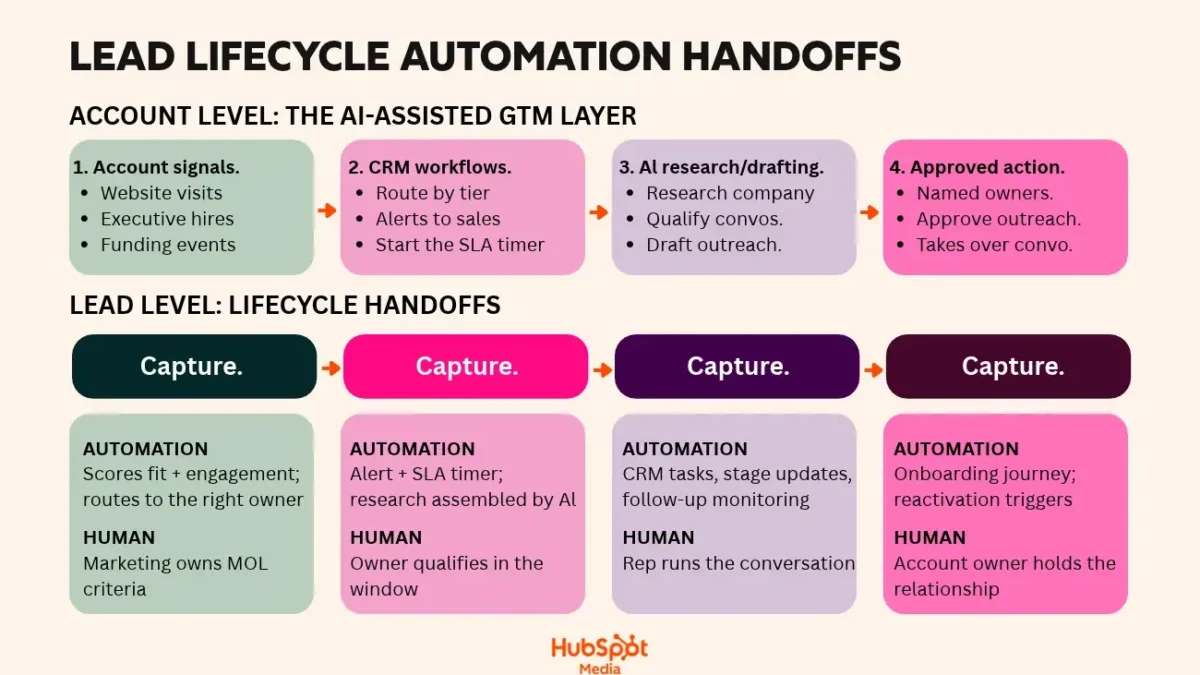
Parallel to data decay is the enduring friction between sales and marketing teams—a structural misalignment that 27.6% of marketers now identify as a primary operational barrier. This disconnect typically materializes at the lead handoff stage. When marketing defines a qualified lead through superficial engagement metrics while sales demands rigorous qualification based on budget and authority, automated nurturing engines inevitably produce output that sales representatives refuse to work. Compounding the issue, modern buyers increasingly penalize vendors for inconsistent messaging; a comprehensive DemandGen report highlights that 67% of B2B buyers actively withdraw from consideration when encountering fragmented communication across a vendor’s touchpoints. To bridge this divide, high-performing enterprises implement Service Level Agreements (SLAs) that explicitly define lead lifecycle stages, outline mandatory follow-up timeframes, and utilize shared CRM views to ensure total transparency between departments.
Compounding strategic and cultural misalignment is the pervasive issue of siloed tooling. The historical tendency for marketing departments to adopt isolated point solutions for email marketing, social media management, customer relationship management, and intent tracking has created severe architectural fractures. Each isolated tool operates within its own data silo, resulting in latency, synchronization errors, and fragmented customer records where marketing perceives an intensely engaged prospect while sales views an entirely blank profile. Industry consultants emphasize that attempting to solve these gaps by purchasing additional standalone software typically exacerbates the problem. Instead, organizations are increasingly turning toward unified, composable marketing stacks built around a single customer relationship management spine. This architectural consolidation ensures that every workflow—whether initiated by an AI agent, an email sequence, or a sales representative—reads from and writes to the exact same record simultaneously.

The integration of artificial intelligence into automated customer journeys also introduces significant considerations regarding customer experience and brand voice. Over-automation frequently leads to robotic, impersonal interactions that alienate buyers through poorly timed emails, superficial personalization tokens, and relentless multi-channel cadence that ignores explicit consumer intent. Industry leaders stress that AI should be deployed to manage high-frequency, repetitive administrative tasks—such as data enrichment, lead routing, and initial signal monitoring—while reserving nuanced, relationship-building activities for human professionals. By establishing hybrid operational frameworks where AI handles background research and drafting, but human sales owners retain final review and approval authority over outbound communications, organizations can successfully scale their outreach without sacrificing authenticity or trust.
Furthermore, the rapid execution speed of automated workflows introduces substantial regulatory and compliance risks, particularly regarding international data protection frameworks such as the General Data Protection Regulation (GDPR), the California Consumer Privacy Act (CCPA), and the Controlling the Assault of Non-Solicited Pornography And Marketing (CAN-SPAM) Act. Because automated systems operate at high velocity without pausing for manual review, a single configuration error can result in non-compliant communications dispatched to thousands of protected individuals simultaneously. To mitigate these risks, modern RevOps (Revenue Operations) teams embed explicit compliance safeguards directly into workflow logic—including automated suppression lists, geographic exclusion filters, and verified consent checkboxes—while assigning formal governance oversight to designated privacy and legal stakeholders.

Measuring the true impact of these complex, automated systems requires a balanced framework that evaluates both high-level financial outcomes and granular operational health. Industry benchmarks suggest dividing performance indicators into two distinct tiers. The first tier encompasses outcome metrics, which evaluate whether automation is genuinely driving top-line revenue through influenced pipeline growth, velocity from lead to closed-won, and customer acquisition cost reduction. The second tier focuses on operational metrics, tracking system-level indicators such as error rates, database decay velocity, and workflow execution latency. Organizations that successfully track both layers typically utilize unified reporting environments where marketing automation data and revenue attribution live within the same ecosystem, allowing leadership to view leading operational indicators and lagging financial results side-by-side.
As enterprises look toward the future of marketing operations, market analysts agree that sustainable success requires a systematic, architectural overhaul rather than superficial software adjustments. Fixing underperforming automation programs begins with establishing crystal-clear go-to-market strategies, rigorously governing database hygiene, dismantling technological silos, and aligning sales and marketing around shared revenue goals. Platforms featuring smart CRM capabilities, native AI agents, and comprehensive customer journey orchestration tools provide the foundational infrastructure required to achieve this alignment. By treating marketing automation as a cohesive enterprise system rather than a collection of tactical shortcuts, organizations can finally bridge the gap between technological adoption and verifiable financial return.