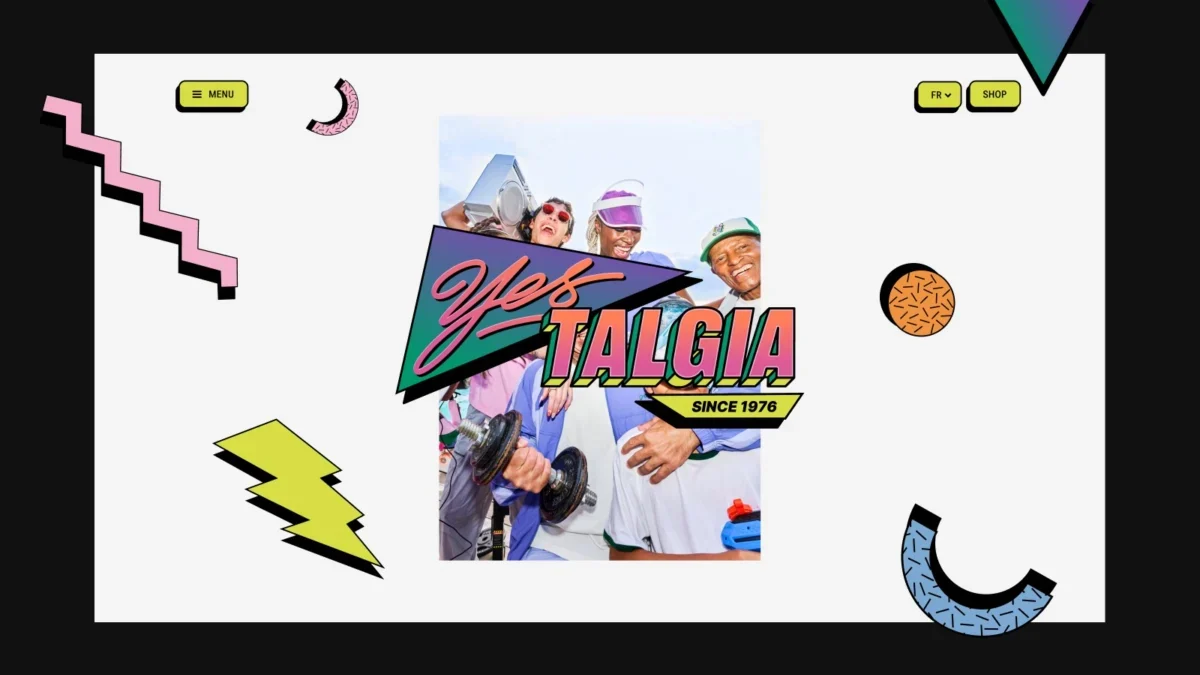
Global sporting goods retailer Decathlon has officially launched "Yestalgia," an exclusive capsule collection accompanied by a highly immersive, retro-inspired digital experience. Designed to celebrate the reinterpretation of the brand’s 1990s product archives, the campaign successfully merges the optimistic spirit, bold color palettes, and playful aesthetics of the decade with contemporary web development techniques. The digital platform, developed in collaboration with prominent creative studios, represents a significant milestone in modern e-commerce and brand storytelling, demonstrating how high-performance technical architecture can coexist with avant-garde artistic direction.
Background Context and Strategic Evolution
The launch of the Yestalgia collection reflects a broader contemporary fashion and retail trend: the resurrection of 1990s nostalgia. During this era, outdoor and athletic wear underwent a cultural shift, moving from purely functional utility items into bold statements of lifestyle and pop culture. Decathlon, founded in France in 1976, played a quiet yet substantial role in democratizing access to sports during these decades, producing durable, brightly colored gear that became ubiquitous across European campsites, hiking trails, and city streets.
In recent years, legacy brands have increasingly looked to their historical archives to forge deeper emotional connections with consumers. By reissuing reimagined versions of classic items through the Yestalgia capsule, Decathlon aims to capture both older demographics seeking a sense of personal history and younger consumers fascinated by retro aesthetics. However, rather than relying solely on traditional retail methods, the company recognized that a collection celebrating a distinct cultural era required an equally distinctive digital environment. The resulting web experience was engineered not just as an online catalog, but as an interactive homage to the hardware and media consumption habits of the 1990s.

Creative Direction and Visual Identity
The visual framework of the Yestalgia digital experience was developed in partnership with illustrator and visual artist Dalkhafine. The collaboration produced an aesthetic that combines vibrant, expressive vector illustrations with typography and spatial compositions designed to evoke the transition from mechanical to digital media at the turn of the millennium.
The core challenge for the development team was translating this rich creative vision into a high-performance web architecture. Traditional digital campaigns often struggle to balance heavy artistic direction with fast loading times and seamless user interaction. To solve this, the project adopted a product-first editorial approach. Large-scale imagery and generous layout compositions allow users to inspect the archival pieces almost instantly. Minimal interface elements keep the focus on the merchandise, creating a browsing flow that mimics flipping through a high-end fashion magazine rather than scrolling through a conventional e-commerce grid.
Interspersed throughout the product sequences are graphic interludes where typography, geometric shapes, and motion take center stage. Rather than treating campaign assets as static decoration, the designers embedded them directly into the interface’s functional language.
Innovative Interaction Design: The Walkman Navigation and Graphic Threads
One of the most defining technical and conceptual features of the Yestalgia platform is its primary navigation mechanism, modeled directly after a vintage portable cassette player, or "Walkman."

Upon entering the site, a 3D-rendered Walkman slides into the viewport. The menu interface is presented as a collection of cassette tapes, with each tape corresponding to a distinct section or destination within the website. Selecting a tape triggers a physical-feeling interaction: the cassette slides out of the deck, snaps securely into place with carefully timed easing curves and micro-animations, and the device gracefully transitions to reveal the chosen content. On mobile devices, this interaction is enhanced with subtle haptic feedback to simulate the tactile sensation of operating mechanical audio equipment.
This playful homage extends into the site’s micro-interactions. A recurring graphic thread of abstract lines and shapes runs across the entire platform. Substantive motion design principles ensure these elements react dynamically as the user scrolls, creating a continuous visual rhythm. Vector animations powered by Rive are integrated throughout the experience, utilizing intersection observers to pause playback the moment elements leave the viewport, thereby conserving GPU resources and optimizing battery life on mobile devices. Furthermore, the site fully respects user accessibility settings, featuring a dedicated reduced-motion mode that instantly snaps animated elements to their final states without sacrificing layout integrity.
Engineering Architecture and Content Management
Behind the nostalgic exterior lies a robust, highly sophisticated technical stack designed to meet the rigorous demands of modern digital publishing. The back-end of the Yestalgia platform is built on WordPress, utilizing a fully custom theme powered by Timber and Polylang to deliver a seamless multi-language experience across seven distinct regional markets.
The central engineering challenge for the development team was ensuring that an intensely art-directed, highly custom site remained genuinely manageable and updateable for the client. To achieve this, every section of the platform was constructed as a modular Blockstudio block, combining a JSON schema with a Twig template. This modularity allows Decathlon’s internal content teams to reorder, recompose, and swap campaign materials without altering underlying code or compromising the strict parameters of the artistic direction.

On the front-end, the site operates on piecesjs, a lightweight framework built upon native web components. Each component functions autonomously, lazy-importing only the specific JavaScript and CSS stylesheets required for its operation. Scroll-driven interactions are centralized through a specialized Scroll Piece that integrates Lenis smooth scrolling with GSAP ScrollTrigger. This architecture allows complex interactive behaviors, such as scroll-driven timelines and dynamic typography reveals, to be declared directly within the HTML markup via custom data attributes, minimizing script bloat and ensuring optimal performance across a wide range of devices.
Industry Implications and Future Outlook
The deployment of the Yestalgia digital experience highlights a growing shift in how major retail brands approach digital product launches. As consumer expectations for web design rise, standard e-commerce templates are increasingly seen as insufficient for high-impact marketing campaigns. By investing in custom, narrative-driven web applications that blend nostalgic storytelling with advanced front-end engineering, brands can significantly enhance user engagement and brand affinity.
Industry analysts note that projects like Yestalgia demonstrate the viability of combining heavy creative art direction with enterprise-level content management systems. By prioritizing modularity and performance optimization—such as viewport-gated animations and lightweight component architectures—developers can deliver visually stunning digital experiences without sacrificing accessibility or page-load speeds.
As Decathlon continues to roll out the Yestalgia capsule collection globally, the digital platform stands as a case study in effective cross-disciplinary collaboration. By uniting the creative visions of illustrators and motion designers with meticulous back-end and front-end engineering, the project successfully transforms a simple retail product launch into an engaging, interactive cultural retrospective.