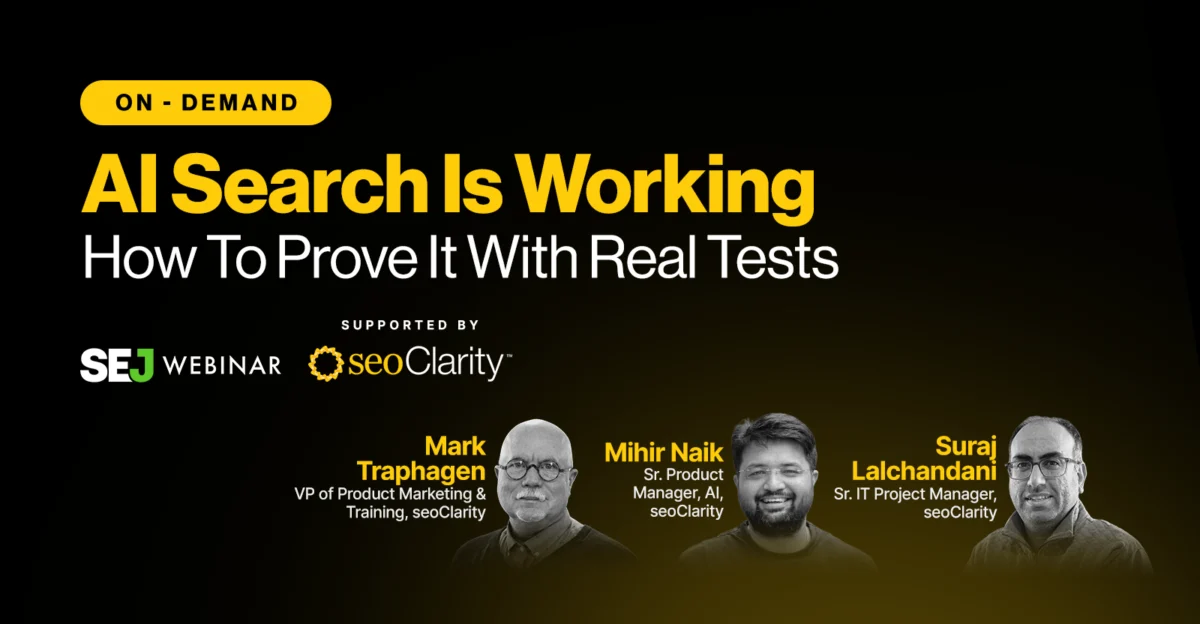
The landscape of search engine optimization (SEO) is undergoing a profound transformation with the advent and rapid integration of Artificial Intelligence (AI) into core search functionalities. As AI Overviews and conversational AI modes become increasingly prevalent across platforms like Google, ChatGPT, Claude, Perplexity, and Gemini, the challenge for marketers and content strategists has shifted from merely appearing in search results to proving that their efforts genuinely influence AI citations and responses. A recent Search Engine Journal (SEJ) webinar, featuring seoClarity’s Mark Traphagen (VP of Product Marketing & Training), Mihir Naik (Senior Product Manager, AI), and Suraj Lalchandani (Sr. IT Project Manager), meticulously outlined a groundbreaking methodology designed to establish causation, not just correlation, in AI search optimization (AEO).
The webinar highlighted a critical demonstration: adding FAQ sections to a set of test pages resulted in a measurable increase in AI citations. Crucially, when these FAQ sections were subsequently removed, the citations dropped back to their original levels. This reversion, the seoClarity team emphasized, represents the gold standard of proof – the difference between observing a correlation and definitively establishing causation. This level of rigorous measurement is largely absent in the current AI search optimization landscape, making seoClarity’s framework a significant advancement.
A New Era of AI Search Measurement: Google Search Console’s Game-Changer
A pivotal development underpinning the webinar’s discussion was Google’s announcement on June 3, 2024, of dedicated Search Console reports for AI Overviews and AI Mode. For the first time, a subset of sites can now access first-party data, showing precisely how often each URL appears within Google’s AI search features, on a page-by-page basis. This update has been widely hailed as the most substantial measurement upgrade for AI search testing to date.
Suraj Lalchandani underscored the magnitude of this release, stating, "This has been the hardest thing to measure in AI search. Everyone was sampling. Everyone was inferring. But now Google is just giving it to you." Prior to this update, SEO professionals relied heavily on anecdotal evidence, manual checks, third-party scraping tools, and proxy metrics to gauge their content’s visibility within AI-generated responses. This often led to educated guesses rather than concrete, actionable insights. The introduction of first-party data directly from Google provides an unparalleled level of trust and accuracy, eliminating much of the ambiguity that previously plagued AEO efforts.
However, the seoClarity team was also pragmatic about the limitations of these new reports. While invaluable for Google’s AI features, they cover only a part of what a comprehensive AI search testing program requires. Measurement for other prominent large language models (LLMs) and conversational AI interfaces like ChatGPT, Claude, and Perplexity still necessitates robust structured third-party tracking. The webinar provided a detailed mapping of which gaps the new Google reports close and which areas still require external solutions, alongside a platform-by-platform reference for what each AI engine can crawl and render. This comprehensive view is essential for strategists aiming to optimize across the diverse AI search ecosystem.
Beyond Visibility Scores: Proving Impact with Page-Level Performance
The core philosophy espoused by seoClarity is that "Visibility scores tell you if you showed up. Page-level performance and split testing tell you if what you did actually mattered." This distinction is critical in a world where simply ranking for a keyword or appearing in an AI-generated snippet doesn’t automatically translate to business value. Understanding the true impact of content changes requires a methodology that moves beyond surface-level metrics to establish a clear cause-and-effect relationship.
The seoClarity methodology, which their enterprise clients deploy across various AI surfaces, is built on several foundational pillars:
-
Building a Funnel-Spanning "Golden Set of Prompts":
Instead of randomly testing content, the team advocates for constructing a highly curated "golden set" of prompts. These prompts are designed to span the entire customer journey, from initial awareness through consideration, conversion, and even retention. Each prompt is meticulously tagged by its stage in the funnel, allowing for targeted analysis of content performance at different points of user intent.
Furthermore, these prompts are sorted into tiers based on the brand’s current standing in the AI’s response for that specific query. Tier 1 prompts represent "easy wins," where the brand is relevant but the AI hasn’t yet found a sufficiently compelling URL to cite. As Lalchandani put it, "You’re relevant, but AI just hasn’t been given a URL worth linking to." Tier 2 involves a heavier lift, requiring more significant content or structural changes. Interestingly, the methodology also identifies a bucket of prompts that are dropped from testing entirely, a strategic decision designed to focus resources on areas with the highest potential for impact. This deliberate sequencing – securing early wins to build "political capital" – enables teams to undertake more challenging tests later, demonstrating tangible value from the outset. -
Constructing a Control Group for LLM Testing:
One of the significant challenges in A/B testing with LLMs is the inability to split live traffic 50-50, as is common in traditional web analytics. AI models are constantly evolving, and their responses can be non-deterministic, making direct comparisons difficult. seoClarity’s solution is to build a robust control group comprising a set of correlated pages. These control pages act as a crucial "noise filter" against external variables such as general model updates, algorithmic shifts, or seasonal trends that could otherwise skew test results.
Lalchandani emphasized the necessity of this approach: "Without a control group, every result would be guesswork. With one, you can tell a real win from the background noise." This controlled environment allows strategists to isolate the impact of their specific content changes, ensuring that observed increases or decreases in AI citations are genuinely attributable to the intervention, rather than broader shifts in the AI’s behavior. -
The Discipline of Timing in AI Search Testing:
Unlike traditional SEO, where some changes might yield overnight results, AI search often requires a longer observation period. The seoClarity methodology prescribes specific baseline periods before any change goes live and a minimum test window after implementation. Cutting this window short can lead to misinterpretation, as Lalchandani warned, "you could be reading noise." The nature of AI model training and update cycles means that the impact of content changes may not be immediate, necessitating patience and a statistically significant data collection period to draw accurate conclusions. Every test, regardless of outcome, is categorized into one of three results, each offering valuable insights into the validity of the initial hypothesis.
Real-World Causation: The FAQ Test and Unpredicted Outcomes
To illustrate the efficacy of their methodology, seoClarity shared results from three real client tests, each yielding distinct, yet equally valuable, outcomes. This variety underscores the principle that not every tactic will work universally, and rigorous testing is the only way to determine effectiveness for a specific brand or context.
The most compelling example was the FAQ test. For a client measuring approximately 1,000 prompts, the addition of well-structured FAQ sections to a set of test pages resulted in a significant and sustained increase in AI citations compared to the control group. The citations remained elevated for the entire period the change was live. The critical second step, however, was the reversion: the team removed the FAQ sections. "The citations fell back down. That’s the second half of proof. Not that citations just went up when we added FAQs, but that they went back down when we took them away. That’s causation, not correlation," the team explained. This direct demonstration of cause and effect provides irrefutable evidence that well-implemented FAQs can directly influence how AI models source and cite information. The underlying reason is often that FAQs provide concise, direct answers to common user questions, making them easily digestible and citable for LLMs designed to provide quick, authoritative responses.
The other two tests, one focusing on meta descriptions and another on listicle formatting, yielded very different results. While the specifics were reserved for the full webinar, the implication was clear: these tactics did not produce the desired lift in AI citations. This is a crucial lesson for anyone planning to invest resources in either strategy. As Mihir Naik framed it, "Every result is a win, because you have evidence instead of guesses. That is more than most teams in AI search have today." Negative results, when proven causally, save companies from wasting time and money on ineffective strategies, allowing them to pivot to tactics that demonstrably work. The webinar also delved into blueprints for testing schema markup and markdown, two highly debated topics in AEO, and outlined "fast structural tests" for high-value templates that can be executed quickly.
Addressing Key Questions: Implications for AI Search Strategy
The webinar concluded with a robust Q&A session, addressing pressing concerns from attendees and further illuminating the complexities of AEO.
Q: How do you measure AI authority when there is no clean authority metric?
Lalchandani acknowledged the absence of a single, definitive AI authority score. Instead, he proposed stacking multiple signals to form a working picture. Key among these are citation share on top prompts and cross-engine consistency. "Consistency across engines just means that you become the authoritative source in your category for specific kinds of questions," he explained. This suggests that a brand consistently cited across different LLMs for specific topics is perceived as more authoritative, reinforcing its status as a trusted source.
Q: Can AI bots read FAQ answers hidden behind collapsible toggles?
The answer, according to Lalchandani, is nuanced: "Collapsible can mean many different things. It’s how you are having it collapsible." The implementation dictates visibility. Some common setups, typically using CSS for display, keep collapsed FAQs fully readable to both traditional search engines and AI crawlers. However, other implementations can render content invisible, as "even Google will not click around on your site" to expand hidden sections. The standing advice from seoClarity remains: "If you’re unsure of something, just test it out. It takes effort, but it’ll give you a sure answer." This highlights the need for careful technical SEO considerations in AEO.
Q: What is the ROI of an AI citation that does not drive referral traffic?
This question touches upon a critical strategic shift in the age of AI Overviews, where users may get an answer directly from the AI without clicking through to the source. Mihir Naik clarified that even without direct referral traffic, being cited holds significant value: "You want to be cited because you are controlling the answer that is actually going to be showing up." Citations shape the narrative, especially in comparison queries, where they position brands and highlight unique selling propositions (USPs). The ROI shifts from direct clicks to brand representation, accuracy control, and thought leadership. Lalchandani provided a cautionary example from a restaurant client where AI’s inability to access content led to misrepresentation, demonstrating the tangible negative impact of not being cited. In essence, an AI citation represents a powerful form of brand visibility and message control, even if it doesn’t immediately translate to a click.
Q: Is traditional SEO still a factor in moving the AI findability needle?
Unequivocally, "Absolutely. It is foundational. It is the foundation," affirmed Mark Traphagen. He noted that seoClarity’s longest-standing clients, those with meticulously optimized content and technically robust websites, consistently perform best in AI search. AI optimization, therefore, acts as an "extra layer" on top of a strong SEO foundation. Lalchandani further supported this, stating, "When we run tests with our clients, we’ve rarely, if ever, found a situation where something works for SEO and does not work for AI search." This provides a crucial reassurance: the core principles of good SEO – crawlability, indexability, high-quality, relevant, and authoritative content, and excellent user experience – remain paramount. AI models learn from the vast indexed web, making content optimized for traditional search inherently more accessible and trustworthy for LLMs.
Conclusion: The Future of Data-Driven AI Optimization
The seoClarity webinar marks a significant moment in the evolution of AI search optimization. By introducing a rigorous, causation-focused split testing methodology and leveraging the latest Google Search Console data, it provides enterprise SEO professionals with the tools and framework to move beyond guesswork. The emphasis on data-driven decisions, the strategic selection of prompts, the necessity of control groups, and the unwavering commitment to proving causation rather than merely observing correlation, collectively represent a new standard for AEO. As AI continues to reshape how users interact with information, the ability to accurately measure and prove the impact of optimization efforts will be the defining characteristic of successful digital strategies. The insights shared by seoClarity reinforce that while the tools and interfaces may evolve, the fundamental need for high-quality, well-structured, and strategically optimized content, backed by verifiable data, remains at the heart of effective search performance.