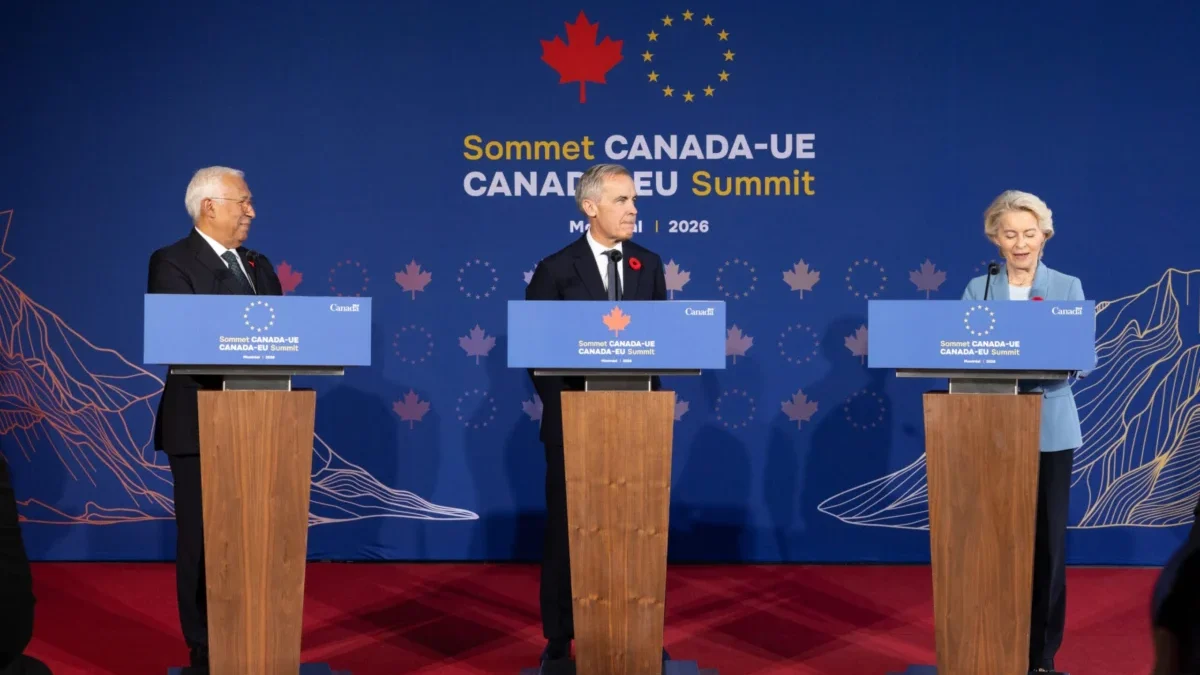
Canadian Prime Minister Mark Carney announced on Friday that Ottawa is on the precipice of a historic geopolitical shift, expecting to conclude negotiations by June that would designate Canada as the European Union’s first-ever associate member. This landmark move, finalized at the conclusion of a high-stakes two-day summit in Montreal, represents a fundamental restructuring of Canada’s international policy. By pivoting closer to the European bloc, Canada aims to insulate its economy and security framework from the volatility of shifting U.S. trade policies and global protectionism.
The decision to seek associate membership—a status that exists as a bridge between a standard free-trade partner and a full EU member—reflects a growing consensus among Western democratic powers that the established world order is undergoing a permanent transformation. The initiative, dubbed the Alliance for the Future, seeks to harmonize digital trade, integrate critical mineral supply chains, and bolster joint defense mechanisms, effectively creating a transatlantic economic bulwark.
A Chronology of the Strategic Pivot
The path to this alliance has been paved by years of mounting friction between traditional North American and European allies. The impetus for this acceleration can be traced back to the onset of the latest wave of U.S. trade protectionism.
- 2024: Heightened tensions regarding tariffs and trade barriers imposed by the United States prompt exploratory talks between Ottawa and Brussels.
- Early 2025: Canadian and European officials begin drafting a framework for the "Alliance for the Future," focusing on diversifying supply chains away from the North American dependence model.
- March 2026: A scheduled summit of Canadian Cabinet ministers and European commissioners is set to iron out the technical parameters of the association.
- June 2026: Prime Minister Carney is slated to attend the European Council meetings, where he intends to formally finalize the terms of the associate membership.
- 2027: The target date for the realization of an "ever-closer association," as codified in the joint declaration signed in Montreal.
Economic Realignment and Trade Diversification
The economic logic underpinning this alliance is rooted in the necessity of market diversification. As of 2025, the United States accounted for approximately 71.7% of Canada’s total merchandise exports. This concentration leaves the Canadian economy uniquely vulnerable to fluctuations in U.S. political sentiment and trade policy. Prime Minister Carney has set an ambitious goal: to double Canadian exports to non-U.S. partners over the next decade.
The newly signed agreements represent a significant step toward this goal. The conclusion of a comprehensive digital trade agreement will streamline cross-border data flows, drastically reducing the "red tape" currently hindering tech startups in cities like Vancouver from accessing European markets in Berlin or Paris.
Furthermore, the partnership with the European Investment Bank (EIB) to finance Canadian critical minerals—essential for the transition to green energy and advanced manufacturing—is a strategic move to secure the supply chains required for the 21st-century economy. By linking Canada’s vast mineral wealth with Europe’s industrial base, the alliance effectively creates a closed-loop system that reduces reliance on third-party powers.
Technological and Security Integration
Beyond trade, the alliance focuses on high-end technological collaboration. Canada’s entry into the European supercomputing initiative, including access to the JUPITER supercomputer, is expected to revolutionize Canadian research capabilities. Officials noted that the computational power offered by this partnership will allow for simulations and data processing in a single day that would otherwise require six months of work on current Canadian infrastructure.
Security cooperation is equally prioritized. The joint declaration highlights a new border security arrangement, alongside pledged cooperation on cybersecurity, Arctic sovereignty, and defense. Given the increasing strategic importance of the Arctic, both Canada and the EU are eager to establish a unified front against foreign interference and to protect shared interests in the northern maritime routes.
Official Perspectives and Diplomatic Friction
The announcement has not been without controversy. U.S. leadership has expressed skepticism, with President Donald Trump characterizing the proposed arrangement as a "hostile act" and hinting at potential retaliatory tariffs. This reaction has only served to solidify the resolve of the European and Canadian delegations.
European Commission President Ursula von der Leyen was resolute in her defense of the partnership. "What brings us together goes far beyond geography. We see the world through the same eyes," von der Leyen stated during the Montreal press conference. She emphasized that the "headwinds" of the current global order are not transitory, but represent a permanent shift in how sovereign nations must organize themselves to ensure economic prosperity and political stability.
Prime Minister Carney, when pressed on whether the alliance was an adversarial response to the United States, maintained a diplomatic stance. "It is not against anything, it’s for," Carney said. "It is about reinforcing sovereignty. Why? So we can live our lives as we choose, our people can live their lives as they choose and have the full freedoms that people enjoy in the European Union and in Canada."
The "Ever-Closer Association" Defined
While the term "associate membership" dominated the public narrative, the formal joint declaration uses the language of an "ever-closer association." European Council President António Costa clarified that the objective is to create a unique category of partnership that exceeds standard bilateral agreements but stops short of full, treaty-based EU membership. This allows Canada to retain its distinct legislative and constitutional identity while benefiting from the integration of the European single market.
The ambiguity regarding the final title of the relationship may stem from the complexities of EU law, which requires unanimous consent from all member states to create new formal statuses. Nevertheless, the political will for a deep integration appears to have broad support across the European Council.
Broader Implications for Global Stability
The shift toward a formal Canadian-EU association signals a potential fragmentation of the traditional post-WWII security architecture. If successful, this alliance could serve as a blueprint for other like-minded nations to form similar regional clusters. The feasibility studies currently underway regarding the export of Canadian liquefied natural gas (LNG) to Europe and the development of undersea communication cables connecting Canada, Europe, and Asia underscore the long-term intent to create a trans-continental infrastructure network.
Additionally, the expansion of the Erasmus+ student exchange program will facilitate a "brain circulation" between the two regions. By making it easier for young professionals and students to move across the Atlantic, the alliance aims to build long-term cultural and professional ties that will sustain the partnership for generations.
Future Outlook and Challenges
The months leading up to the June negotiations will be critical. The successful implementation of these agreements will require navigating complex regulatory differences, particularly in the realms of labor standards, environmental regulations, and data privacy.
Despite the threats of tariffs from Washington, the resolve expressed in Montreal suggests that both Ottawa and Brussels have calculated that the cost of inaction—remaining dependent on an unpredictable trade partner—is higher than the potential short-term economic friction. As the world moves toward a more multipolar order, the alliance between Canada and the European Union stands as a significant test case for whether middle powers can effectively pool their sovereignty to maintain autonomy in an age of giants.
The next year will be defined by the technical work of ministers and commissioners as they hammer out the details of what may ultimately be remembered as the most significant foreign policy realignment for Canada since the post-war era. Whether this leads to a new "Alliance for the Future" that expands to include other nations remains to be seen, but the intent is clear: to build a resilient, sovereign, and deeply integrated transatlantic community.