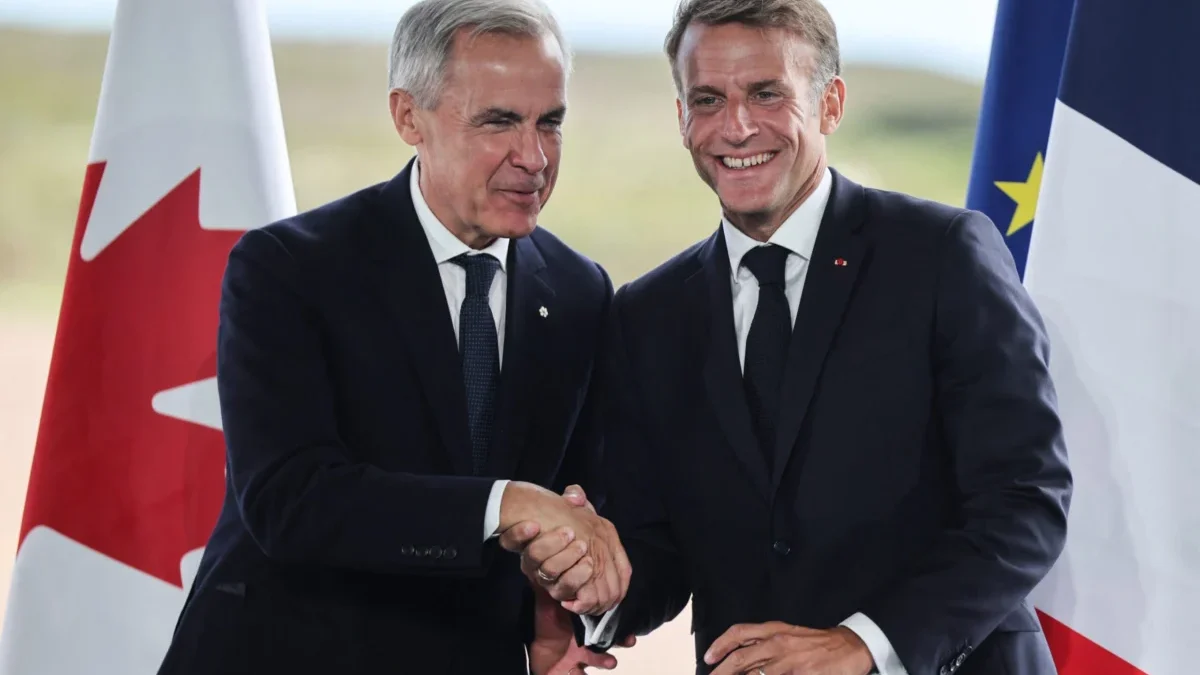
Canadian Prime Minister Mark Carney and French President Emmanuel Macron met on Sunday in the French territory of Saint-Pierre-et-Miquelon to formalize a sweeping expansion of bilateral cooperation across the domains of space, defense, energy, and emerging technology. The meeting marks a pivotal shift in Canadian foreign policy, as Ottawa seeks to insulate itself from the risks of over-dependence on the United States and move toward a more integrated role within the European economic and security architecture.
The summit, held off the coast of Newfoundland, serves as a cornerstone for what both leaders described as a new era of transatlantic resilience. For Canada, the partnership is a direct response to a period of unprecedented volatility in relations with the Trump administration, characterized by the imposition of trade tariffs, demands for economic concessions, and unconventional rhetoric regarding Canada’s political sovereignty.
A New Strategic Doctrine: The European Pivot
The meeting follows a high-stakes address by Prime Minister Carney, in which he formally embraced the potential for Canada to become the European Union’s first associate member. This proposal, while currently in its conceptual infancy, reflects a growing consensus in Ottawa that the traditional North American security and economic framework is facing structural challenges. By aligning more closely with European standards, regulatory frameworks, and security protocols, Canada aims to hedge against the threat of unilateral economic coercion.
"Canada and Europe will build an alliance for the future that will strengthen our collective resilience so we can live our lives as we choose based on the values that we share," Prime Minister Carney stated during the joint press engagement.
The strategy is viewed by analysts as a "diversification of dependencies." For decades, the Canadian economy has been inextricably linked to the United States, with approximately 75% of Canadian exports destined for its southern neighbor. The recent shift in Washington’s policy toward protectionism and nationalist economic agendas has prompted the Canadian government to identify Europe as the primary partner for long-term stability.
Defense and Space Infrastructure Integration
A significant outcome of the summit is the directive issued to both nations’ space agencies and defense ministries to synchronize their infrastructure. The agreement includes the collaborative development and sharing of launch systems and ground-based reception facilities, effectively merging portions of their aerospace capabilities.
This cooperation is particularly critical in the Arctic and North Atlantic regions, where monitoring capabilities are essential for both national security and environmental research. By pooling resources, Canada and France aim to enhance their maritime domain awareness and satellite coverage, sectors that have become increasingly vital as the geopolitical significance of the North Pole grows due to climate change and renewed competition from global powers.
Beyond space, the two nations have committed to joint ventures in telecommunications, climate resilience, and advanced technologies. The communique from the Prime Minister’s office highlighted specific cooperation in quantum computing and supercomputing, fields that are increasingly defined as "strategic assets" in the modern intelligence and economic landscape.
Energy Security Amidst Global Conflict
The meeting between Macron and Carney also addressed the urgent matter of global energy security. With the ongoing war in Iran causing significant disruptions to the global supply chain and fueling fears of volatile commodity pricing, France is looking to Canada to bolster its energy portfolio.
"Canada is a country with significant resources of critical minerals and rare earths," President Macron noted. "It is also a major oil and natural gas producer. What we want to do is conclude agreements to secure more liquefied natural gas (LNG) that can be shipped to Europe’s Atlantic coast."
France has been actively seeking to reduce its reliance on traditional energy suppliers as geopolitical tensions escalate. Canada, possessing one of the world’s largest proven reserves of oil and vast deposits of critical minerals—essential for the green energy transition and high-tech manufacturing—represents an ideal partner for the European market. The challenge remains the logistical infrastructure; both leaders discussed the technical feasibility of expanding LNG shipping lanes to ensure that Canadian exports can efficiently reach the European mainland.
The Greenland Factor: Regional Stability
The summit was underscored by the recent U.S. deal regarding Greenland, which permits an expanded American military presence on the island while maintaining nominal Danish sovereignty. President Macron, who has previously expressed concern regarding the shifting power dynamics in the Arctic, offered a cautious but measured response to the development.
"Danish sovereignty is being respected, international law is being respected," Macron said. "Anything that helps ease tensions is a good thing."
However, diplomatic observers note that the American move in Greenland has accelerated the desire among European powers and Canada to establish their own, more robust, presence in the North. The collaboration between Canada and France is seen as a way to ensure that the Arctic remains a space of international cooperation rather than a theater for unilateral military expansion.
Chronology of Recent Shifts
- Late 2024: President Trump initiates a new round of tariff threats and suggests the integration of Canada into the U.S. political structure, triggering a review of Canadian foreign policy.
- Early 2025: Prime Minister Carney delivers a speech advocating for Canada to pursue associate membership with the European Union, signaling a major shift in diplomatic strategy.
- Mid-2025: The U.S.-Greenland military deal is announced, further catalyzing the need for European-Canadian security coordination.
- Current Date: Prime Minister Carney and President Macron meet in Saint-Pierre-et-Miquelon to operationalize the new partnership.
Economic and Political Implications
The implications of this closer relationship are profound. For Canada, the partnership with France serves as a diplomatic firewall. By formalizing agreements in critical sectors, Canada effectively secures a "seat at the table" in European strategic planning, granting it a measure of influence in the EU’s regulatory and security decisions.
For France, the partnership provides a reliable, democratic source of energy and raw materials, as well as a key ally in the North American hemisphere. The agreement also serves as a subtle assertion of European autonomy. By fostering ties with Canada, France demonstrates that Europe is capable of building robust, independent alliances that do not require U.S. mediation.
However, the path forward is not without risks. Integrating defense and space infrastructure requires navigating complex legal and security hurdles. Furthermore, the economic shift toward Europe will require significant investment in transport and logistics infrastructure, which may take years to yield results.
Moreover, the domestic political landscape in both nations will be a factor. While both leaders have expressed a strong commitment to this pivot, future electoral outcomes in Canada and France could alter the trajectory of these agreements. Maintaining institutional continuity in the face of political change will be the primary challenge for the bureaucracies tasked with implementing these directives.
Conclusion: A Transatlantic Rebalancing
The meeting in Saint-Pierre-et-Miquelon marks the end of an era where Canada’s foreign policy could be viewed primarily through the lens of the U.S.-Canada relationship. As the world moves toward a more multipolar order, the strategic alignment between Ottawa and Paris suggests that Canada is no longer content to remain on the periphery of European affairs.
By prioritizing shared values, technological integration, and resource security, Carney and Macron are creating a blueprint for how mid-sized powers can navigate a period of global uncertainty. As the implementation of these agreements begins, the success of this alliance will likely be measured by the ability of both nations to translate high-level diplomatic pledges into tangible, long-term strategic assets. Whether this leads to a new, broader European-Canadian framework remains to be seen, but the intent is clear: to build a future defined by resilience, autonomy, and mutual support in an increasingly volatile global landscape.