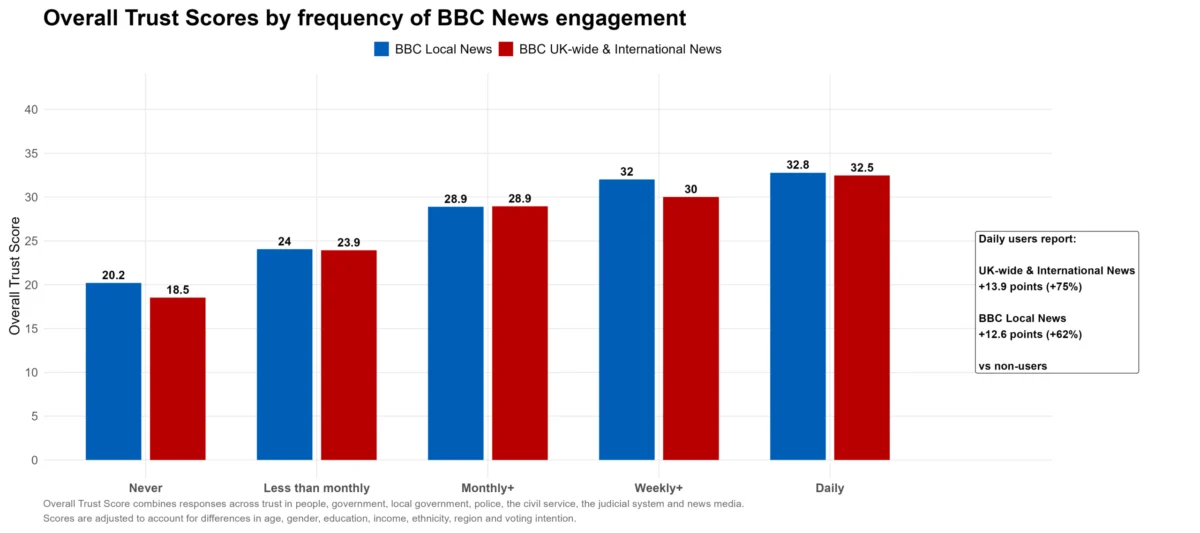
A newly published survey commissioned by the British Broadcasting Corporation reveals a striking correlation between the regular consumption of public service news and heightened levels of societal trust. According to the research, which surveyed 5,750 UK adults in January, individuals who engage with BBC News and BBC Local News daily report substantially greater confidence in both major public institutions and their fellow citizens compared to those who do not use these services.
The findings indicate that daily users of the BBC’s domestic and international news platforms record an overall trust score that is 75% higher than non-users. Meanwhile, consumers of BBC Local News demonstrated trust scores 62% higher than their non-consuming counterparts. The composite trust metric utilized in the survey evaluated broad public perceptions across several foundational pillars of civic life, including faith in government bodies, local authorities, the police, the civil service, the judicial system, and the wider news media landscape.
This quantitative boost in institutional confidence coincides with a period of profound operational restructuring and fiscal constraint within the corporation. In February, leadership announced aggressive cost-saving measures designed to strip £500 million from annual expenditures over a three-year window, representing roughly 10% of the broadcaster’s entire yearly budget. Despite these internal economic pressures, the newly released data underscores what proponents argue is the unique societal value delivered by publicly funded media infrastructure during an era of deep socio-political polarization.
Methodology And Statistical Insights
Conducted by London-based research consultancy Yonder Consulting—an organization with an established commercial background working alongside major enterprises such as Marks & Spencer and Vodafone—the survey employed a rigorous zero-to-one-hundred scoring scale. This quantitative framework enabled researchers to compute nuanced average scores, facilitating direct comparisons between regular BBC consumers and non-consumers across a diverse suite of demographic metrics.
Beyond institutional trust, the study investigated indicators of social cohesion, including individual senses of belonging, social inclusion, community representation, and interpersonal connectivity. Daily users of BBC News reported a 15% higher social cohesion score relative to non-users, while daily consumers of BBC Local News recorded a 16% advantage in this domain.

The localized data proved even more pronounced regarding community-focused benchmarks. Daily consumers of regional and hyper-local BBC programming exhibited a 29% increase in local community engagement and a 23% increase in perceived local community connection when compared against individuals who bypass these services.
Crucially, the BBC has noted that these statistical relationships should not be interpreted as definitive proof of direct causation; the data does not conclusively prove that consuming public service journalism unilaterally causes individuals to develop higher baseline trust or social cohesion. Nevertheless, analysts confirmed that many of the identified correlations maintained strong statistical significance even after controlling for various demographic and political variables.
Leadership Perspectives And The Value Of Public Service Broadcasting
Rachel Jupp, the director of BBC News and Current Affairs, emphasized the broader implications of the findings during a statement to media industry observers. In an environment marked by declining public confidence in mainstream media and democratic frameworks alike, Jupp argued that the research validates the core mission of public service broadcasting.
At a time when trust is under pressure in the UK, this research highlights the important role the BBC can play in bringing people together in an increasingly fragmented world, Jupp stated. As one of the UK’s most-used public institutions, we are proud to serve audiences with trusted and impartial news and content that helps people understand each other and the world around them. These findings demonstrate the value of a strong public service broadcaster that serves all audiences and acts in the public interest.
The survey findings also explored wider metrics including civic participation, perceptions of the BBC’s ultimate societal contributions, distinct media consumption habits, and general well-being indicators. By mapping these variables against demographic realities, the broadcaster sought to capture a holistic snapshot of how media consumption patterns intersect with modern British civic life.
Internal Restructuring And Contradictory Pressures On Local Journalism

The publication of these positive trust metrics occurs against a complex and frequently turbulent backdrop for the broadcaster’s workforce, particularly within regional and local divisions. While the survey data explicitly highlights the immense social value generated by BBC Local News, the corporation is simultaneously implementing deep structural cutbacks that threaten the very fabric of its regional reporting apparatus.
In September, the BBC confirmed plans to eliminate approximately 90 jobs from its local radio and regional television newsrooms as part of a targeted initiative to shave £9.1 million from the BBC Local budget. Furthermore, leadership warned that headcount within the broader Nations division must be reduced by roughly 250 full-time equivalent posts by the 2027/28 financial year, yielding an additional £33 million in necessary savings. These rolling reductions have sparked widespread anxiety among media unions, frontline journalists, and regional audiences who rely on hyper-local bulletins for civic accountability.
The BBC’s simultaneous championing of its local news output and its implementation of deep staffing cuts has drawn intense scrutiny from commercial competitors. Over recent years, major regional publishers have openly criticized the broadcaster’s digital expansion strategy. Executives from publishing giants like Reach plc have previously condemned what they characterize as an aggressive expansion into local digital news markets, accusing the corporation of scraping and republishing original local reporting without adequate attribution or credit.
Manchester Evening News editor Sarah Lester has similarly voiced concerns regarding the perceived competitive distortion introduced by the publicly funded broadcaster’s online operations, arguing that such practices threaten the fragile economic viability of independent and commercial local press outlets across the United Kingdom.
Broader Implications For The Media Landscape
The juxtaposition between the new trust research and the reality of ongoing regional job cuts highlights a central paradox facing modern public service media. On one hand, empirical evidence compiled by independent consultants demonstrates that robust, accessible news services heavily correlate with enhanced social cohesion, community engagement, and institutional trust. On the other hand, shrinking funding settlements, inflationary pressures, and the migration of advertising revenue to major technology platforms continue to force painful contractions in newsrooms across the country.
As policymakers, media regulators, and BBC executives debate the future funding model of the corporation ahead of upcoming charter reviews, the tension between maintaining expansive regional footprints and achieving necessary fiscal efficiencies will remain a focal point of public discourse. Whether the demonstrated societal benefits of public service journalism will translate into increased political and financial protection for the BBC’s local networks remains an open question for media analysts and lawmakers alike.