The midterm elections have triggered a significant political realignment and a subsequent confrontation between former President Donald Trump and Fox News, the network that has long served as the primary media conduit for the American conservative base. Following a disappointing night for the Republican Party in this week’s midterm cycle, Trump utilized his Truth Social platform to cast blame on the network, alleging that its editorial decisions—specifically the allocation of airtime to Democratic candidates—contributed directly to the party’s electoral setbacks. This public rebuke was punctuated by a late-night appearance on the network’s live broadcast, where the former president intensified his critique, specifically targeting the accuracy and methodology of the outlet’s polling operations.
The tension between the former president and the network is not a novel development, but its timing follows a period of shifting media consumption habits. Fox News has reported a decline in viewership throughout October, a trend that the network’s leadership, including CEO Lachlan Murdoch, has characterized as a form of broad "viewer fatigue" within the political news landscape. Conversely, the former president has framed these declining figures as a referendum on the network’s editorial integrity and its perceived lack of loyalty to the Republican platform.
A Legacy of Conservative Dominance and Shifting Allegiances
To understand the weight of this public rift, one must examine the unique position Fox News has held within the American electorate. For decades, the network has functioned as a central pillar of Republican information consumption. Data from the Pew Research Center’s 2025 news media tracker illustrates this dominance: 57% of Republicans and GOP-leaning independents identified Fox News as a regular source of information, a figure that eclipsed any other media outlet by a margin of 30 percentage points.
Leading up to the 2024 presidential cycle, that influence reached even higher levels, with 69% of Republicans citing the network as a major or minor source of their political and election-related information. This symbiotic relationship, however, has become increasingly strained as the Republican Party navigates the post-midterm political landscape. When a network serves as the primary news source for nearly seven-in-ten members of a political party, any perceived deviation from the party’s preferred narrative—or any failure to deliver electoral wins—inevitably leads to high-stakes tension between political leaders and media executives.
Chronology of the 2026 Midterm Media Conflict
The current friction represents the culmination of several months of deteriorating relations between the Trump camp and the Murdoch-owned network.
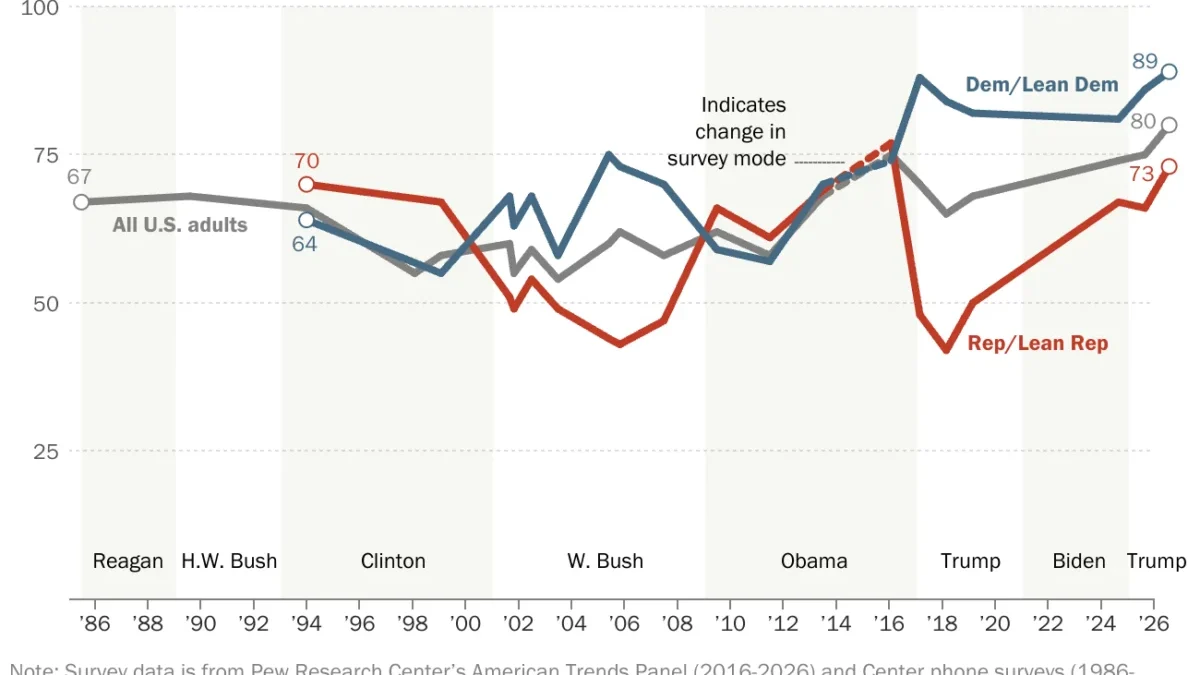
- August 2026: Public trust in the watchdog role of the media reaches a notable inflection point, as surveys show 80% of U.S. adults believe that news organization criticism is essential to preventing political overreach.
- September 2026: The Pew-Knight Initiative releases findings suggesting a deep-seated public anxiety regarding corporate and political influence in media, with 54% of Americans believing that corporate and financial interests exercise "a great deal" of control over news output.
- October 2026: Fox News reports a consistent decline in viewership metrics. Management cites general market fatigue, while external critics—including the former president’s inner circle—begin to point to programming choices as the culprit.
- Tuesday, November 3, 2026: The midterm elections conclude with the Democratic Party securing control of both the House and the Senate.
- Wednesday, November 4, 2026: President Trump issues a formal statement on Truth Social accusing Fox News of being complicit in the GOP’s losses.
- Midnight, November 4, 2026: Trump appears in a live interview on Fox News to explicitly challenge the validity of the network’s internal polling, which had previously projected different outcomes than the final results.
Public Trust and the Watchdog Role
Despite the vitriol between specific political figures and the media, a broader analysis of public sentiment reveals a paradox. While political figures may be attacking news organizations, the American public is becoming increasingly reliant on them. According to a November 2026 survey by the Pew Research Center, trust in national news organizations has risen to 62%, up from 56% in 2025. Local news has seen an even more robust increase, with 75% of Americans expressing trust in their local outlets, compared to 70% the previous year.
This increase in trust spans the partisan divide. While Democrats remain significantly more likely to trust media institutions than Republicans, the uptick in trust among both groups suggests that the electorate is increasingly looking to established news organizations for verification in a post-election environment. Furthermore, the perception of the media as a "watchdog" has reached a new peak. Eight-in-ten U.S. adults now agree that criticism from news organizations serves a vital function in keeping political leaders in check. Notably, the share of Republicans who subscribe to this view has risen from 67% in 2024 to 73% in 2026, marking a departure from the historical trend where support for media oversight typically dips after a party gains power.
Legislative Implications and Future Investigations
As the dust settles from the midterms, the shift in power within the House and Senate is expected to bring the media industry under a microscope. Legislative reports indicate that the new Democratic majority is already contemplating a series of investigations into the relationship between the Trump administration and various media conglomerates.
The scope of these potential inquiries is broad. Legislative staff are reportedly eyeing the government’s role in high-profile media mergers and the sale of significant communication platforms, including Paramount and TikTok. Additionally, the Federal Communications Commission (FCC) may face rigorous oversight regarding its criteria for the renewal of broadcast licenses. This move suggests that the battle between political figures and media companies will move from the arena of public rhetoric to the halls of Congress, where subpoena power and regulatory authority could force a shift in how news organizations operate.
Analysis of Corporate and Political Influence
The skepticism toward media is not limited to the rhetoric of political leaders. The American public possesses a sophisticated, albeit cynical, understanding of the pressures acting upon news organizations. Data collected in June 2026 by the Pew-Knight Initiative highlights that nearly half of the public (49%) believes that news outlets are influenced "a great deal" by government and political interests.
This sentiment serves as the backdrop for the current conflict. When a figure as influential as Donald Trump characterizes a network’s coverage as being driven by political bias, it resonates with a public that is already primed to believe that news is not objective, but rather a product of external influence. The "viewer fatigue" identified by Lachlan Murdoch may, therefore, be less about the content itself and more about a exhaustion with the constant interplay between politics and journalism.
The Path Forward
The impact of this latest confrontation remains to be seen, but the structural implications are clear. Fox News is currently attempting to balance its legacy as a conservative-leaning institution with the shifting demands of a fractured electorate. Meanwhile, the incoming Congress is signaling that it intends to use its oversight authority to scrutinize the power dynamics within the media landscape.
For the average American, the current environment presents a complex information ecosystem. While the public is increasingly turning to news organizations to hold their leaders accountable, they are simultaneously becoming more skeptical of the institutions themselves. The discord between the former president and the network that helped define his political rise is merely one symptom of a broader, systemic tension. As the 2026 political calendar winds down and the legislative session approaches, the role of the press as both a watchdog and a political participant will continue to be a subject of intense debate, oversight, and public scrutiny. The challenge for news organizations in the coming months will be to navigate these political pressures while maintaining the public trust that, despite the volatility, appears to be on a gradual, steady incline.