The enterprise software landscape is undergoing a significant structural evolution. According to recent data from market research firm Forrester, 81 percent of business-to-consumer (B2C) marketing executives planned to comprehensively evaluate their social software suites heading into recent operational cycles. This widespread reassessment is primarily driven by the escalating costs and elongated deployment timelines associated with legacy, highly modular platforms.

Chief among the platforms under scrutiny is Sprinklr. Long established as a dominant unified customer experience management (Unified-CXM) system, Sprinklr combines social media management with advertising, marketing, research, and agent-based customer care. Built primarily for massive global organizations operating multiple brands across diverse geographic regions, Sprinklr offers unprecedented breadth. However, this vast scope has increasingly become a double-edged sword. Enterprise buyers frequently report that the platform’s opaque pricing models, lengthy implementation phases—often stretching across multiple quarters—and modular contract structures force them to pay for heavy enterprise infrastructure they do not fully utilize.
As enterprises seek agile, cost-effective solutions that do not compromise on security, governance, or analytical depth, a diverse ecosystem of competitors has emerged. Evaluating these alternatives requires examining how well they balance robust enterprise features with rapid deployment and transparent value.

Understanding the Sprinklr Value Proposition and Its Limitations
To understand why organizations are actively seeking alternatives, one must examine what Sprinklr offers and where the friction occurs. Sprinklr’s architecture is designed to unify disparate customer-facing departments under a single administrative umbrella. Its core modules include automated publishing and scheduling, advanced social listening, paid social advertising campaigns, customer service queues, and robust analytics layered with artificial intelligence for sentiment analysis and message routing.
The barriers to adoption, however, are substantial. Sprinklr does not publish standardized pricing tiers. Instead, it relies on a traditional enterprise sales cycle involving custom quotes, modular add-ons, and mandatory professional services for implementation. For mid-market companies or even large enterprises whose primary requirements are social publishing, listening, and community management, deploying Sprinklr often feels disproportionately complex. Organizations find themselves locked into expensive multi-year contracts that demand dedicated technical resources just to maintain basic workflows.
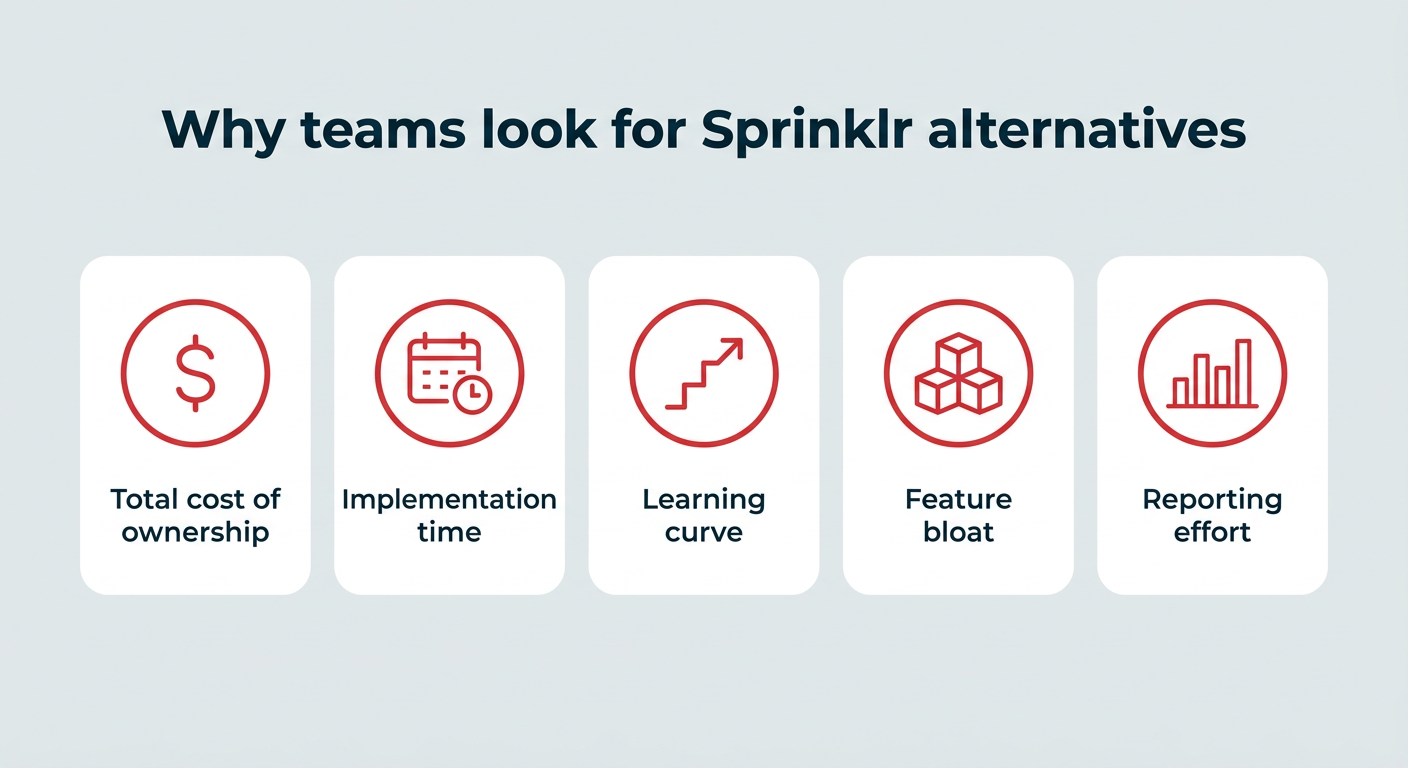
Consequently, procurement teams and marketing leaders are looking toward platforms that deliver enterprise-grade governance and intelligence without the associated deployment bottlenecks.
Comprehensive Evaluation of Top Sprinklr Alternatives
The market for social media management and intelligence tools is segmented by use case, ranging from all-inclusive social operating systems to specialized listening and PR platforms.

1. Hootsuite
Positioned as a comprehensive social operating system, Hootsuite bridges the gap between intelligence and execution. Unlike platforms that separate listening from publishing, Hootsuite’s architecture—incorporating tools like Lumen for insights, Perch and Nest for engagement, and Vigil for governance—allows teams to act on data within a single dashboard.
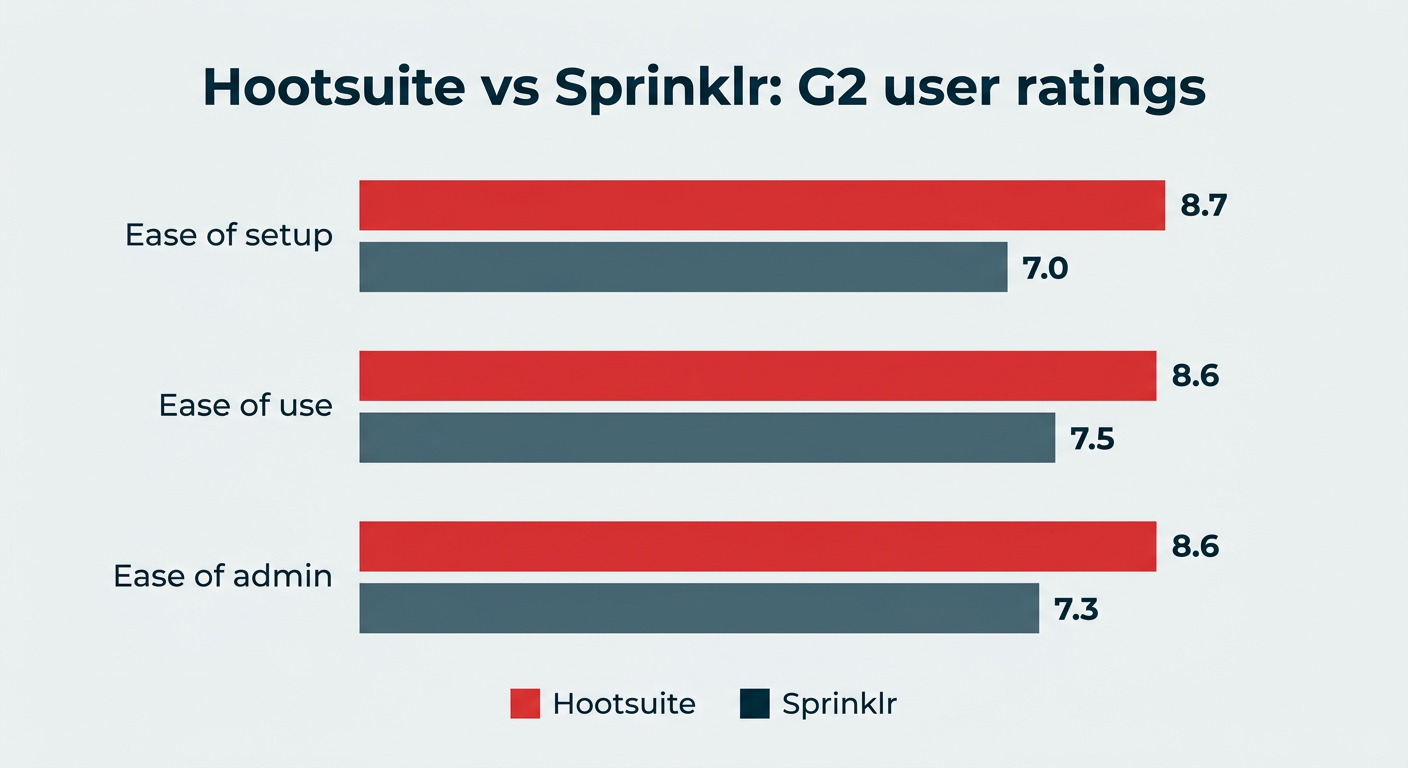
For enterprise buyers, Hootsuite’s primary competitive advantage is its time-to-value. While Sprinklr implementations can take months, Hootsuite integrates rapidly with existing enterprise software stacks, including Salesforce, Adobe, and Microsoft. User feedback aggregated on review platforms like G2 consistently rates Hootsuite higher than Sprinklr in ease of setup, administrative usability, and overall user adoption rates. Starting at $99 per user per month, it provides an scalable entry point for organizations requiring robust security workflows without excessive overhead.
2. Meltwater
For organizations where public relations, earned media, and brand monitoring take precedence over day-to-day social publishing, Meltwater remains a leading contender. Meltwater excels by combining traditional media intelligence—such as press and broadcast tracking—with social media monitoring under a single subscription.
While its publishing and inbox management features are comparatively lighter than dedicated social suites, its ability to aggregate earned and social media mentions into unified executive dashboards makes it indispensable for corporate communications teams. Pricing is customized based on data volume and user seats.

3. Brandwatch
Brandwatch serves as a powerful alternative for research-heavy and consumer-insights teams. Rather than focusing primarily on content scheduling, Brandwatch specializes in deep social listening, sentiment analysis, trend spotting, and audience segmentation.
Enterprise research divisions utilize Brandwatch to analyze millions of online conversations and track shifting consumer narratives over time. While it often requires pairing with a separate publishing tool for day-to-day community management, its analytical depth makes it a premier choice for data-driven organizations.

4. Sprout Social
Sprout Social is widely recognized for its polished user interface, intuitive navigation, and presentation-ready reporting. Positioned as a streamlined alternative to Sprinklr, Sprout offers robust publishing, engagement, and customer care tools that require minimal training to master.
The platform’s trade-off lies in its pricing model and modular limitations. Sprout utilizes per-user pricing, meaning subscription costs scale directly with team size, and advanced features such as social listening are structured as paid add-ons.

5. Khoros
Khoros approaches enterprise social management through the lens of digital customer care and online community building. Rather than spreading its capabilities evenly across advertising and marketing, Khoros concentrates heavily on agent-based social support, secure messaging, and branded peer-to-peer forums.
This narrow focus makes Khoros a primary shortlist candidate for heavily regulated, support-intensive sectors such as telecommunications, financial services, and consumer technology, though marketing-centric teams may find its interface overly specialized.

6. Emplifi
Formerly known as Socialbakers, Emplifi bridges the gap between social media marketing, customer care, and social commerce. Its distinctive capability lies in its integration of shoppable content features and influencer management alongside standard publishing and analytics workflows. Retail and direct-to-consumer brands benefit most from this setup, though organizations focused strictly on deep listening or rigid corporate governance may prefer alternative architectures.
7. Zoho Social, Buffer, and Later
For smaller businesses, lean marketing teams, and individual creators, platforms like Zoho Social, Buffer, and Later provide cost-effective entry points. Zoho Social offers deep integration with the broader Zoho CRM ecosystem starting at accessible monthly price points. Buffer focuses on simplicity and low-cost multi-channel scheduling, while Later prioritizes visual drag-and-drop planning for Instagram-heavy and creator-led businesses. However, none of these platforms offer the enterprise governance, audit trails, or multi-region security controls required by large corporations.

8. HubSpot
HubSpot’s Marketing Hub serves enterprises deeply embedded in the HubSpot CRM ecosystem. By tying social media scheduling directly into CRM data, marketing teams can track social interactions alongside email campaigns and lead generation workflows. While its social tools lack the deep listening and advanced queue management found in dedicated platforms, its unified data approach makes it highly efficient for inbound marketing teams.
Comparative Feature Analysis
When assessing these platforms against enterprise requirements, distinctions emerge across core operational pillars:

- Publishing and Scheduling: Hootsuite, Sprout Social, and Emplifi offer comprehensive multi-network publishing suites, whereas listening-first tools like Brandwatch and Meltwater maintain limited publishing capabilities.
- Social Listening: Brandwatch and Meltwater lead in raw intelligence depth, while Hootsuite embeds listening directly into its operational workflows. Sprout Social offers listening as an expanded tier.
- Customer Care: Khoros and Hootsuite provide advanced agent routing and shared inbox management capable of handling high-volume consumer inquiries.
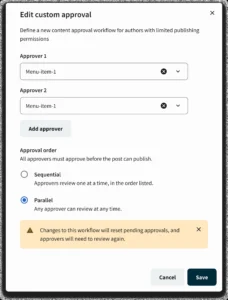
- Governance and Compliance: Enterprise buyers must prioritize platforms offering granular permission settings, automated approval workflows, and audit logs. Hootsuite and Khoros excel in this category, whereas SMB tools generally omit these controls.
Strategic Framework for Selecting an Enterprise Social Partner
Choosing the right alternative to Sprinklr requires a methodical internal assessment prior to engaging vendors for software demonstrations. Organizations should evaluate their strategy through three primary lenses:
- Audit Workflow Dependencies: Determine whether your team genuinely utilizes cross-departmental features like paid advertising and market research within Sprinklr, or if daily operations are largely confined to publishing, listening, and community management.
- Calculate Total Cost of Ownership: Factor in not just the software licensing fees, but also implementation timelines, professional service costs, and the internal labor required to maintain the platform.
- Prioritize Usability and Adoption: High software abandonment rates often stem from overly complex interfaces. Selecting a platform with high user adoption reduces onboarding friction and accelerates campaign execution.
Ultimately, while Sprinklr remains a viable option for massive multinational conglomerates with vast IT budgets, the modern enterprise social market offers agile, secure, and deeply integrated alternatives. Platforms like Hootsuite provide the necessary scale, artificial intelligence integration, and governance controls required by modern marketing leaders, achieving enterprise-grade outcomes without the prohibitive deployment costs of legacy systems.