The digital marketing landscape is undergoing its most profound structural shift since the advent of search engine optimization. As millions of consumers pivot from traditional search engines to conversational artificial intelligence interfaces like OpenAI’s ChatGPT, Perplexity, and Google’s Gemini, the way digital visibility is earned and measured has drastically changed. Instead of browsing a traditional index of blue links, modern users increasingly rely on answer engines that synthesize complex information into a single, cohesive response. This zero-click reality means that a brand’s hard-earned search visibility can quietly vanish into an automated summary, never registering as a traditional website click. To combat this hidden erosion of traffic, digital strategists are adopting a new class of enterprise software known as Answer Engine Optimization (AEO) checkers.
Understanding the Mechanics of Answer Engine Optimization
Answer Engine Optimization is defined as the deliberate practice of improving how frequently and how accurately a brand is cited, referenced, and represented within AI-generated responses. While traditional SEO focuses on securing high rankings within a list of indexed web pages, AEO operates on a fundamentally different paradigm. It targets the underlying semantic and entity-based structures that large language models (LLMs) use to build their summaries.
![AEO checker tools that measure answer engine visibility [2026]](https://53.fs1.hubspotusercontent-na1.net/hubfs/53/aeo-checker-1-20260903-3858273.webp)
The two strategies are complementary rather than competing. Foundational SEO principles—such as robust site crawlability, technical health, clear information architecture, and high domain authority—supply the underlying signals that answer engines rely on when selecting authoritative sources to cite. However, an optimized page that ranks number one in a traditional results page may still be entirely ignored by an AI model if its content is not structured for direct extraction or if its entity relationships are poorly defined.
The evolution accelerated significantly in May 2024 when Google integrated AI Overviews directly into its main search results, establishing a summary-first framework for mainstream users. By synthesizing multi-source data directly at the top of the page, Google and competing conversational platforms changed consumer behavior permanently. Users frequently resolve their intent directly within the search results page or chat window, leaving website owners to figure out how to measure visibility in an environment where traditional click-through rates no longer tell the full story.
What an AEO Checker Does
To manage this complex visibility puzzle, organizations deploy AEO checkers. These analytical tools function as automated auditors for the generative web. A comprehensive AEO checker measures brand visibility across multiple generative platforms, diagnosing where a brand is successfully cited, where competitors are winning the recommendation, and where an AI model is misinterpreting brand data or propagating factual errors.
![AEO checker tools that measure answer engine visibility [2026]](https://no-cache.hubspot.com/cta/default/53/9dd5e54b-fbef-4dd0-bc44-1689feb1ea18.png)
An effective AEO checker typically evaluates several critical parameters: citation frequency, sentiment analysis around brand mentions, content gap analysis, and the accuracy of structured data schemas. Once these metrics are gathered, the software generates prioritized recommendations, flagging specific content updates, schema corrections, and entity enhancements designed to increase the likelihood of being cited by LLMs.
Evaluating Manual Versus Automated Tracking Methods
While enterprise software provides automated scale, digital marketing teams often begin their AEO journey through manual spot-checking across major platforms like Google AI Overviews, ChatGPT, and Perplexity.
For Google AI Overviews, manual auditing involves defining a core set of priority queries—including brand terms, product categories, and high-intent informational questions—and executing them in incognito sessions. Because AI Overviews only appear when Google’s algorithms determine that a summary adds distinct value to a traditional search, results vary dynamically between sessions. Analysts must record whether an overview appears, whether their domain is included in the inline citation links, and the exact claims made by the model.
![AEO checker tools that measure answer engine visibility [2026]](https://53.fs1.hubspotusercontent-na1.net/hubfs/53/aeo-checker-2-20260903-852936.webp)
Similarly, auditing conversational platforms like ChatGPT and Perplexity requires evaluating both brand mentions and explicit citations. Perplexity automatically appends inline citations and maintains a dedicated source panel for every response, whereas ChatGPT utilizes web-search capabilities dynamically based on query intent. Because LLM outputs are inherently probabilistic, a single manual check provides limited reliability. Digital teams must run standardized prompts across multiple fresh sessions to establish a dependable baseline of visibility.
The Ecosystem of AEO Checking Tools
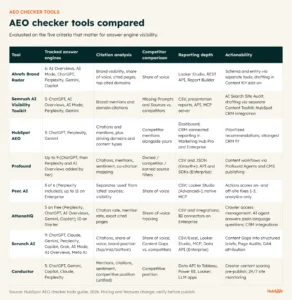
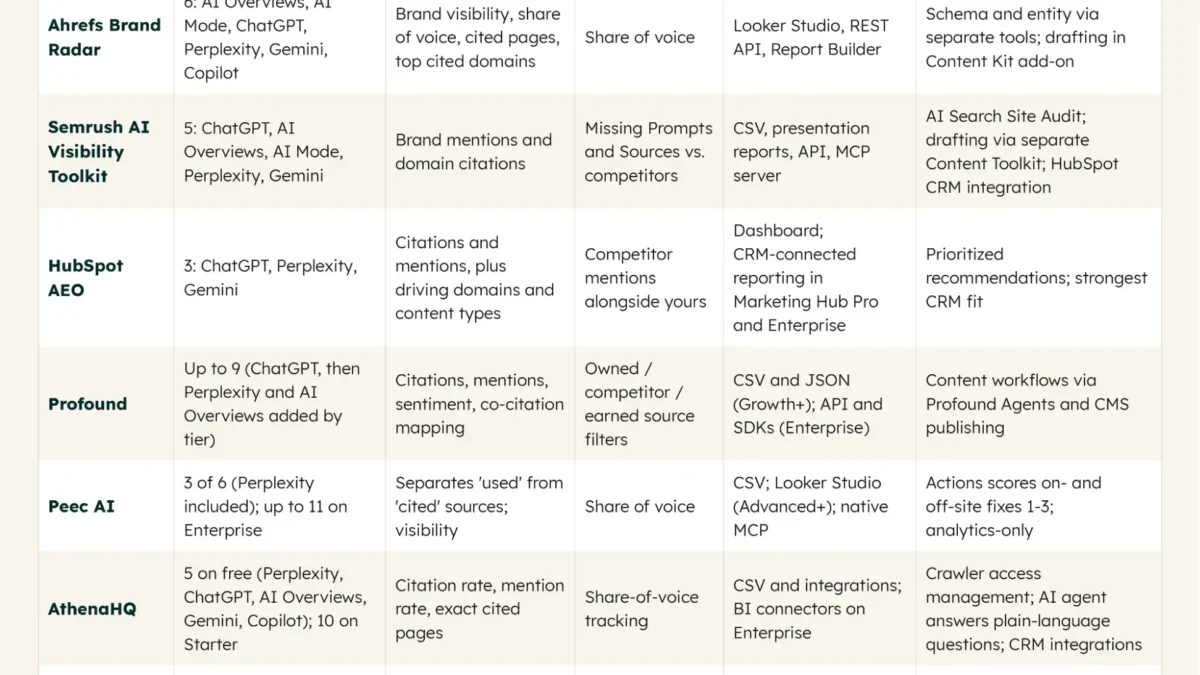
Recognizing the limitations of manual sampling, the software market has rapidly introduced specialized AEO tools tailored to different aspects of generative visibility. Brand-tracking platforms have evolved to meet this demand through several distinct categories:
Tools specializing in AI Overviews tracking, such as Ahrefs Brand Radar and the Semrush AI Visibility Toolkit, leverage massive search indices to cross-reference organic keyword rankings with generative features. These platforms help organizations identify which pages are on the cusp of inclusion, allowing marketing teams to optimize near-miss content.
![AEO checker tools that measure answer engine visibility [2026]](https://53.fs1.hubspotusercontent-na1.net/hubfs/53/aeo-checker-3-20260903-8904553.webp)
For dedicated citation detection in conversational environments, tools like HubSpot AEO and Profound provide granular analytics. HubSpot AEO tracks both explicit citations and unlinked brand mentions, mapping out the specific domains and content types driving visibility. Profound expands on this by incorporating sentiment scoring, uncited prompt flagging, and a detailed breakdown of citations across owned, earned, and competitor channels.
Perplexity-specific monitoring tools, including Peec AI and AthenaHQ, offer targeted analytics for platforms where citation links are a core component of the user interface. Meanwhile, technical readiness platforms like Scrunch AI and Conductor focus on the foundational infrastructure required for AI crawlers, auditing page rendering capabilities, schema markup, and entity relationships to ensure that web content remains easily parseable by automated systems.
Key Metrics That Define AEO Success
As organizations integrate AEO checkers into their daily workflows, traditional metrics must be updated to reflect the realities of zero-click search environments. Modern digital strategists monitor several core indicators to gauge the health of their generative visibility:
![AEO checker tools that measure answer engine visibility [2026]](https://53.fs1.hubspotusercontent-na1.net/hubfs/53/aeo-checker-4-20260903-6212698.webp)
- Citation Share: The percentage of relevant queries in which a brand’s domain is explicitly cited as a source by an AI engine compared to its competitors.
- Mention Sentiment: The qualitative tone of unlinked brand references within generative summaries, ensuring the brand is portrayed accurately and favorably.
- Content Gap Ratio: The frequency with which competitor domains are cited for high-value informational prompts where the target brand is conspicuously absent.
- AI-Referred Traffic and Pipeline Attribution: Tracking the downstream impact of users who do click through generative citations, connecting modern CRM data directly to AI-driven discovery.
Because generative visibility fluctuates based on model updates, prompt phrasing, and real-time web retrieval, marketers are advised to track these metrics as multi-week trends rather than reacting to isolated daily readings.
Implications for the Future of Digital Strategy
The proliferation of answer engines marks a permanent maturation point in digital information retrieval. As artificial intelligence models take on a greater share of consumer decision-making, the battleground for brand awareness has moved upstream from search engine results pages directly into the reasoning engines of LLMs.
Organizations that fail to adapt their measurement strategies risk operating blindly in an era where traditional analytics packages capture only a fraction of their true market visibility. By combining continuous automated AEO monitoring with rigorous technical optimization and CRM-connected attribution, modern businesses can ensure they remain visible, authoritative, and trusted in the rapidly evolving landscape of generative search.