The modern digital discovery landscape has undergone a profound structural shift. For decades, online visibility was dictated by a familiar blueprint: a user typed a query into a search engine, scanned a list of blue links, and clicked through to a website. Today, that paradigm is rapidly dissolving. Platforms such as ChatGPT, Perplexity, Gemini, and Google’s AI Overviews increasingly resolve a user’s intent directly on the results page or conversational interface. By synthesizing vast troves of information into a single, cohesive answer, these answer engines frequently render traditional website clicks obsolete. Consequently, brand visibility that once translated into predictable traffic can now vanish entirely into an AI-generated response that marketers rarely see.
This transformation has given rise to a vital new discipline known as Answer Engine Optimization, or AEO. Unlike traditional Search Engine Optimization (SEO), which aims to secure a high ranking within a directory of web links, AEO focuses on ensuring a brand is explicitly mentioned, cited, and accurately represented within the synthesized text of AI responses. To navigate this zero-click ecosystem, digital marketers are turning to specialized diagnostic instruments known as AEO checkers. These tools measure brand visibility across conversational models, identify content gaps, and track how artificial intelligence models perceive and relay corporate data.
![AEO checker tools that measure answer engine visibility [2026]](https://53.fs1.hubspotusercontent-na1.net/hubfs/53/aeo-checker-1-20260903-3858273.webp)
The Evolution of Search: From Keyword Rankings to Conversational Synthesis
The genesis of this shift traces back to the rapid commercialization and adoption of generative artificial intelligence models. While search engines historically acted as routing mechanisms, directing human traffic to secondary publishers, contemporary platforms act as direct arbiters of information. In May 2024, Google introduced AI Overviews to its primary search architecture, permanently altering how informational queries are handled by prioritizing summaries over raw directory listings.
This behavioral evolution created a pressing operational challenge for brand managers and digital strategists. When a potential buyer asks ChatGPT to evaluate the best software for a specific enterprise use case, or queries Perplexity for specialized industry insights, the platform delivers a comprehensive narrative. If a brand is absent from that narrative—or worse, if the AI misrepresents its features—the company loses prospective revenue without ever knowing it was in the running.
Industry analysts emphasize that SEO and AEO are not mutually exclusive, but rather complementary halves of a modern discovery strategy. Traditional SEO builds the technical foundation, crawlability, and domain authority that AI engines rely upon to evaluate trustworthiness. AEO, conversely, optimizes the structured data, direct phrasing, and primary-source citations necessary for an algorithm to parse a brand’s authority and integrate it into a conversational reply.
![AEO checker tools that measure answer engine visibility [2026]](https://no-cache.hubspot.com/cta/default/53/9dd5e54b-fbef-4dd0-bc44-1689feb1ea18.png)
Understanding the Mechanics of an AEO Checker
As manual spot-checking across multiple AI interfaces quickly proves unsustainable at scale, automated AEO checking software has emerged as an essential component of the marketing technology stack. A sophisticated AEO checker evaluates several critical dimensions of digital presence:
- Citation Tracking: It monitors whether an engine actively links back to a brand’s domain within an AI-generated response.
- Brand Mentions: It detects instances where a company is referenced by name within the text, even when a direct hyperlink is absent.
- Competitor Benchmarking: It identifies which rival companies are capturing market share for high-intent queries and analyzes the source material supporting those competitors.
- Sentiment and Accuracy Analysis: It flags instances where an artificial intelligence model mischaracterizes product specifications, pricing, or corporate positioning.
- Content Gap Diagnostics: It translates visibility shortfalls into actionable recommendations, guiding content updates, schema corrections, and entity optimizations.
By continuously logging this data, these platforms replace volatile, single-session manual lookups with longitudinal visibility metrics.
Landscape of AEO Tools: A Comparative Overview
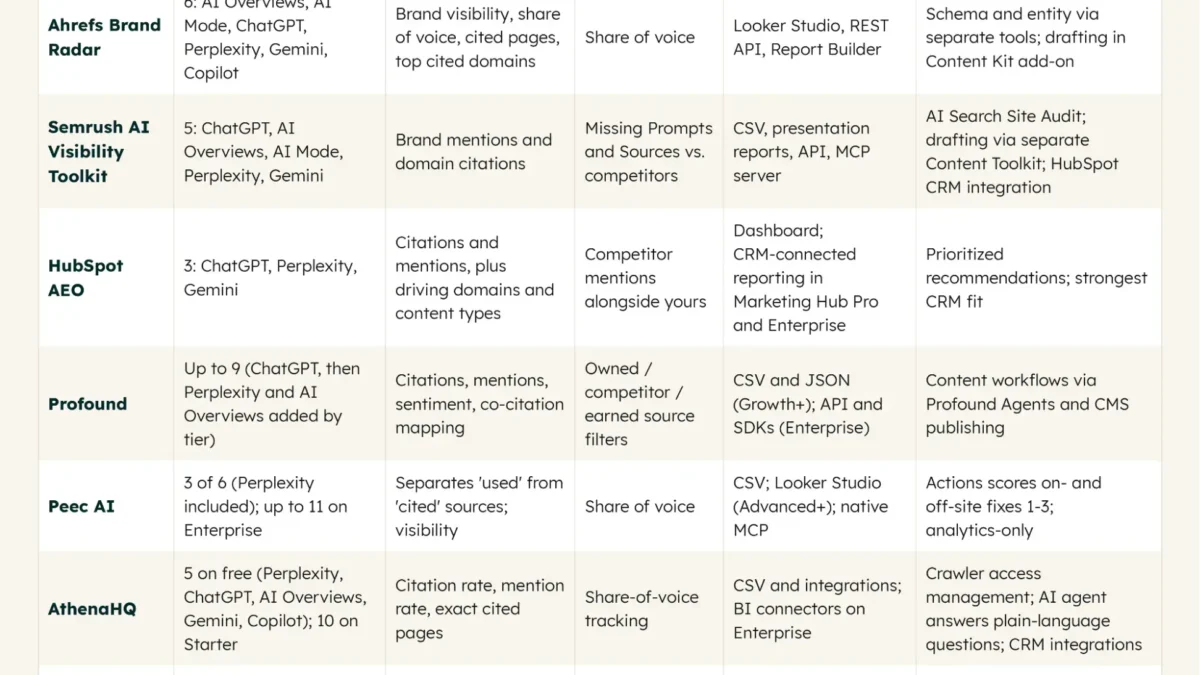
The software market has responded rapidly to the demand for conversational visibility tracking, resulting in a diverse ecosystem of specialized checkers and enterprise toolkits.
![AEO checker tools that measure answer engine visibility [2026]](https://53.fs1.hubspotusercontent-na1.net/hubfs/53/aeo-checker-2-20260903-852936.webp)
Tools equipped with AI Overviews Tracking, such as Ahrefs Brand Radar and the Semrush AI Visibility Toolkit, leverage extensive organic search indices to correlate traditional keyword rankings with AI Overview triggers. This integration allows SEO professionals to pinpoint which of their existing high-ranking pages are on the verge of inclusion in Google’s summary boxes.
For deep monitoring of conversational models like ChatGPT, platforms such as HubSpot AEO and Profound offer granular analytical capabilities. HubSpot AEO tracks both citations and unlinked brand mentions, synthesizing visibility data into prioritized content workflows. Meanwhile, Profound evaluates the broader context of citations, incorporating sentiment scoring and source-type breakdowns—differentiating between owned, earned, and competitor media.
In the realm of Perplexity monitoring, specialized solutions like Peec AI and AthenaHQ provide dedicated oversight of conversational queries, ensuring brands can track their frequency of citation in real-time. Additionally, technical readiness platforms such as Scrunch AI and Conductor focus on the foundational infrastructure of websites, ensuring that AI crawlers can successfully access, render, and interpret structured data and schema markup.
![AEO checker tools that measure answer engine visibility [2026]](https://53.fs1.hubspotusercontent-na1.net/hubfs/53/aeo-checker-3-20260903-8904553.webp)
Defining Metrics for the Zero-Click Era
Evaluating the success of an AEO strategy requires a departure from legacy metrics like raw click-through rates. Industry standards now revolve around a refined set of performance indicators:
- Visibility Share: The frequency with which a brand appears either as a cited source or a named entity across a defined corpus of priority queries.
- Citation-to-Mention Ratio: A comparative measure revealing whether an engine views a brand as an authoritative, linkable source or merely a passive data point.
- Competitor Displacement Rate: The speed at which optimized content successfully captures share of voice from rivals in AI-generated answers.
- Zero-Click Influence Proxies: Indirect measurements—such as branded search volume lift and direct-navigation traffic—that capture the unseen brand awareness generated by conversational engines.
Market analysts note that because zero-click answers do not always generate immediate web traffic, organizations must reconcile traditional pipeline attribution models with qualitative visibility scores.
Implications for Enterprise Marketing Strategy
The widespread adoption of AEO checkers signals a maturation in how businesses approach digital marketing. As generative search models continue to handle increasingly complex consumer queries, passive visibility is no longer guaranteed by high search engine rankings alone.
![AEO checker tools that measure answer engine visibility [2026]](https://53.fs1.hubspotusercontent-na1.net/hubfs/53/aeo-checker-4-20260903-6212698.webp)
Industry leaders suggest that the integration of AEO diagnostics into core customer relationship management (CRM) platforms—exemplified by enterprise offerings from HubSpot and other major tech providers—will streamline the journey from diagnosis to remediation. By automating the transition from identifying an AI visibility gap to generating optimized, brand-compliant content drafts, organizations can proactively adapt to the demands of answer engines.
Ultimately, the rise of the AEO checker underscores a fundamental truth of the digital age: as search engines evolve from directories into conversational advisors, brands must ensure their digital footprint is not only authoritative to human buyers, but comprehensible, citable, and accurate to the artificial intelligence models shaping modern commerce.