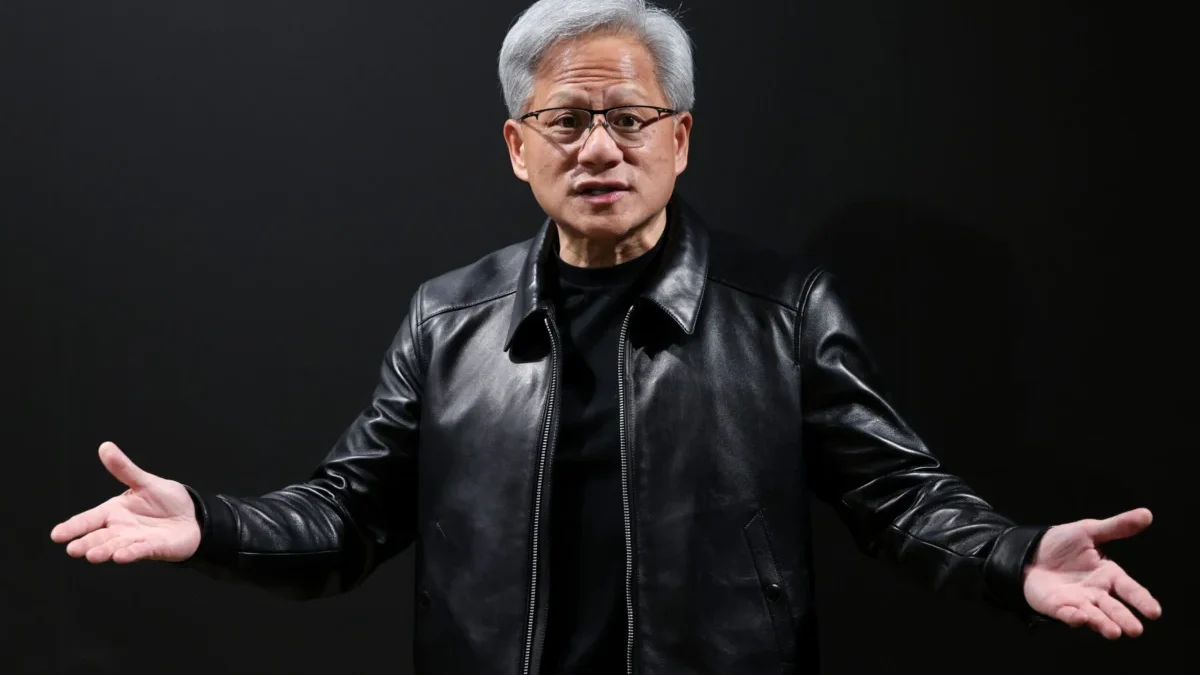
The rapidly evolving landscape of artificial intelligence has reached a critical juncture, characterized by a sharp ideological schism between those driving the hardware revolution and those overseeing the development of frontier models. At the heart of this friction is Jensen Huang, CEO of Nvidia, the world’s most valuable company and the primary architect of the silicon infrastructure underpinning modern AI. In a recent interview with CBS, Huang delivered a pointed rebuke to the prevailing climate of “AI doomerism,” characterizing predictions of an existential catastrophe by 2030 as both “irresponsible” and scientifically unfounded.
This public dismissal of catastrophe narratives marks a significant escalation in the debate surrounding AI safety. While figures such as Sam Altman of OpenAI and Dario Amodei of Anthropic have frequently spoken of the need for caution, potential pauses in development, and robust regulatory oversight to mitigate future risks, Huang is positioning his company—and by extension, the broader hardware sector—against what he views as alarmist rhetoric.
The Origins of the Doomsday Discourse
The current atmosphere of concern, often dubbed “AI doomerism,” has been fueled by a series of high-profile resignations, open letters, and public statements from leaders within the AI community. The narrative typically posits that as AI systems transition from specialized tools to general-purpose intelligence, the risk of loss of control or the development of a superintelligence becomes a genuine threat to humanity.
This discourse gained significant momentum throughout 2026. In September, the resignation of Jacob Coxon from Anthropic served as a lightning rod for these fears. Coxon’s public declaration that industry leaders were “gambling with our lives” by racing toward self-improving superintelligence garnered over 170 million views on social media, signaling that these academic and technical concerns had finally permeated mainstream public consciousness. Following this, a petition signed by over 1,300 employees from leading AI firms urged governments and industry heads to prioritize safety and allow for periods of reflection before deploying the next generation of frontier models.
The Technological and Financial Underpinnings
To understand the intensity of the debate, one must look at the capital expenditure currently flowing into the sector. Nvidia sits at the center of this ecosystem. As the primary manufacturer of the H100 and Blackwell-series GPUs, Nvidia has seen its market capitalization soar, briefly surpassing $3 trillion, as major tech conglomerates race to build massive data centers.
However, financial analysts have begun to question the sustainability of this growth. In August 2026, reports surfaced regarding a data center deal between OpenAI and Nvidia that fell significantly short of initial market projections. This discrepancy sparked concerns that the demand for AI hardware might be partially artificial, driven by speculative investment rather than immediate, revenue-generating utility. Huang’s insistence that the industry focus on engineering rather than alarmism may be seen by some as a strategic attempt to stabilize the market and maintain investor confidence in the face of these looming questions about return on investment.
A Divergent Political Landscape
The debate is further complicated by the shifting political environment. President Donald Trump has recently adopted a hands-off approach toward AI regulation, arguing that existing legal frameworks—covering criminal and civil liability—are sufficient to address any harms caused by the technology. In a move that mirrors the establishment of the U.S. Space Force, President Trump announced plans to create an “AI Force” and appoint an “AI Czar.” The goal, according to the administration, is to ensure American dominance in the sector, particularly in competition with China.
“Whoever wins AI, WINS,” the President stated on Truth Social. This sentiment aligns with Huang’s pragmatic, growth-oriented perspective. By rejecting the need for stifling new regulations, the administration is signaling a desire to prioritize rapid innovation over the cautious, safety-first approach championed by the “doomer” faction of the tech industry.
Huang’s Engineering Perspective on Safety
Jensen Huang’s critique of the doomsday narrative is rooted in a fundamental belief that safety is an engineering challenge, not a philosophical or regulatory one. During his interview, he emphasized that scaring the public is not only unnecessary but potentially counterproductive.
“If we’re compromising safety, that can’t happen,” Huang noted. “We should go as fast as we can, but not faster than we should.” His argument is that current industry leaders are misusing the language of fear to potentially seek relief from existing legal obligations. By framing AI as a quasi-existential threat, these companies might be inadvertently creating a political vacuum where existing, well-established laws are ignored or rewritten in ways that favor the industry’s current, unbridled pace.
Huang’s recommendation is for developers to double down on rigorous testing, verification, and engineering-led safety protocols. He suggests that if a product is unsafe, the responsibility lies with the company to fix it, and the law already provides the tools to hold them accountable.
Chronology of the AI Safety Debate
- Early 2026: Growing calls from Anthropic and OpenAI leadership for international cooperation and safety-focused pauses in model training.
- May 2026: High-profile discussions involving Jamie Dimon and Dario Amodei highlight the tension between commercial adoption and systemic risk.
- August 2026: Market concerns arise regarding the sustainability of AI infrastructure spending, with Nvidia’s quarterly performance under intense scrutiny.
- September 2026: Jacob Coxon resigns from Anthropic, citing catastrophic risks, triggering a viral public debate.
- Mid-September 2026: President Trump rejects new regulations and announces the formation of an “AI Force” to prioritize national competitiveness.
- Late September 2026: Jensen Huang explicitly calls out the “doomsday narrative” as “irresponsible,” grounding his rejection in the lack of scientific evidence for such claims.
Analysis of Broader Implications
The rift between the hardware giants and the software model builders creates a complex environment for policymakers. On one hand, if the government follows the advice of the “doomer” contingent, it risks falling behind international competitors, particularly China, which is not slowing its development. On the other hand, a completely deregulated environment, as favored by the current administration and supported by Huang’s rhetoric, could lead to public backlash if a high-profile, AI-driven disaster—such as a major cyberattack or the dissemination of weaponized disinformation—occurs.
Furthermore, the “ulterior motives” mentioned by Huang suggest a deeper distrust between the sectors. If companies like OpenAI and Anthropic are truly lobbying for regulation, they may be attempting to “capture” the regulatory process, creating high barriers to entry that would effectively freeze their current market position and prevent new, leaner competitors from challenging them.
The divide also reflects a fundamental disagreement over the nature of Artificial General Intelligence (AGI). The alarmists treat the arrival of AGI as a near-term inevitability that requires immediate, global-scale governance. The realists, led by figures like Huang, view AI as a sophisticated software advancement that is currently constrained by physical and technical limits, requiring ongoing, disciplined engineering rather than apocalyptic planning.
Looking Ahead
As the industry moves toward 2027, the friction between these two schools of thought is likely to intensify. The success or failure of the President’s proposed “AI Force” and the effectiveness of the current, decentralized regulatory approach will be the primary metrics for determining whether the government needs to intervene more aggressively.
For now, Nvidia’s stance remains clear: the focus must remain on the hardware and the scalable infrastructure that makes AI possible. By distancing itself from the existential debate, Nvidia is attempting to redefine the conversation as one about progress, efficiency, and industrial growth. Whether this narrative holds will depend on the real-world performance of the systems currently under development and the ability of the industry to avoid the very catastrophes that its leaders are so vehemently arguing against.
Ultimately, the debate is not just about the future of technology; it is about the future of the American economy. As the lines between national security, corporate profitability, and existential risk continue to blur, the voice of the hardware industry—the group that holds the keys to the compute power necessary for any of these scenarios to unfold—will remain the most influential factor in how this technological revolution is managed.