
The third-quarter financial results, released throughout this week, paint a vivid picture of a bifurcated advertising technology landscape. While the industry has long anticipated a return to robust growth following a period of macroeconomic instability, the data suggests that success is increasingly concentrated among firms that have successfully pivoted toward app-based ecosystems and mobile-first advertising strategies. Conversely, companies heavily reliant on the open web and traditional display formats are facing a protracted struggle to maintain revenue parity.
The Divergent Paths of Market Leaders
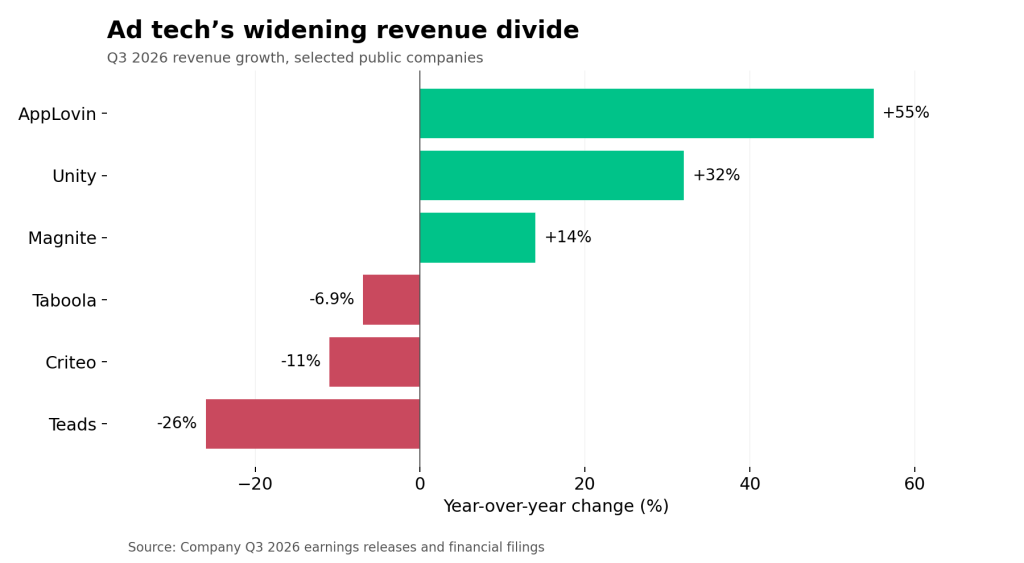
The most striking development in the Q3 reports is the widening chasm between mobile-centric giants and the remainder of the mid-tier ad tech sector. AppLovin, which has increasingly become the bellwether for the mobile app advertising market, reported a staggering 55% year-over-year revenue increase to $2.19 billion. Perhaps more significantly, the firm reported net income of $1.44 billion, a 72% jump, signaling that its proprietary machine learning and AI-driven ad-matching engine—the AXON platform—is yielding unprecedented efficiencies.
AppLovin’s dominance was underscored during its investor call, where executives noted that the company’s quarterly revenue alone exceeded the combined revenue of its five peers—Criteo, Taboola, Teads, Magnite, and Unity—which collectively generated approximately $1.94 billion in the same period.
Unity, while embroiled in a complex legal dispute with AppLovin over data collection practices, also posted strong figures. The company reported $622 million in total revenue, a 32% increase. Its "Grow Solutions" division, which handles its core advertising media offerings, grew 44% to $457 million. Of particular note was the Vector ad platform, which saw a 126% year-over-year expansion, suggesting that even amid operational restructuring and legal headwinds, Unity’s underlying ad technology remains a high-growth asset.
The Struggles of the Open Web
While the app-based giants celebrated record-breaking quarters, the "open web" cohort faced a more challenging reality. Criteo, long a staple of retail media and retargeting, reported a 11% revenue decline to $416 million. After accounting for traffic acquisition costs (TAC), the company’s contribution fell by 17% to $240 million.

The decline at Criteo was compounded by a 23% drop in retail media revenue. Executives attributed a portion of this shortfall—roughly $20 million—to changes within two specific, unnamed client accounts. This underscores the volatility inherent in the retail media space, where platform-level decisions by major retailers can have outsized impacts on the tech providers serving them.
Taboola, similarly, grappled with a 6.9% decline in revenue, totaling $462.3 million. The company cited a contraction in advertising impression volumes across its network. However, in a display of operational discipline, Taboola managed to grow its gross profit by 9.6% to $152.3 million, proving that revenue growth and profitability are currently decoupled in the sector; by optimizing costs and focusing on higher-margin inventory, some firms are finding ways to remain lucrative despite top-line stagnation.
Teads, a historic rival to Taboola, faced the most severe contraction of the group. With revenue falling 26% to $235.1 million, the company reported a net loss of $325.5 million. Executives at Teads pointed to persistent weakness in the open-internet advertising environment, a sentiment echoed by several analysts who suggest that brand budgets are increasingly shifting away from open-web display and toward walled-garden social platforms and connected TV (CTV).
Connected TV as a Strategic Oasis
The earnings reports consistently highlighted Connected TV (CTV) as the primary growth engine for companies outside of the mobile-first duopoly. Magnite, which reported a 14% overall revenue increase to $204.2 million, served as the primary case study for the efficacy of a CTV-first strategy. Its CTV-specific contribution, ex-TAC, rose 39% to $105.4 million, now accounting for more than half of the company’s total contribution.
This growth is significant because it is occurring while traditional display and digital video (DV+) advertising growth remains muted. For example, while Magnite’s CTV segment soared, its broader DV+ business grew by only 5%.
Teads, despite its overall revenue challenges, similarly pointed to its CTV business as a focal point for recovery. While the channel grew 37% year-over-year for the firm, the scale of that growth was insufficient to offset the double-digit declines in its legacy web-based business. This highlights a recurring theme in the industry: CTV is a vital growth vector, but it is not a silver bullet. For companies where CTV represents only a small slice of total revenue—such as Teads, where it sits alongside a larger, declining legacy business—the transition period is proving to be financially painful.
Profitability and the Post-IPO Landscape
A critical point of analysis for investors is the variance in profitability metrics. Unity, in particular, reached a symbolic milestone this quarter by reporting its first profitable quarter since its initial public offering. This achievement signals a successful maturation of its business model, moving from aggressive, loss-leading growth to a sustainable, cash-generative enterprise.
Conversely, Criteo’s results indicate a period of margin compression. The company saw its gross margin slip from 55% to 50%, while net income plummeted 85% to $6 million. This contrast serves as a cautionary tale: companies that fail to evolve their value proposition in the face of shifting privacy regulations and changing consumer behaviors risk seeing their margins eroded by the need to invest heavily in new infrastructure just to maintain their existing market position.
Market Implications and Future Outlook
The broader impact of these earnings reports is the consolidation of market power. The industry is currently moving away from a fragmented ecosystem where many players could thrive on the open web, toward a model where scale, data depth, and platform-specific advantages are the only pathways to significant growth.
As the industry moves toward the second half of the quarter, market analysts are closely watching the upcoming filings from Zeta Global, The Trade Desk, PubMatic, and Liftoff Mobile. These companies represent different facets of the advertising stack—from demand-side platforms (DSPs) to identity management and mobile growth. Their performance will likely clarify whether the current trends—mobile resilience and open-web struggle—are systemic or specific to the business models of the companies that reported this week.
The divergence between the "haves" and "have-nots" in the ad tech sector is no longer merely a matter of cyclical economic fluctuations. It reflects a fundamental shift in how advertising dollars are allocated in a post-cookie, privacy-centric world. Advertisers are prioritizing environments where they can track outcomes with precision and scale—conditions that mobile apps and premium CTV environments currently provide in abundance. For the firms caught in the decline of the open web, the challenge ahead is not just one of execution, but of fundamental identity. They must prove that they can offer a value proposition that is as compelling as the data-rich environments of their mobile-first rivals.
As the dust settles on this earnings week, the industry is left with a clear directive: the era of "growth at all costs" has been replaced by an era of "growth through integration." Those who cannot bridge the gap between their legacy business and the new, high-growth channels of CTV and mobile will likely find themselves at an increasing disadvantage as the industry moves further into 2025 and beyond. The coming week of earnings will be the final test of whether this trend is a broad-based industry transformation or a localized phenomenon among the specific cohort of firms that reported during this cycle.