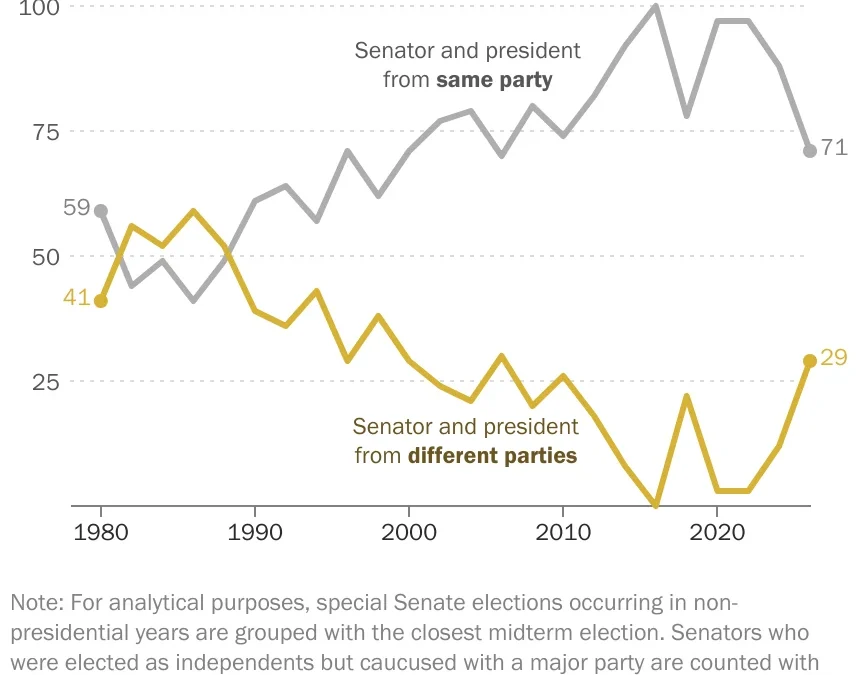
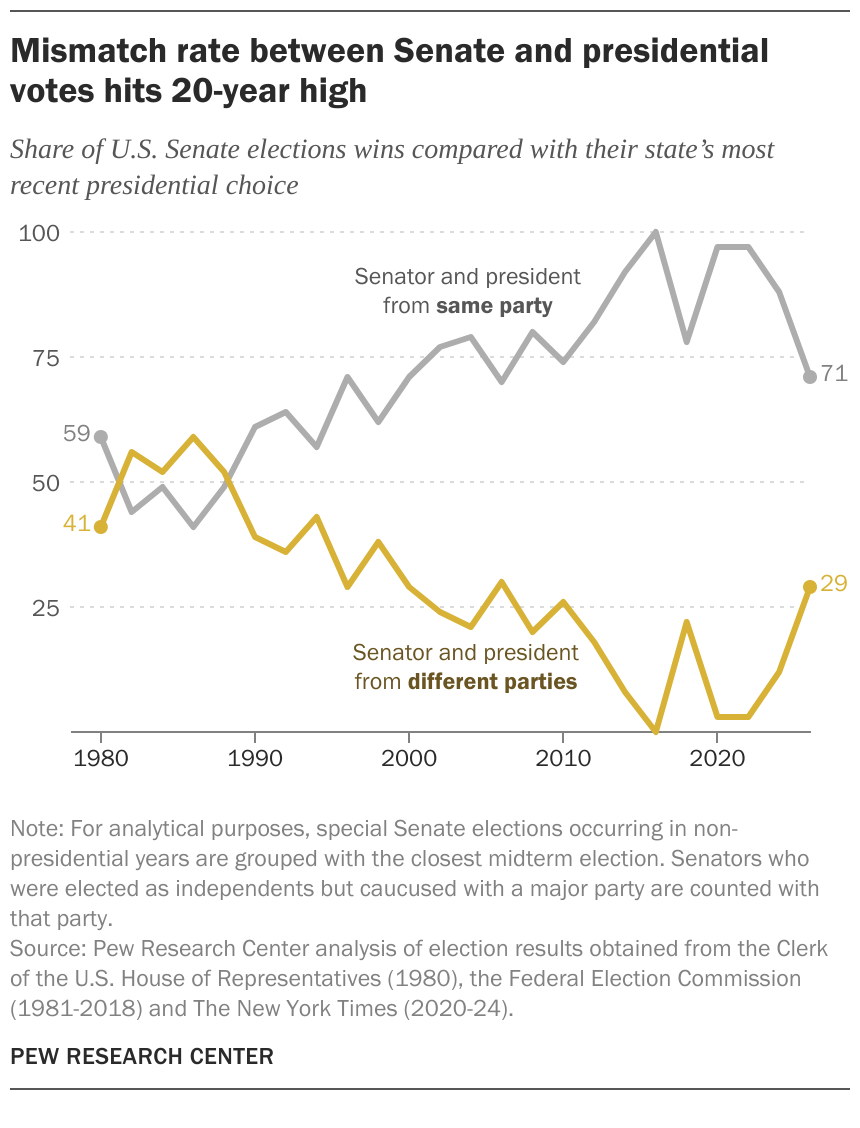
The American political landscape witnessed a significant trend reversal in the 2026 midterm elections, as a growing number of states diverged from their recent presidential voting patterns to elect senators from the opposing party. According to a comprehensive analysis by the Pew Research Center, voters in 10 states that favored Republican Donald Trump in the 2024 presidential election opted to send Democratic senators to Washington this year. This phenomenon, categorized by political scientists as a "mismatch," reached a 20-year high, signaling a departure from the intense partisan alignment that has characterized U.S. politics for much of the last decade.
With 35 Senate seats up for contest during the 2026 cycle, the data indicates that 28.6% of these races resulted in a split-ticket outcome. To find a comparable level of divergence, one must look back to 2006, when 30.3% of the 33 Senate seats on the ballot resulted in a mismatch between the state’s presidential preference and its senatorial choice. This recent shift marks a notable deviation from the highly polarized patterns observed between 2016 and 2022, where the vast majority of Senate outcomes perfectly mirrored the presidential results of the preceding cycle.
A Historical Context of Ticket-Splitting
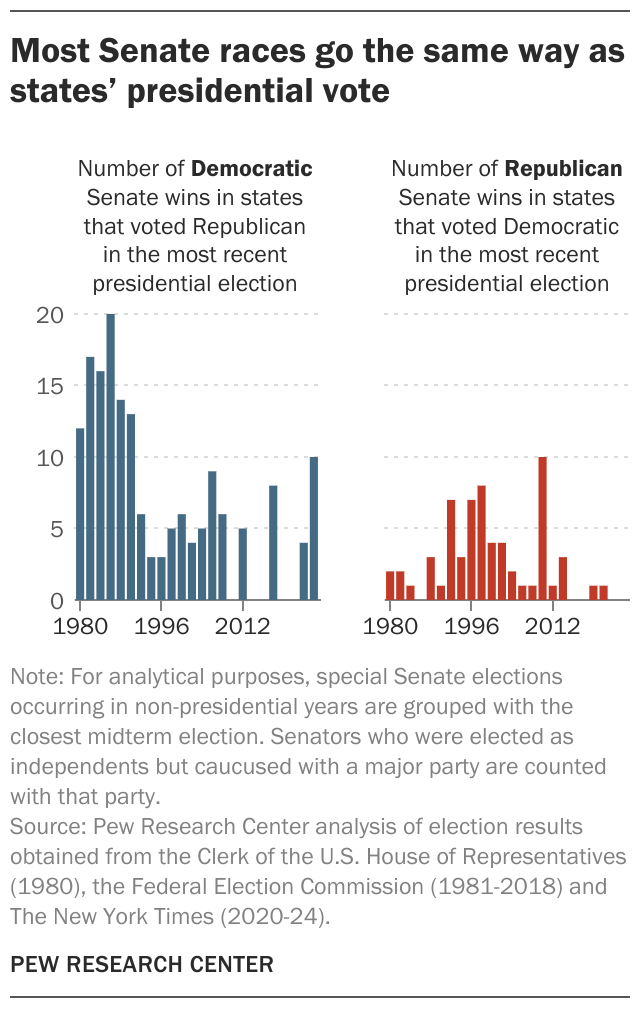
The tendency for voters to decouple their presidential preferences from their legislative choices is not a new feature of American democracy, but its prevalence has fluctuated dramatically over the past half-century. In the 1980s, when the Pew Research Center’s longitudinal analysis begins, it was common for the mismatch rate to hover around or exceed 50%. During that era, the Democratic Party frequently secured Senate victories in states that had supported Republican Ronald Reagan in his landslide presidential campaigns.

Throughout the 1990s and early 2000s, this rate gradually began to compress. By the mid-2010s, the "nationalization" of American politics—a process wherein voters began to prioritize national partisan identity over local or state-specific candidate appeal—became the dominant trend. The peak of this alignment occurred in 2016, a year in which every single state’s Senate election aligned with its presidential choice. This era of uniformity persisted through the 2020 and 2022 election cycles, where the mismatch rate fell to a mere 3%, with only one state in each cycle bucking the national trend.
Chronology of Recent Election Trends
The trajectory toward the 2026 high-water mark provides critical insight into the changing behavior of the American electorate. Following the 2016 election, the 2017-2018 cycle saw a minor resurgence in ticket-splitting, with eight mismatches out of 36 races, totaling 22.2%. At that time, much like the current cycle, those instances were characterized by Democratic victories in states that had previously supported the Republican presidential candidate.
The subsequent years, however, saw a sharp decline in this behavior. In 2020 and 2021, only one Senate race across the country resulted in a split outcome. Similarly, in 2022, only a single seat defied the presidential voting history of its state. The 2024 presidential election year then saw 12% of Senate races split, a number that has now climbed to 29% in the 2026 midterms. This progression suggests that while the "nationalization" of politics remains strong, there is a renewed willingness among the electorate to evaluate Senate candidates independently of the executive branch leadership.
The Dynamics of "Wave" Elections
Political analysts often attribute these spikes in mismatch rates to the nature of "wave" elections. A midterm cycle often acts as a referendum on the incumbent administration, leading to a "rebound" effect where the party that lost the White House two years prior makes significant gains in Congress. This dynamic appears to have played a role in 2026, as the opposition party sought to check the power of the administration by placing candidates in seats that might otherwise be considered safe for the incumbent party’s presidential platform.
In 2026, the data confirms that all 10 mismatches were instances of Democratic candidates winning in states that had supported Donald Trump in 2024. Conversely, there were no instances in this cycle of a state that voted for Democrat Kamala Harris in 2024 electing a Republican senator. This indicates that the 2026 divergence is primarily driven by Democratic resilience in "red" states rather than a broader, bilateral shift in ticket-splitting behavior.
Analytical Methodology and Definitions
The Pew Research Center’s analysis relies on a rigorous methodology to ensure consistency across nearly five decades of data. For the purposes of this study, special Senate elections occurring in non-presidential years are grouped with the closest preceding midterm election. Furthermore, to maintain a clear partisan framework, senators who were elected as independents but choose to caucus with a major party—such as Bernie Sanders of Vermont or Angus King of Maine—are categorized as members of that party.
This classification system also extends to complex political figures like former Senator Kyrsten Sinema of Arizona, who left the Democratic Party in 2022. Because she retained her committee assignments through the Democratic caucus, the analysis counts her as a Democrat. This nuance is vital for understanding the true composition of the Senate, as it differentiates between formal party affiliation and the practical reality of legislative governance and coalition building.
Implications for Governance and Partisanship
The rise in the mismatch rate has significant implications for the legislative branch. A Senate that is less aligned with the presidential vote of its respective states often results in a more divided government, which can lead to both gridlock and forced compromise. When a senator represents a constituency that voted for the opposing party in the presidential election, that legislator is under unique pressure to moderate their policy stances to satisfy a diverse, often split-leaning electorate.
From a policy perspective, this creates a "check-and-balance" environment. Senators in states with opposing presidential leanings may be more inclined to prioritize local interests over national party dictates, as they must maintain support from a coalition that includes members of both parties. Conversely, this can also lead to increased volatility in future election cycles, as these seats are often the most targeted by national political action committees and high-spending interest groups.
Official and Institutional Perspectives
While political parties rarely comment on "mismatch" rates as a primary metric, the underlying data points to the challenges faced by both the Republican and Democratic parties in maintaining a "big tent" strategy. For the Republican Party, the inability to capture Senate seats in states where they hold a presidential majority represents a failure to capitalize on the "top-of-ticket" momentum. For the Democratic Party, the 2026 results are a testament to the effectiveness of localized campaigning, but they also highlight the difficulty of sustaining such support in a political environment that is increasingly driven by nationalized, often polarized, messaging.
The academic community views this trend with cautious interest. If the mismatch rate continues to climb, it could signify a long-term shift away from the hyper-alignment of the early 2020s. However, if the 2026 results prove to be an outlier driven by specific midterm dynamics, the American political system may return to the more predictable, unified voting patterns seen in the preceding decade.
Conclusion: The Path Ahead
The 2026 election cycle serves as a reminder that the American electorate remains fluid. While the nationalization of politics remains a dominant force, the 28.6% mismatch rate proves that voters are still capable of distinguishing between executive and legislative candidates. As the nation prepares for the next presidential cycle, the ability of both parties to bridge this gap—or conversely, to exploit these divisions—will define the legislative agenda for the remainder of the decade. The data provided by the Pew Research Center acts as a vital compass for navigating these shifts, offering a factual basis for understanding how the electorate balances local representation with national partisan identity.