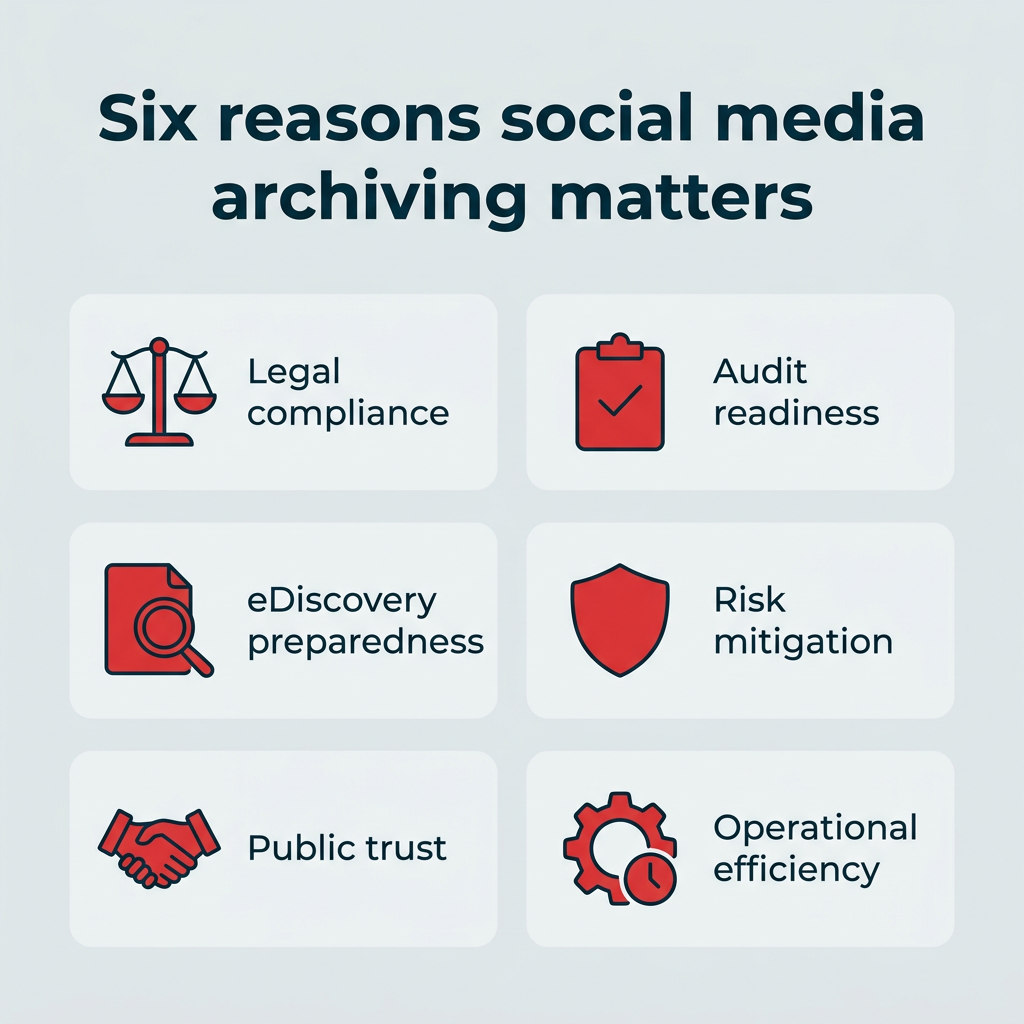
Social media archiving has transitioned from an overlooked back-office administrative task into a critical risk-management pillar for modern government agencies, financial institutions, healthcare providers, and educational organizations. In an era where digital communication shapes public discourse, influences markets, and forms the baseline of constituent interaction, preserving a tamper-proof digital footprint is no longer optional. Regulatory bodies across the globe are intensifying their scrutiny of digital channels, making automated, legally defensible archiving a primary safeguard against catastrophic compliance failures, steep financial penalties, and costly litigation.
The core challenge facing organizations today lies in the fundamental nature of social media platforms. Mainstream networks operate as private-sector entities entirely independent of public records mandates. They are under no legal obligation to maintain an organization’s historical digital data indefinitely, nor do they protect against unannounced application programming interface (API) alterations that can permanently erase public access to historical threads, edits, or direct messages. Consequently, relying on native platform storage or manual capture methods—such as static screenshots or PDF exports—leaves institutions exposed to compliance breaches, compromised eDiscovery processes, and indefensible legal records.

Decoding the Regulatory Landscape: FOIA, SEC, HIPAA, and FERPA
To fully appreciate the necessity of comprehensive social media retention, organizations must examine the specific regulatory frameworks governing their respective industries. Each sector operates under distinct statutory mandates that treat digital communications as formal, accountable records.
For government agencies operating within the United States, social media forums are legally classified as public records under the Freedom of Information Act (FOIA) and various state-level open records laws. Federal, state, and municipal entities must systematically preserve all posts, comments, direct messages, and multimedia interactions on official channels. This requirement extends to content that is subsequently hidden or deleted by administrators or users. Because official agency social media pages constitute designated public forums, they are also bound by First Amendment protections. When government administrators exercise their right to remove abusive, spam, or violative comments, they must retain an unalterable audit trail proving that valid cause existed for the removal, thereby shielding the agency from constitutional challenges.

In the financial services sector, compliance obligations are heavily enforced by the Securities and Exchange Commission (SEC) and the Financial Industry Regulatory Authority (FINRA). Under SEC Rule 17a-4 and FINRA Rules 3110 and 2210, financial institutions are required to retain all business-related electronic communications. This mandate covers promotional social posts, direct messaging interactions, and interactive third-party dialogue. Furthermore, regulatory scrutiny has widened to target "off-channel communications," penalizing institutions where employees utilize unapproved consumer messaging apps like WhatsApp or Signal for business transactions. Regulatory enforcement actions have demonstrated that failure to systematically archive these communication streams results in multimillion-dollar fines.
Healthcare providers face unique privacy constraints under the Health Insurance Portability and Accountability Act (HIPAA). Sharing protected health information (PHI) on social media without explicit patient authorization violates federal privacy rules and exposes organizations to maximum penalties reaching upwards of $2.19 million annually for willful neglect. Archiving becomes vital when patients initiate inquiries or disclose personal medical details within comments or direct messages on a healthcare provider’s social page. Even if a moderator immediately removes the post to protect patient privacy, the initial interaction must be permanently secured within a compliant archive.
Educational institutions similarly navigate complex retention rules under the Family Educational Rights and Privacy Act (FERPA). Any digital communication published by a school or university that identifies a student, references their academic standing, or details disciplinary actions forms part of their official educational record and must be retained in alignment with institutional policies and state statutes.
Cross-Border Compliance and Data Sovereignty
Beyond industry-specific regulations, organizations must address regional data privacy laws and strict data residency requirements. International compliance frameworks dictate not only what information must be saved, but precisely where that data is physically stored.
For instance, public sector agencies operating within regions like British Columbia or the Commonwealth of Australia are bound by stringent public data policies. Australian public data guidelines mandate that citizen-related social information be archived locally within Australian data centers, necessitating the use of specialized software vendors with domestic infrastructure capabilities. Similarly, organizations operating inside or interacting with citizens of the European Union must strictly adhere to the General Data Protection Regulation (GDPR), which imposes rigorous limitations on the collection, retention, and processing of personally identifiable information (PII) embedded within social media conversations.
The Five-Step Blueprint for Compliant Social Media Archiving
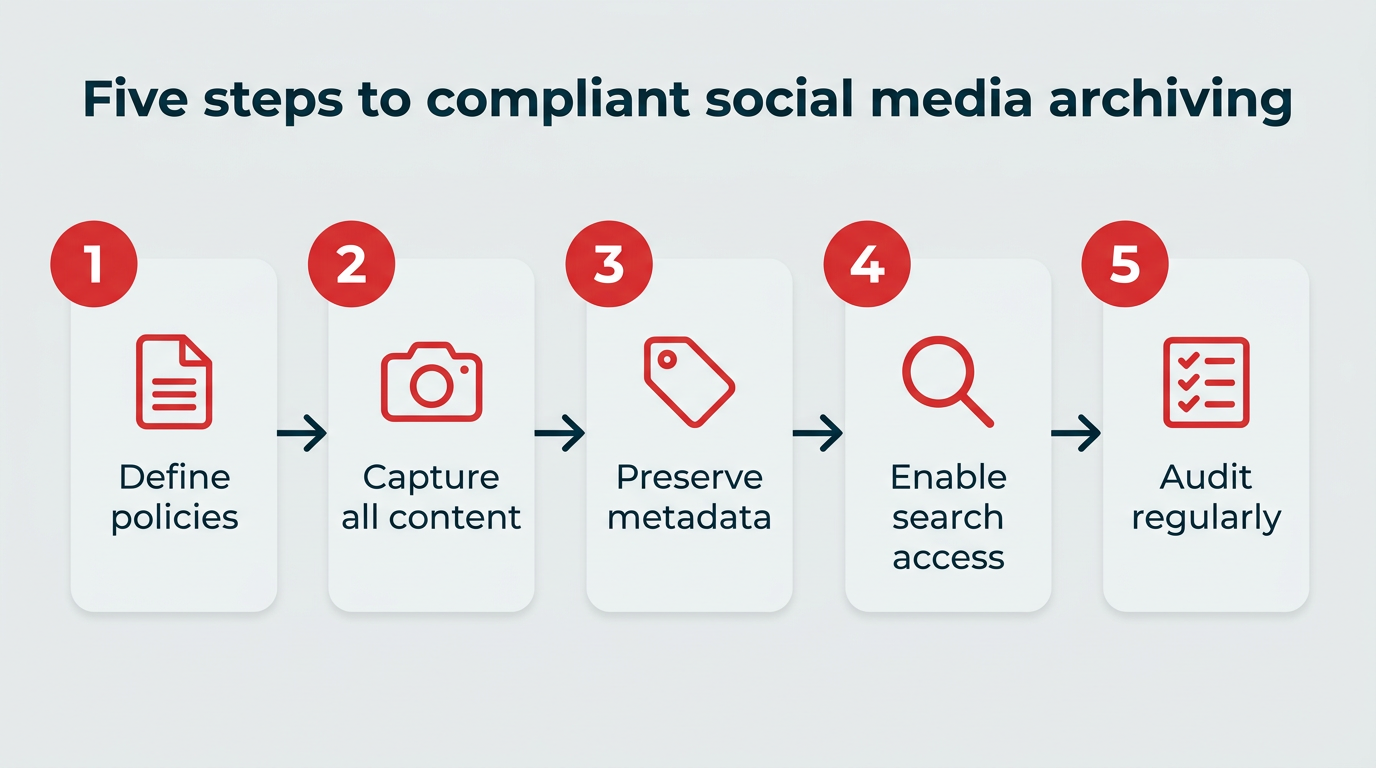
Implementing a resilient archiving architecture requires a structured, multi-phase operational workflow. Organizations can eliminate compliance blind spots by adhering to a five-step integration process:
-
Define Archiving Policies and Procedures: Establish a solid governance framework by auditing applicable jurisdictional legislation and embedding archiving policies directly into overarching organizational guidelines. Before deploying new departmental social channels, ensure they are integrated into the automated archiving pipeline. Additionally, verify that chosen software vendors satisfy regional data residency laws.
-
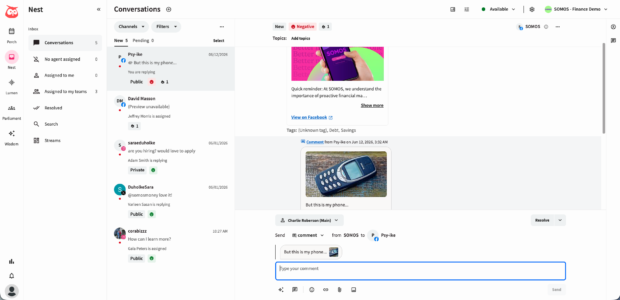
Capture and Preserve All Content Universally: Deploy purpose-built archiving tools that interface directly with platform APIs to capture all incoming and outgoing content in real time. This includes posts, comments, edits, deletions, multimedia attachments, and user tags or mentions across every official account.
-
Embed Metadata and Contextual Information: Ensure that preserved records include complete background metadata, such as exact timestamps, author identification details, device information, and comprehensive edit histories. Screenshots are inadequate for legal proceedings because they lack metadata and can be easily manipulated; complete metadata ensures records are authentic, unaltered, and legally defensible during eDiscovery.
-
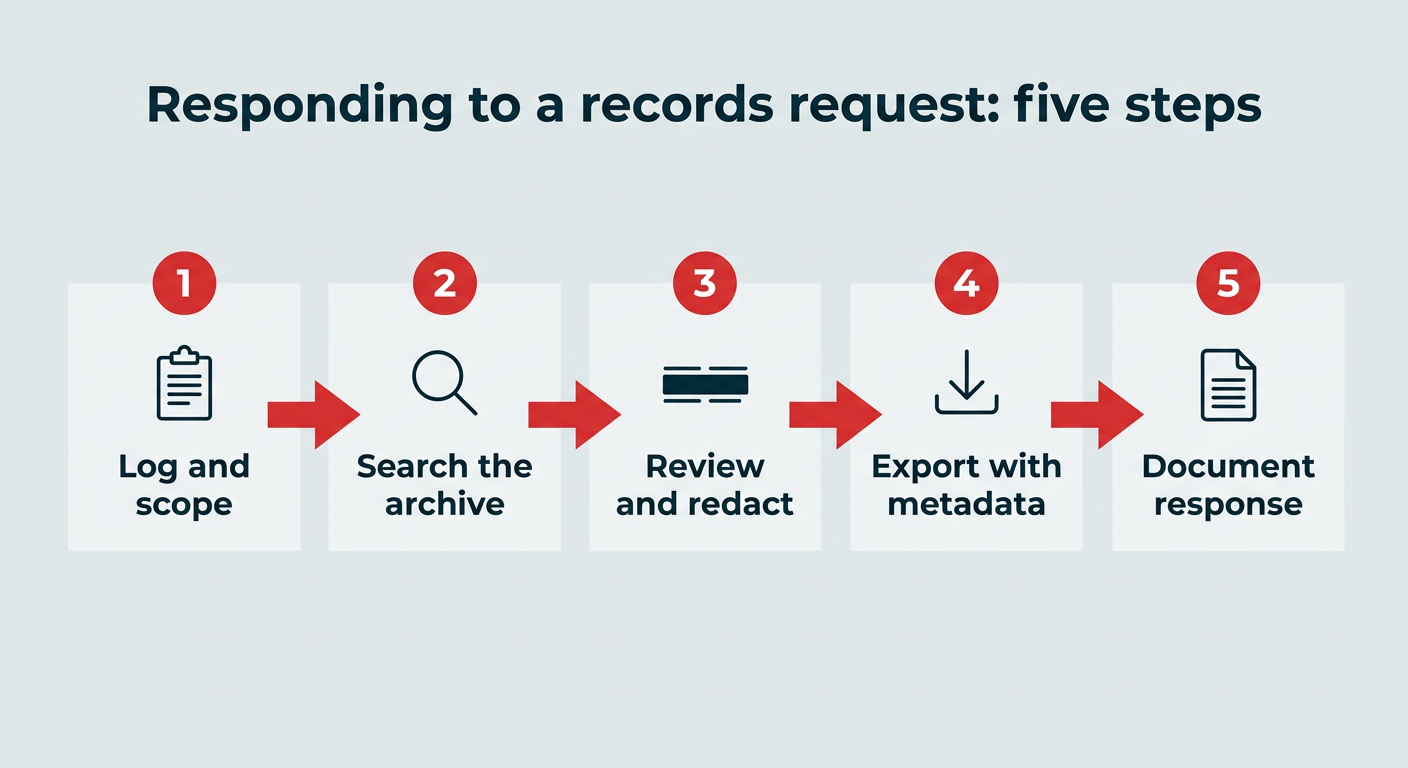
Establish Searchable and Accessible Repositories: Maintain a secure yet readily searchable archive that authorized legal, compliance, and public relations teams can access immediately. Advanced search capabilities, keyword filtering, tagging, and export functions are essential for rapidly responding to public information requests or legal discovery demands.
-
Conduct Rigorous Regular Audits: Because digital platforms, APIs, and regulatory frameworks evolve continuously, organizations must schedule thorough quarterly audits of their archiving processes. These reviews ensure that newly launched accounts are covered, staff are trained on updated protocols, and technical integrations remain fully operational.
Automated Archiving Versus Manual Methods
A common pitfall for resource-constrained institutions is relying on manual archiving methods, such as periodic screenshot captures, PDF exports, or manual spreadsheet logging. While these approaches require no upfront software subscription costs, they create unacceptable exposure to regulatory penalties.

Manual methods are fundamentally reactive and prone to human error. They fail to capture real-time edits or comments deleted moments after publication, carry no background metadata to verify authenticity, and disintegrate when scaled across multiple enterprise accounts. In contrast, automated archiving solutions establish a tamper-proof, real-time repository that preserves the complete contextual lifecycle of every digital interaction, fulfilling the exacting standards required by courts and regulatory auditors.
Mitigating Enterprise Risk
Organizations that neglect social media archiving expose themselves to severe legal, financial, and operational vulnerabilities. The most prevalent risks of non-compliance include:
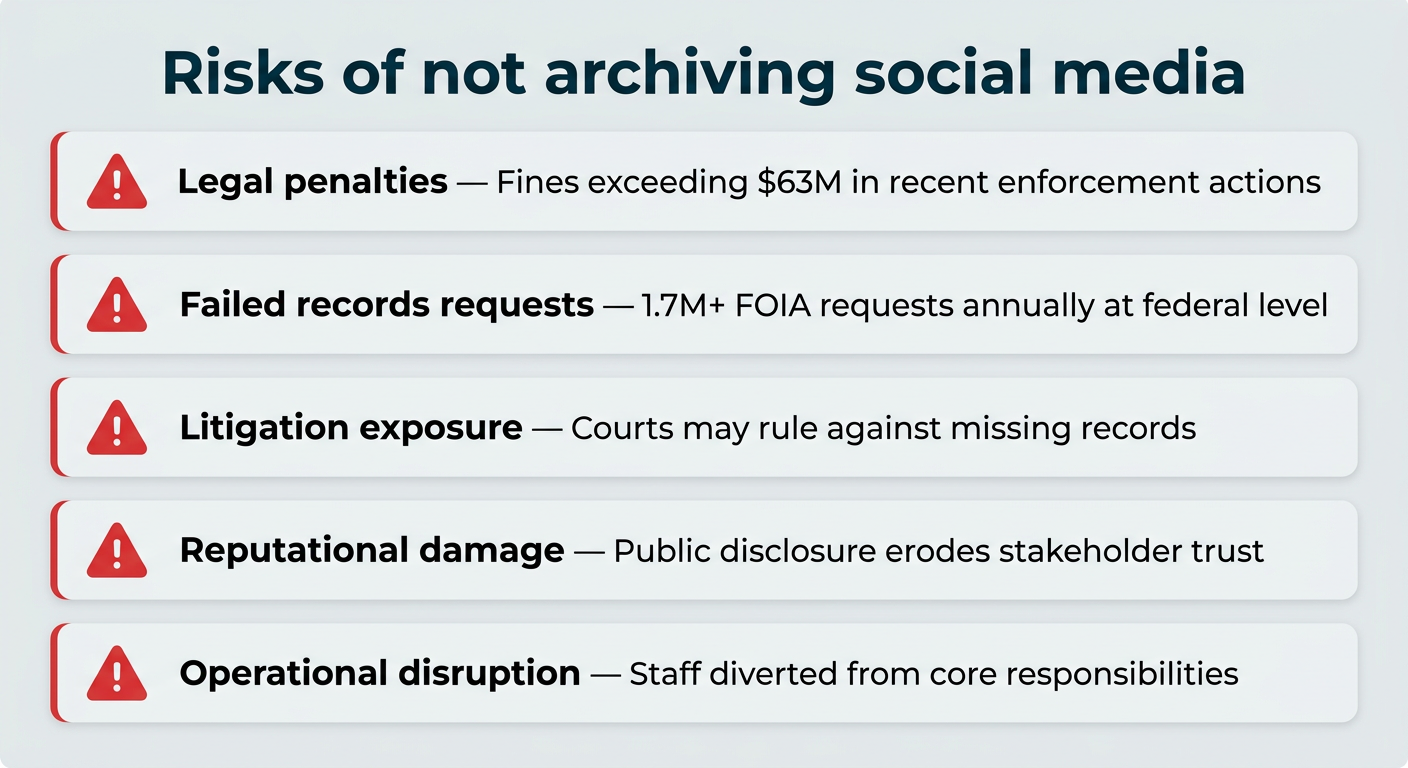
- Legal Sanctions and Court Penalties: Inability to produce complete records during litigation can lead to severe judicial sanctions, adverse inference rulings, and substantial fines.
- Regulatory Fines: Regulatory bodies such as the SEC, FINRA, and the HHS Office for Civil Rights routinely issue multi-million-dollar penalties for communication retention failures.
- Loss of Public Trust: Failing to fulfill Freedom of Information Act requests or mishandling public accountability damages institutional credibility and erodes public confidence.
- Vulnerability to First Amendment Challenges: Without complete comment histories and metadata, government agencies cannot legally defend decisions to moderate or remove disruptive online commentary.
Choosing the Right Compliance Partner
When selecting a social media archiving and compliance vendor, enterprise organizations must prioritize security credentials, platform coverage, and data integrity features.
For government agencies operating within the United States, utilizing cloud services certified under the Federal Risk and Authorization Management Program (FedRAMP) is a strict prerequisite. Platforms such as Hootsuite maintain FedRAMP authorization, satisfying rigorous federal security standards while supporting compliance mandates across financial, healthcare, and professional services sectors through integrated solutions like Proofpoint and Brolly.
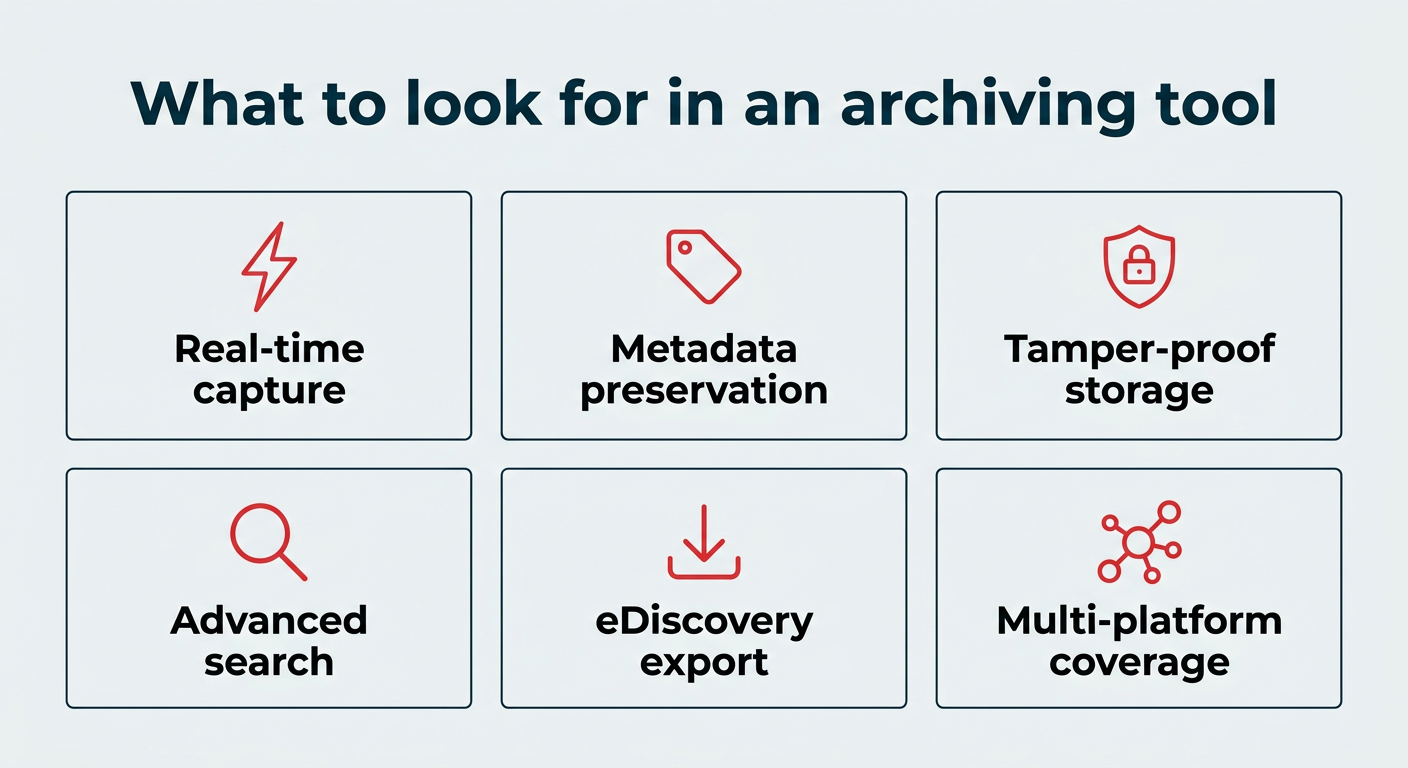
By centralizing governance, automating real-time capture with immutable metadata preservation, and enabling plain-language querying and advanced search capabilities, modern enterprise platforms allow organizations to navigate complex regulatory environments with absolute confidence. Transitioning from a manual oversight model to an automated, auditable archiving strategy ensures that institutions remain audit-ready, legally defensible, and fully compliant in an increasingly regulated digital landscape.