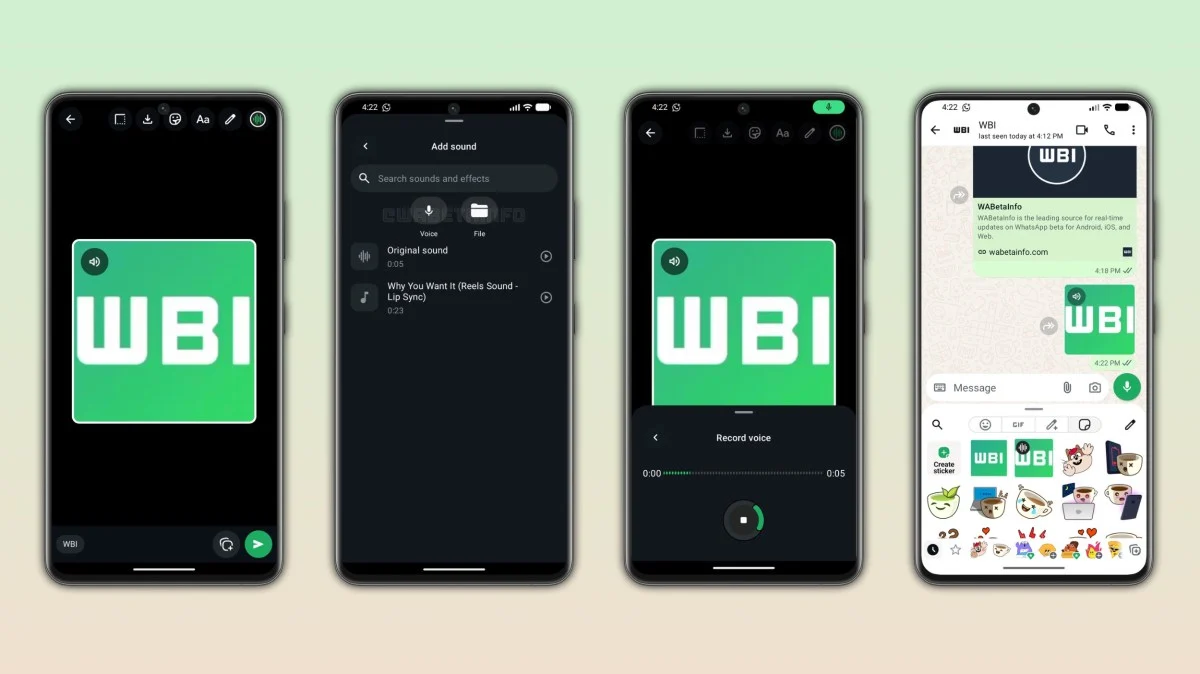
WhatsApp is officially moving beyond static and animated visual imagery by introducing "sound stickers," a feature that adds an auditory layer to the messaging experience. First identified in development within an Android beta release in October, the feature has begun its official rollout to select beta testers on the Google Play Store as of version 2.26.47.1. This development marks a significant shift in how users communicate, moving the platform closer to the rich-media capabilities found in competing services while maintaining the focus on privacy and user control that has defined WhatsApp’s growth strategy.
The Mechanics of Sound Stickers
The implementation of sound stickers is designed to be intuitive, leveraging existing sticker creation workflows. Users accessing the sticker keyboard within the application will now see a "Create sticker" option. Upon selecting a video from their device gallery, WhatsApp’s internal processing engine automatically converts the file into an animated sticker. The distinguishing feature is a new audio interface located at the top of the editor.
This editor provides four distinct methods for adding sound to the visual element:
- Retaining Original Audio: The user can opt to keep the native sound captured in the source video.
- Preset Effects: A built-in library of sound effects is available for quick application.
- External File Import: Users can upload audio tracks directly from their device’s file manager.
- Voice Recording: The feature allows for real-time recording, enabling personalized audio messages attached to stickers.
To ensure that the user experience remains non-intrusive, these stickers are muted by default. When a recipient receives a sound sticker, a small audio icon is displayed on the image, providing a visual cue that the file contains an auditory component. The audio is designed to loop exactly three times before stopping, preventing unnecessary battery drain or prolonged disruptions. Consistent with WhatsApp’s core architecture, both the sticker file and its associated audio track are protected by end-to-end encryption, ensuring that only the sender and the recipient have access to the content.
Chronology of Development
The trajectory of this feature reflects WhatsApp’s methodical approach to feature deployment. The earliest indicators of sound stickers emerged in mid-October, when code-miners identified references to audio-enabled stickers within the Android beta framework. At that stage, the feature was largely non-functional, serving as a placeholder for the engineering team to test integration.
Throughout late October and November, the development team refined the playback logic and the compression algorithms required to keep these files optimized for data efficiency. By the time version 2.26.47.1 hit the beta channel, the feature had transitioned from a hidden experimental toggle to a user-facing tool. Parallel to the Android deployment, similar testing phases have begun on the iOS platform, specifically targeting users enrolled in the TestFlight beta program and, in limited instances, some general App Store users.
Supporting Data and Market Context
The introduction of sound stickers arrives at a time when WhatsApp is under increasing pressure to innovate. As of late 2024, WhatsApp maintains a global user base exceeding two billion monthly active users. Despite this massive scale, the platform faces fierce competition from platforms like Telegram and Discord, which have long integrated advanced multimedia features, including interactive media and high-fidelity audio sharing.
Market research indicates that the "creator economy" within messaging apps is growing. Data from current messaging usage patterns suggest that personalized, user-generated content—such as custom stickers—drives higher engagement rates than static text. By allowing users to create their own assets, WhatsApp is effectively crowdsourcing its content library, which reduces the server-side burden of maintaining a massive catalog of official, pre-made stickers. Furthermore, the inclusion of audio is a strategic move to capture the demographic of younger users who increasingly rely on "audio-visual shorthand" to convey complex emotions that text alone cannot capture.
Official Responses and Technical Considerations
While Meta, the parent company of WhatsApp, has not released a formal press statement detailing the full roadmap for the global release, the company’s recent history of feature deployment suggests a "phased rollout" strategy. This approach allows the company to monitor server load and identify potential bugs without risking a global service disruption.
From a technical perspective, the challenge for WhatsApp lies in bandwidth and storage. Animated stickers are already more resource-intensive than static PNG or WebP files. Adding an audio track—depending on the codec and duration—increases the file size significantly. Meta’s decision to limit audio loops to three repetitions is a calculated technical constraint intended to minimize the impact on mobile data usage and internal storage for the end-user. By forcing a playback limit, the application avoids the pitfalls of large, uncompressed audio files clogging device memory, a common issue in developing markets where device specifications may be more modest.
Implications for Privacy and Communication
The integration of end-to-end encryption into these new media files is a critical reaffirmation of WhatsApp’s privacy mandate. Since the introduction of the Signal Protocol in 2016, encryption has been the bedrock of WhatsApp’s competitive advantage. By extending this to sound stickers, the company is signaling that it does not intend to compromise user security for the sake of functionality.
However, the rollout also introduces new moderation challenges. The ability for users to record custom voice notes or import arbitrary audio files means that content moderation systems—such as those designed to flag hate speech or copyright infringement—must now be capable of scanning audio components attached to stickers. Industry analysts suggest that WhatsApp is likely utilizing a combination of automated hash matching (for known infringing content) and user-reporting mechanisms to mitigate potential misuse.
The Broader Impact on Digital Interaction
The shift toward "rich-media" messaging is not merely an aesthetic choice; it is an evolution of language. The use of sound stickers serves as a digital equivalent of tone-of-voice. In text-based communication, sarcasm, urgency, or playfulness are often lost. By allowing a user to overlay a specific sound effect or their own voice onto an animated image, the platform is narrowing the "empathy gap" inherent in digital text.
Looking ahead, the logical progression for this feature would be the integration of a searchable "Sound Sticker Store," similar to the existing marketplace for static stickers. If the initial reception among beta testers remains positive, it is highly probable that WhatsApp will look to monetize this space through partnerships with media companies, allowing for branded stickers that feature iconic movie quotes or popular music clips, similar to how platforms like TikTok and Instagram handle audio-driven trends.
Conclusion and Future Outlook
As the rollout continues through the coming weeks, the focus will shift from feature functionality to user adoption. For now, the feature remains restricted to a subset of the beta community. The lack of a definitive date for a general release is typical for Meta’s development cycle, which prioritizes stability over speed.
For the average user, the arrival of sound stickers represents a more expressive way to communicate. For the messaging industry, it serves as a reminder that the battle for user attention is increasingly won through multimedia integration. As WhatsApp continues to bridge the gap between simple messaging and full-featured social networking, the "sound sticker" may well become a standard component of the digital vernacular, provided the company can balance its innovative ambitions with its commitment to performance and user security. While the feature is still in its infancy, its trajectory suggests that the future of instant messaging is not just about what we say, but how it sounds when we say it.