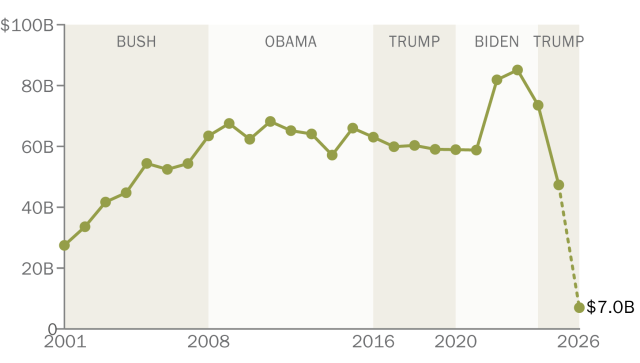
U.S. assistance to foreign countries plummeted to its lowest level in over two decades during the fiscal year that concluded on September 30, 2025, according to a comprehensive analysis of federal data by the Pew Research Center. This dramatic reduction, which saw federal agencies disburse $47.3 billion in foreign aid—a substantial $26 billion less than in fiscal year 2024—marks the steepest decline in recent history when adjusted for inflation, reaching a low point not seen since fiscal year 2004. The downward trajectory is projected to continue, with current data indicating an even lower disbursement for the ongoing fiscal year.
A Shifting Landscape: Historical Context and Recent Trends
The federal fiscal year, which spans from October 1 to September 30, provides a clear timeline for these significant shifts. The substantial decrease in fiscal year 2025 follows a period of elevated foreign assistance, largely driven by geopolitical events. Between fiscal years 2008 and 2021, the annual level of U.S. aid spending, when adjusted to constant 2025 dollars, typically fluctuated between $57 billion and $68 billion. During this era, foreign assistance consistently represented approximately 1% of total federal expenditures, reflecting a relatively stable commitment to international development, humanitarian efforts, and security partnerships.
However, the landscape of U.S. foreign aid underwent a marked transformation with the onset of the Russian invasion of Ukraine in February 2022. This global crisis triggered a significant surge in U.S. assistance, particularly directed towards Ukraine. Consequently, inflation-adjusted assistance spiked dramatically in fiscal years 2022 and 2023, reaching an unprecedented peak of $85.1 billion in fiscal year 2023. This surge underscored the U.S.’s capacity and willingness to deploy substantial resources in response to urgent international security and humanitarian needs.
The subsequent fiscal year, 2024, saw a slight reduction from this peak, with disbursements totaling $73.5 billion. However, fiscal year 2025 ushered in an abrupt and sharp reversal of this trend. The $47.3 billion disbursed that year represented not only a significant absolute decrease but also a proportional decline, accounting for only 0.67% of total federal spending. This downward momentum has intensified into fiscal year 2026, where as of July 1, just three-quarters into the current fiscal year, a mere $6.97 billion has been disbursed, representing a staggering drop to approximately 0.09% of estimated federal spending. This precipitous fall signals a profound reorientation of U.S. foreign policy and resource allocation.
Policy Shifts and the Dismantling of Aid Infrastructure

The drastic reduction in foreign aid coincides with a broader policy direction under the Trump administration, which has been characterized by efforts to "dismantle much of the United States’ aid infrastructure." This approach aligns with an "America First" doctrine, prioritizing domestic spending and often questioning the efficacy and necessity of traditional foreign aid programs. Such policy shifts typically involve budgetary reallocations, reviews of existing programs, and a re-evaluation of international commitments. The practical implications of such a strategy include significant staff reductions within agencies like the U.S. Agency for International Development (USAID), as depicted in the image of a laid-off federal worker. These structural changes can severely impact the operational capacity and long-term planning of aid delivery mechanisms, leading to sustained reductions in disbursements.
The data used for this analysis, sourced primarily from ForeignAssistance.gov, the U.S. government’s official portal for aid information, focuses on "disbursements"—the actual cash out the door—rather than merely obligated or appropriated funds. This methodology provides a more accurate picture of the aid that genuinely reaches recipient countries, as obligated funds can often be reduced, rescinded, or cancelled before actual transfer. It is important to note that this data covers various forms of assistance, including funds, goods, services, and technical assistance, but largely excludes arms sales or transfers of military equipment conducted through separate programs like the Foreign Military Sales program.
Who Receives U.S. Foreign Aid? A Shifting Priority
The allocation of U.S. foreign aid in fiscal year 2025 reveals significant shifts in priorities and recipient levels. For the fourth consecutive year, Ukraine remained the largest recipient of U.S. aid, receiving approximately $6.7 billion. However, even this critical support saw a substantial decrease of 34.1% compared to the $10.2 billion it received in fiscal year 2024. The nature of aid to Ukraine in FY 2025 was predominantly economic assistance (69.0%), aimed at supporting its economy and civilian population, with military and security aid constituting a smaller, though still significant, 18.7%.
The picture for fiscal year 2026, as of July 1, shows an even more dramatic reduction for Ukraine, which has received only $214.4 million in U.S. aid, almost entirely in economic or humanitarian forms. This precipitous decline suggests a significant re-evaluation of direct financial support for Ukraine, potentially shifting towards other forms of assistance or indicating a reduction in overall U.S. engagement in its reconstruction and defense.
Following Ukraine, Israel received the second-largest share of U.S. aid in fiscal year 2025, totaling $3.3 billion. This represented a substantial 51.4% decrease from its fiscal year 2024 allocation. Notably, nearly all of the aid to Israel (99.8%) was designated as military and security assistance, reflecting the long-standing strategic alliance and commitment to Israel’s defense capabilities.
Jordan ranked as the third-largest recipient in fiscal year 2025, receiving $1.7 billion, a comparatively modest decrease of 5.2% from the previous year. Aid to Jordan was more diversified, with economic assistance accounting for 46.5%, military and security aid for 26.1%, and education and social services for 10.6%. This reflects Jordan’s critical role in regional stability and its ongoing needs across various development sectors. As of July 1, 2026, Jordan has emerged as the leading individual country recipient in the current fiscal year, having received $965.7 million. This underscores its continued strategic importance amidst a general decline in aid. The West Bank and Gaza also saw significant aid, receiving $325.3 million, followed by Ethiopia with $286.7 million in the current fiscal year.
Other notable recipients of U.S. aid in fiscal year 2025 included Ethiopia ($919.2 million, entirely non-military), the Democratic Republic of the Congo ($748.7 million, 99% non-military), Nigeria ($728.8 million, 99.8% non-military), Sudan ($709.1 million, entirely non-military), Kenya ($651.1 million, 95.8% non-military), Mozambique ($582.1 million, 98.8% non-military), and Uganda ($512.0 million, 98.4% non-military). The predominant non-military nature of aid to these countries highlights a focus on development, health, and humanitarian concerns in these regions.
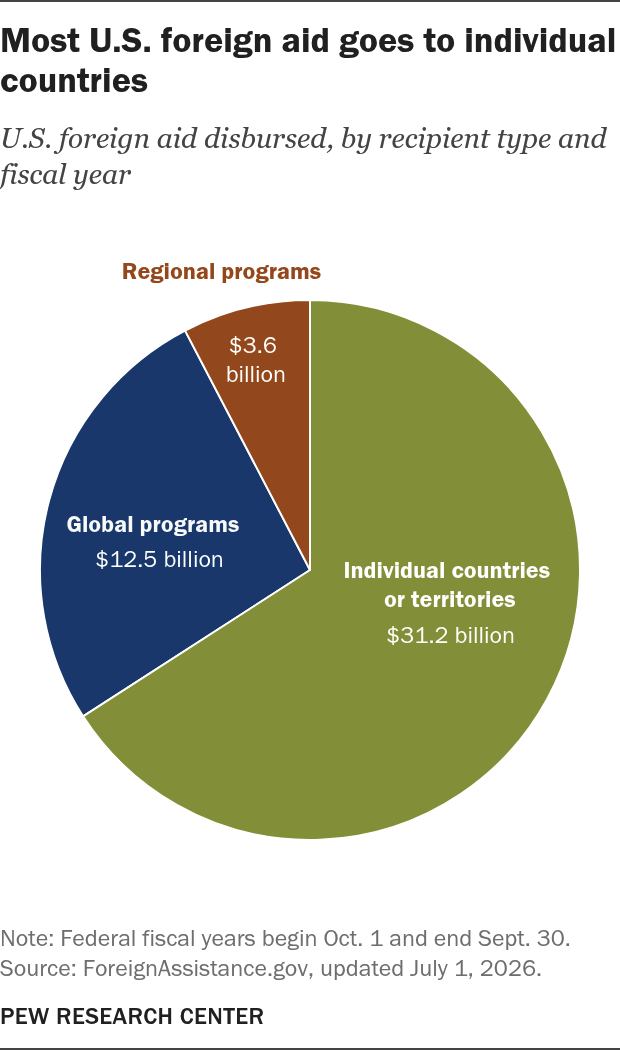
Beyond individual country allocations, U.S. foreign aid also supports programs operating regionally or globally. In fiscal year 2025, approximately 26.5% of total foreign assistance ($12.5 billion) was directed towards global programs, while 7.7% ($3.6 billion) funded regional activities. The majority, 65.9%, went to individual countries or territories. This distribution reflects a balance between targeted bilateral support and broader initiatives addressing transnational challenges.
What is U.S. Foreign Aid Money Used For? Reordered Priorities
The programmatic allocation of U.S. foreign aid underwent a significant reordering in fiscal year 2025, signaling a departure from historical spending patterns. Traditionally, military and security programs often constituted the largest segment of U.S. foreign aid. This broad category encompasses a wide range of activities, including training for military and police forces, counter-terrorism and anti-drug trafficking operations, and conflict resolution efforts. As recently as fiscal year 2024, more than a quarter of all foreign assistance spending—$18.2 billion—was allocated to such endeavors.
However, fiscal year 2025 witnessed a dramatic reduction in this category. Military and security aid was cut by nearly $11 billion, falling to $7.3 billion. Consequently, it accounted for only 15.5% of total aid, marking the smallest share for this category since fiscal year 2001, the earliest year for which data is available on ForeignAssistance.gov. This sharp decline reflects a notable shift away from direct security assistance as a primary component of U.S. foreign policy.
In contrast, public health initiatives emerged as the largest share of foreign aid spending in fiscal year 2025, representing 23.1% of the total, or $10.9 billion. While this figure was still a reduction from the $15.2 billion allocated in fiscal year 2024, its increased proportional share highlights a sustained, albeit reduced, commitment to global health. This category is crucial, encompassing funds for combating major diseases like HIV/AIDS, malaria, and influenza; promoting maternal and child health; and supporting essential infrastructure such as clean water and sewer systems.
Economic development aid also saw its share increase in fiscal year 2025, accounting for 17.3% of foreign assistance, up from 13.3% in fiscal year 2024. This occurred despite a nearly $1.4 billion decrease in absolute terms, from $9.5 billion to $8.1 billion. This indicates a continued emphasis on fostering economic growth and stability in recipient nations, even as overall funding decreases.
The remaining aid dollars in fiscal year 2025 were distributed across various other critical areas. Humanitarian assistance, essential for disaster relief and supporting vulnerable populations, totaled $8.9 billion, down from $12.8 billion in FY 2024. Democracy, human rights, and governance programs received $1.6 billion (down from $2.5 billion). Education and social services accounted for $1.09 billion (down from $1.46 billion). Environmental protection received $304 million (down from $403 million). Program support and multisector initiatives also saw reductions, falling to $5.96 billion and $2.95 billion, respectively.
Broader Implications and Reactions
The substantial and ongoing reduction in U.S. foreign aid carries significant implications across humanitarian, geopolitical, and security spheres. From the perspective of the U.S. administration, these cuts likely reflect a strategic choice to reduce financial commitments abroad, align with an "America First" agenda, and potentially encourage other nations to shoulder a greater share of global responsibilities. This policy stance could be interpreted as a move towards a more transactional foreign policy, where aid is directly tied to perceived national interests or specific concessions.
Internationally, the reactions to such a drastic decline in U.S. foreign assistance are likely varied but generally concerned. Allies may view these cuts as a withdrawal from global leadership and a weakening of international partnerships, potentially increasing the burden on other donor countries or multilateral organizations. Recipient countries, particularly those heavily reliant on U.S. aid for essential services, could face severe challenges. Programs addressing critical needs such as food security, healthcare, education, and infrastructure development may be scaled back or entirely halted, potentially exacerbating poverty, instability, and humanitarian crises. This void could also create opportunities for other global powers, such as China or Russia, to expand their influence through alternative aid and investment initiatives.
Humanitarian organizations and non-governmental organizations (NGOs) that partner with the U.S. government to deliver aid would undoubtedly face operational difficulties, requiring them to seek alternative funding sources or reduce the scope of their vital work. The long-term impact on U.S. soft power and diplomatic influence could also be considerable, as aid has historically been a key tool in fostering goodwill, building alliances, and promoting democratic values. While a reduction in military aid might be seen by some as a step back from foreign entanglements, others might view it as undermining global security partnerships and weakening the collective capacity to address emerging threats.
The trajectory of U.S. foreign aid in fiscal years 2025 and 2026 suggests a sustained policy direction rather than a temporary fluctuation. This enduring shift prompts critical questions about the future of U.S. engagement on the global stage, its commitment to international development and humanitarian principles, and the potential ripple effects on global stability and U.S. standing in the world. The Pew Research Center’s ongoing analysis provides essential, fact-based insights into these evolving dynamics, offering a crucial resource for policymakers, media, and the public to understand this significant reorientation of U.S. foreign policy.