Determining the ideal duration for Instagram Reels has become a primary objective for digital creators, social media managers, and businesses aiming to maximize their visibility on Meta’s flagship short-form video platform. While the technical specifications allow for video uploads of up to 20 minutes, the strategic reality of the Instagram algorithm suggests that duration is a critical variable in determining reach and audience retention. Recent data derived from an analysis of 2.7 million Instagram Reels published via Buffer between January 1 and August 15, 2026, provides a granular look at how video length impacts content performance, offering a roadmap for creators seeking to balance algorithmic distribution with community engagement.
The Technical Evolution of Instagram Reels
Instagram has incrementally increased its video length limits since the inception of Reels in 2020. Initially designed as a direct competitor to TikTok’s short-form, high-velocity content model, the platform began with a 15-second cap. This limit was subsequently expanded to 30, 60, and 90 seconds, before reaching the current maximum of 20 minutes. This shift reflects Instagram’s broader pivot toward a "unified video" strategy, where the platform has sought to consolidate IGTV, Feed videos, and Reels into a single, cohesive viewing experience.
Despite these expanded technical capacities, the platform has maintained a specific threshold for organic discovery. Videos exceeding 180 seconds—or three minutes—are subject to a significant algorithmic limitation: they are generally not recommended to users who do not already follow the creator. This distinction is vital for content strategy. While a 20-minute video may be successfully hosted on a profile, its discovery in the "Reels" tab, the "Explore" page, and the non-follower "Home Feed" is severely restricted compared to shorter content.
Data-Driven Performance Benchmarks
The study of 2.7 million Reels reveals a nuanced relationship between time and distribution. By comparing each creator’s individual baseline performance—effectively neutralizing the impact of follower count—researchers were able to isolate the effect of video duration on reach and engagement.
The findings indicate that Reels lasting between 90 and 179 seconds consistently outperformed shorter content in terms of reach, achieving a 7.4% increase over an account’s average performance. In contrast, videos shorter than 15 seconds saw a 1.5% decrease in reach, while those falling within the 15-to-29-second range saw a negligible decline of 0.9%. This suggests that the "sweet spot" for maximizing new audience exposure lies in the 90-second-to-3-minute bracket.
The data for long-form content—defined as anything exceeding 180 seconds—presents a stark contrast. These videos experienced a 49.3% reduction in reach compared to an account’s baseline. This drop-off is directly correlated with the platform’s policy regarding recommendations. Because the algorithm prioritizes content that can be distributed to new viewers, long-form content is effectively siloed, reaching only the existing, loyal audience.
The Trade-off: Reach vs. Engagement
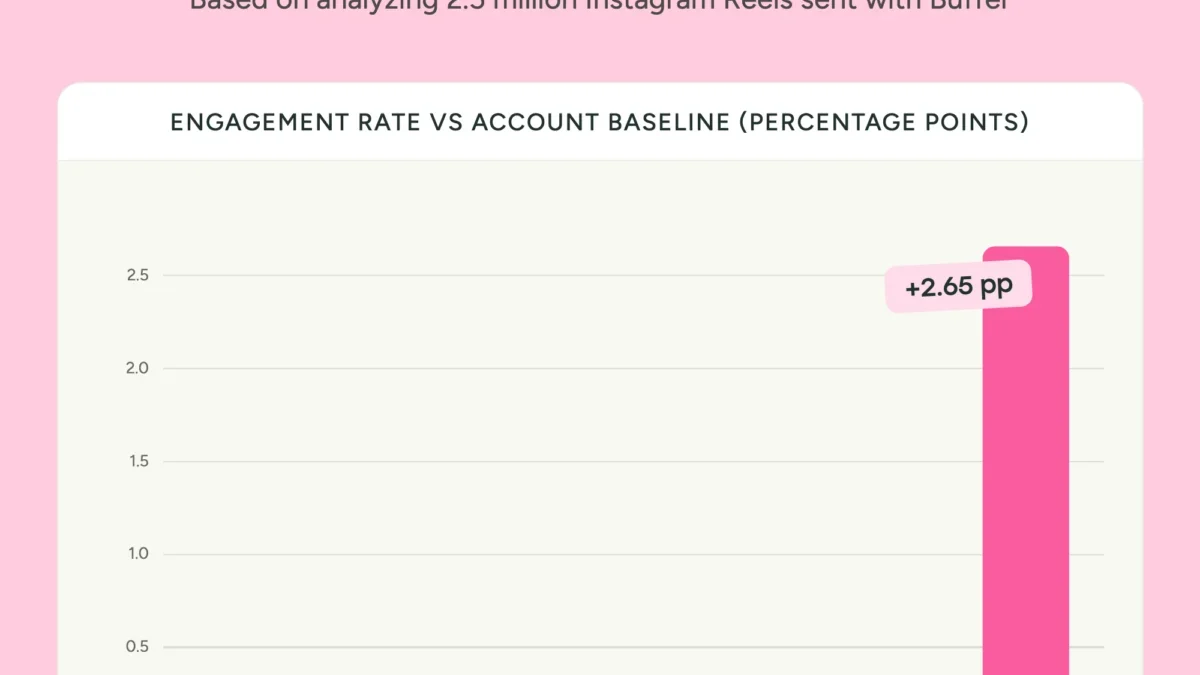
A critical nuance in the data is the inverse relationship between reach and engagement. While Reels exceeding three minutes suffer in terms of raw reach, they consistently deliver higher engagement rates. In the study, videos longer than 180 seconds achieved an engagement rate 2.65 percentage points above the baseline.
This suggests that while the "top of the funnel"—or initial discovery—is hindered for longer videos, the "bottom of the funnel"—or audience depth—is significantly stronger. Viewers who choose to commit to a multi-minute video are inherently more invested in the creator’s content. Consequently, they are statistically more likely to perform high-intent actions, such as saving, sharing, commenting, or visiting the creator’s profile. This creates a strategic dichotomy: creators must choose whether their primary goal for a specific post is "growth" (reach) or "depth" (engagement).
Strategic Implications for Content Creators
For professional content creators and brands, these findings necessitate a bifurcated strategy. If the primary objective is to acquire new followers and expand brand awareness, the content must fall within the 90-to-180-second window. This duration provides enough time to deliver value while remaining within the "recommended" zone of the algorithm.
Conversely, if a creator is focusing on community management, deep-dive tutorials, or long-form storytelling, the three-minute limit should not be viewed as an absolute deterrent. Instead, it should be treated as a strategic choice. Accepting lower reach in exchange for higher quality interaction is a valid trade-off for established creators who are looking to solidify their existing community rather than chase viral reach.
The data also highlights the irrelevance of minor duration adjustments. The performance variance between 15, 30, 60, and 89-second videos is statistically marginal, falling within a narrow 3% range. This implies that creators should focus less on precise time-stamping for shorter clips and more on the quality of the hook, the narrative structure, and the visual value of the content.

Comparative Analysis: Reels, TikTok, and YouTube Shorts
The landscape of short-form video is defined by varying platform limitations. As of late 2026, the competitive environment is as follows:
- Instagram Reels: Up to 20 minutes (3-minute cap for algorithmic recommendation).
- TikTok: 10 minutes for in-app recordings, with the potential for up to 60 minutes for uploaded content.
- YouTube Shorts: A hard 3-minute limit, with content exceeding this duration automatically classified as standard long-form video.
The convergence of these platforms toward a 3-minute recommendation threshold suggests a shared industry standard: the belief that 3 minutes is the maximum window for sustaining the attention of a casual scroller.
Methodological Rigor and Statistical Accuracy
To ensure the integrity of these findings, the study utilized a log-transformation approach to address the inherent skewness in social media metrics, where a single viral video could otherwise distort the average performance of a dataset. By comparing each account’s performance against its own historical baseline, the researchers effectively accounted for the disparity between small-scale creators and high-reach influencers. Furthermore, the analysis excluded outliers by capping the engagement rate at the 99th percentile, preventing "broken" or extremely small-sample data from skewing the results.
Future Outlook and Algorithmic Transparency
As Meta continues to refine the Instagram algorithm, the emphasis on "meaningful interaction" rather than passive consumption remains the guiding principle. Head of Instagram, Adam Mosseri, has frequently emphasized that the platform is not attempting to replicate the YouTube long-form ecosystem. Instead, Instagram’s value proposition is centered on the intersection of discovery and connection.
For creators, this means that the "black box" of the algorithm is not purely mysterious; it is a system that responds to human behavior. When users spend more time on a piece of content, the system identifies that content as valuable. However, the distribution mechanism is calibrated to favor content that can be consumed efficiently within a short timeframe.
In conclusion, the most effective strategy for 2026 is a deliberate one. Creators should prioritize the 90-to-180-second window for growth-focused content to optimize their chances of being served to new audiences. For long-form content, the focus should shift entirely to audience retention and depth, acknowledging that the algorithm will not provide the same discovery benefits as shorter, more agile videos. Ultimately, duration is not a cheat code for success; it is a tool that must be aligned with the specific business or creative objectives of the individual creator.