The digital landscape is undergoing a structural transformation as artificial intelligence redefines how consumers discover information. Instead of browsing through a traditional page of blue links, users increasingly rely on generative AI assistants to synthesize answers directly. When a consumer queries an AI model about a specific product category, the system pulls from an invisible web of data sources. A brand either figures prominently in this synthesized response—or it is entirely omitted from the conversation.
This technological shift fundamentally alters the requirements for modern content marketing. Writing a well-optimized webpage used to represent the final milestone of a successful visibility strategy. Today, digital marketers must comprehend how artificial intelligence systems discover, select, and cite external web pages. Navigating this new reality begins with understanding a foundational concept that many marketing professionals have yet to master: Retrieval-Augmented Generation, commonly known as RAG.
Shifting User Behavior and Declining Click-Through Rates
Empirical data underscores the urgency of this paradigm shift. A comprehensive 2025 analysis conducted by the Pew Research Center, which examined the browsing data of 900 U.S. adults, revealed a dramatic change in consumer behavior when artificial intelligence summaries appear in search engine results. According to the study, users clicked on a traditional search link on only 8% of visits when an AI summary was present on the page. In contrast, that click-through rate rose to 15% when an AI summary was absent.
This sharp decline in outbound clicks indicates that the generated answer itself carries significantly more weight with the audience. Consequently, the underlying sources powering those answers hold immense influence. The specific pages an artificial intelligence system pulls from directly dictate the narrative it constructs about a brand, making source visibility a critical new frontier for digital strategy.
Deconstructing RAG: What Is Retrieval-Augmented Generation?
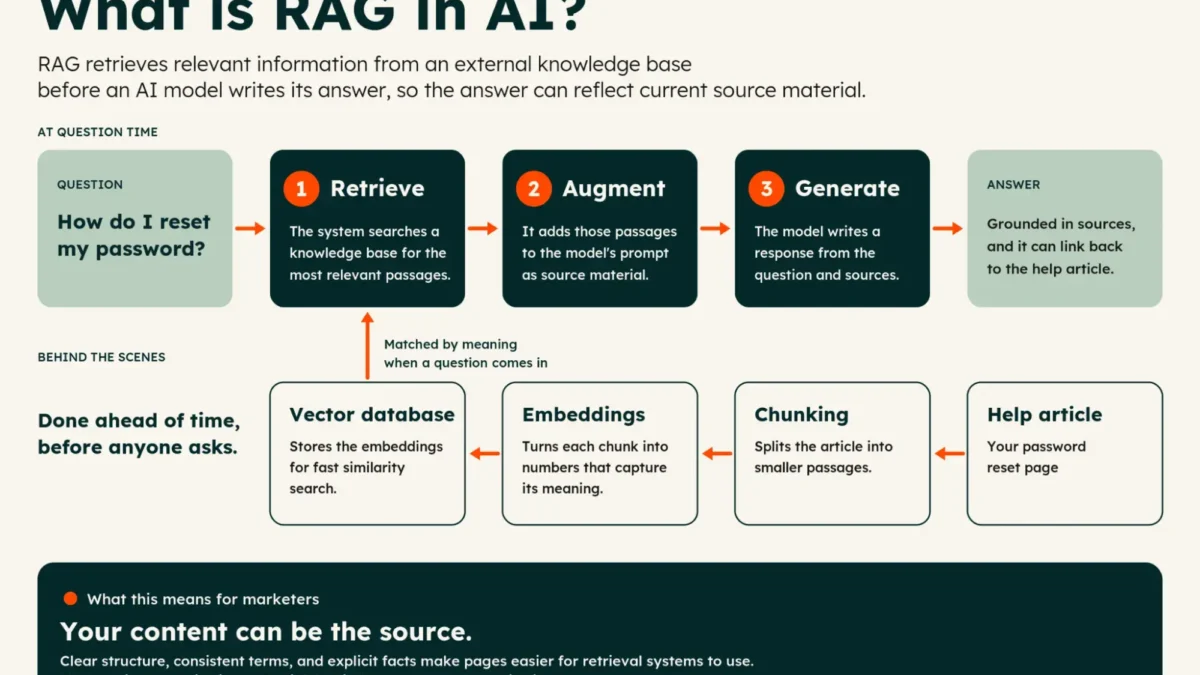
To adapt to this environment, marketing and communications teams must understand the mechanics behind modern language models. Retrieval-Augmented Generation is a method that retrieves relevant information from an external knowledge base before a model generates a response. The terminology emerged prominently from a seminal 2020 research paper titled "Retrieval-Augmented Generation for Knowledge-Intensive NLP Tasks," authored by Patrick Lewis and his colleagues. The paper demonstrated that pairing a pre-trained language model with a searchable external index—such as Wikipedia—drastically improved the factual accuracy and contextual relevance of generated text.
Without a RAG framework, a standard large language model (LLM) relies entirely on the patterns and data it absorbed during its initial training phase. This internal knowledge inherently possesses a cutoff date and fails to account for real-time updates, such as a company’s latest pricing structure, recent product launches, or newly published help articles.
A RAG architecture bridges this gap dynamically. When a user submits a prompt, the system first executes a search across an external knowledge base—which might include a corporate help center, a product database, or an internal document repository. It extracts the most relevant text passages, injects them into the prompt as context, and then commands the model to formulate an answer grounded specifically in those retrieved sources.

To explain the mechanism to non-technical stakeholders, industry experts often rely on a straightforward analogy: a standard LLM is akin to a remarkably articulate colleague answering questions strictly from memory. Conversely, a RAG system represents that same knowledgeable colleague equipped with the company wiki open in a secondary browser tab. The intelligence of the individual remains identical, but the accuracy and currency of the response depend entirely on the quality, organization, and completeness of the reference materials.
The Implications for Answer Engine Optimization (AEO) and Brand Visibility
The integration of RAG into mainstream search and discovery platforms has accelerated the rise of Answer Engine Optimization (AEO). Unlike traditional Search Engine Optimization (SEO), which focuses heavily on keyword rankings and earning a spot on a search engine results page (SERP), AEO focuses on securing citations and mentions within AI-generated responses.
Retrieval systems evaluate web pages by fragmenting them into smaller, digestible segments known as "chunks." Each chunk is evaluated independently for clarity, semantic relevance, and factual reliability. A paragraph that opens with a direct answer, explicitly identifies the subject matter, and states facts in clear, declarative sentences can stand alone as a cohesive unit of information. Conversely, ambiguous phrasing—such as relying on conversational filler or dependent clauses like "as mentioned above"—destroys the contextual integrity of the chunk, rendering it useless to a retrieval algorithm.
This fundamental difference means that traditional ranking success no longer guarantees brand visibility. A webpage may rank in the top three positions for a competitive keyword, but if its content structure is difficult for an AI retrieval system to parse, it will be bypassed in favor of a structurally superior competitor whose insights are seamlessly integrated into the AI’s final output.
Strategic Decision-Making: RAG Versus Fine-Tuning
As organizations invest heavily in artificial intelligence infrastructure, leadership teams frequently debate whether to implement RAG or pursue model fine-tuning. Industry analysts emphasize that these two methodologies serve distinct purposes and are rarely interchangeable.
RAG is the optimal strategy when an organization’s underlying data changes frequently—such as inventory lists, policy updates, or dynamic pricing—or when generated answers require verifiable citations that link back to primary source materials. By keeping the knowledge base external to the model, organizations can update their content continuously without needing to retrain the underlying neural network.
Conversely, fine-tuning involves modifying the internal weights and parameters of a language model by exposing it to a specialized dataset. This approach is best deployed when an organization needs to fundamentally alter a model’s behavioral style, tone of voice, or proficiency in handling specialized, highly technical tasks where core principles remain stable over long periods.
Because both approaches possess inherent limitations—RAG systems remain vulnerable to poor knowledge-base organization, while fine-tuned models inevitably suffer from data obsolescence over time—leading enterprises increasingly adopt a hybrid model. In this setup, automated tools propose data-driven responses, while human editors maintain rigorous oversight.

Mitigating Pitfalls: Hallucinations and Quality Control
Despite its ability to ground AI responses in factual source material, RAG does not completely eliminate the risk of hallucinations—instances where a model generates false or fabricated information with absolute confidence.
The reliability of retrieval systems was highlighted in a 2025 empirical study led by Stanford University researchers, published in the Journal of Empirical Legal Studies. The research team evaluated RAG-based legal research platforms marketed by commercial vendors as advanced solutions designed to eliminate hallucinations. The findings revealed that tools from major providers still hallucinated in more than 17% of test queries, albeit at a lower rate than unaugmented general-purpose chatbots.
These findings underscore a critical operational reality: while retrieval architecture significantly improves data accuracy, automated systems cannot replace human fact-checking. Content governance frameworks must be established to ensure that the foundational knowledge bases feeding RAG systems are regularly audited, updated, and verified by subject-matter experts.
A Practical Checklist for Retrieval-Friendly Content
Content creators and marketing strategists looking to optimize their digital assets for AI retrieval systems must adopt a rigorous editorial and structural discipline. Industry best practices suggest focusing on several key optimization steps:
- Prioritize Direct Answers: Structure content so that headings are immediately followed by concise, definitive one- or two-sentence answers, allowing retrieval algorithms to easily extract self-contained informational chunks.
- Maintain Terminological Consistency: Utilize uniform industry terminology across all documentation to ensure that vector databases and embedding models can accurately match related semantic concepts.
- Eliminate Ambiguity: Write declarative sentences that clearly name their subjects, avoiding pronouns or vague transitional phrases that lose meaning when text is fragmented.
- Utilize Structured Formats: Incorporate bulleted lists, numbered step-by-step guides, and clean data tables to facilitate machine readability.
- Provide Metadata and Timestamps: Include explicit author credentials and publication or modification dates on content where factual recency and domain expertise are paramount.
The Broader Impact on Enterprise Strategy
As search engines, enterprise software platforms, and customer service portals universally adopt Retrieval-Augmented Generation, the division between technical development and content strategy continues to dissolve. Maintaining a robust digital presence now requires treating an organization’s entire public-facing content ecosystem—blogs, help centers, product specifications, and whitepapers—as a mission-critical database designed for both human readers and machine intelligence.
Organizations that adapt their content architecture to meet the rigorous demands of retrieval systems will secure prominent visibility in the next generation of digital discovery. Those that fail to evolve risk being marginalized in an ecosystem where answers are synthesized instantly, sources are vetted algorithmically, and unoptimized brands remain entirely unseen.