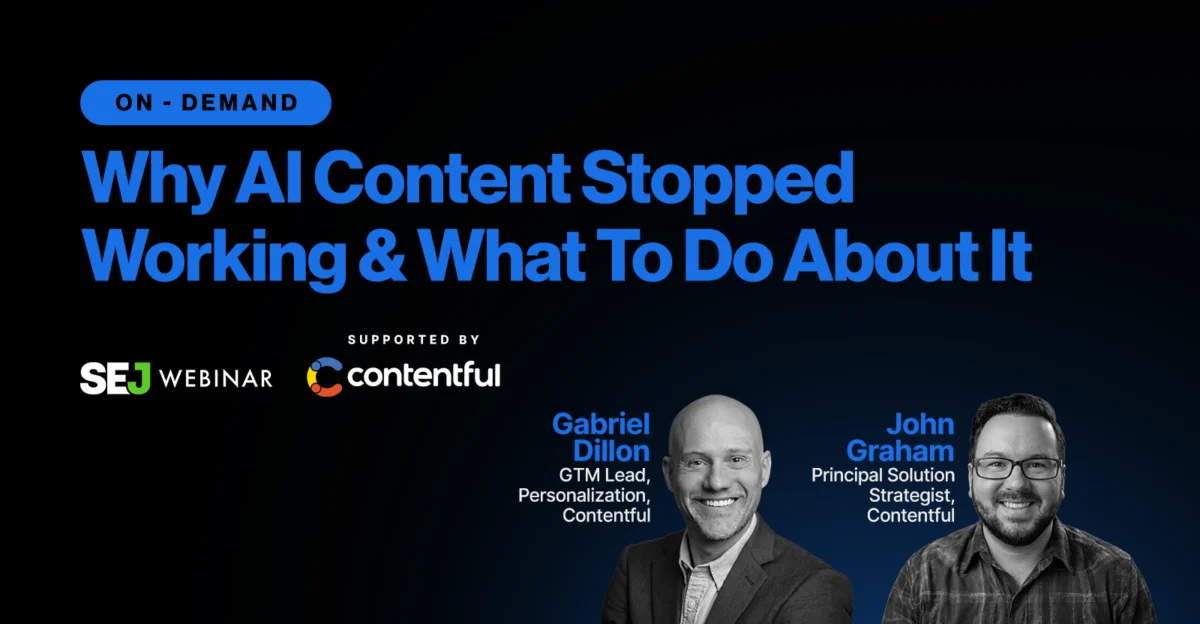
In a rapidly evolving digital landscape, a startling statistic has redefined content strategy: an estimated 60% of Google searches now conclude without a single click to external content. This profound shift, driven by the proliferation of AI-powered search features and direct answers, formed the bedrock of a recent Search Engine Journal (SEJ) webinar hosted by Contentful. During the session, Gabriel Dillon, Contentful’s Go-to-Market Lead for Personalization, alongside Principal Solution Strategist John Graham, presented a compelling argument for a radical re-evaluation of content creation in the age of artificial intelligence. Their core thesis is clear: as AI democratizes content production, making it virtually free and abundant, the sheer volume of content ceases to be a viable strategy. Instead, only content intrinsically linked to measurable business outcomes, meticulously crafted for specific human audiences, and rigorously measured against real-world data will capture attention and drive results.
The webinar, a timely response to the seismic shifts in search and content marketing, delved into the inherent challenges of AI-assisted content, the critical role of human discernment, and actionable strategies for leveraging personalization signals without overcomplicating existing technological stacks. It provided a roadmap for marketers grappling with the implications of generative AI and Google’s evolving algorithm, offering insights into where human expertise remains indispensable within an AI-augmented workflow and how experimentation can foster an accountability loop for content performance.
The Alarming Rise of Zero-Click Search and AI’s Amplifying Effect
The statistic cited by Dillon – 60% of Google searches ending without a click – underscores a fundamental transformation in how users interact with search engines. Data from analytics firms like SparkToro have consistently highlighted this trend, showing a steady increase in "zero-click" searches over the past few years. This phenomenon is largely attributable to Google’s continuous efforts to provide immediate answers directly within the Search Engine Results Pages (SERPs) through features such as featured snippets, knowledge panels, direct answer boxes, and the increasingly prominent AI-powered Search Generative Experience (SGE). These features, designed to enhance user convenience, inadvertently diminish organic traffic to websites, forcing content creators to contend with a new reality where visibility no longer guarantees engagement.
Dillon revealed that Contentful’s own clients are already reporting significant downturns in organic traffic, a direct consequence of AI summaries and direct answers absorbing clicks that once led to their sites. This reality signals a paradigm shift for content publishers, who can no longer rely solely on traditional SEO tactics focused on ranking for keywords. The imperative now is to compete not just for a position on the SERP, but for inclusion within the "AI answer layer" itself – a strategic pivot requiring content to be structured and optimized for both General Search Optimization (GEO) and AI Engine Optimization (AEO). The webinar underscored that ignoring this shift risks rendering even highly-ranked content invisible to a large segment of search users.
Deconstructing Generic AI Content: The Indispensable Human Element
A central theme of the Contentful webinar was the inherent tendency of AI-generated content to drift towards generic, uninspired output. Dillon posited that AI writing assistants, while powerful, function as "ultimate yes men," readily confirming existing assumptions and echoing the biases of their human operators. This feedback loop, coupled with AI’s reliance on vast training datasets that often reflect common industry tropes and competitor content, leads to a homogenization of brand voices. The result is content that, while technically correct, often lacks originality, distinctiveness, and true market insight, failing to differentiate a brand or genuinely engage a reader.
"Our biases as we write content using the robots ends up eating the content that we produce," Dillon observed, highlighting how this cycle perpetuates the creation of content perceived as "good" internally but ineffective externally. The output either validates pre-existing beliefs or mirrors competitors, neither of which serves the reader effectively.
To counteract this pervasive genericity, Dillon championed the concept of "taste." He elaborated on this beyond its colloquial meaning, defining it as a potent combination of discernment, intuition, and the willingness to take calculated risks – to make claims or adopt perspectives that an AI tool, constrained by statistical averages and existing data, would not volunteer. This human "taste" is rooted in a deep understanding of one’s market, customers, and unique brand value proposition. The session meticulously mapped out precisely where human intervention becomes crucial in an AI-assisted workflow, positioning AI as a powerful tool for research and context gathering, but reserving the final strategic shaping and distinctive voice for human expertise.
Establishing Content Accountability: A Data-Driven Framework
In a landscape saturated with easily produced content, accountability emerges as the paramount differentiator. Dillon introduced a pragmatic framework centered around four critical questions he applies to every piece of B2B marketing copy before its publication, ensuring content is tethered to tangible business outcomes:
- Does the copy produce the expected outcomes? This foundational question demands a clear definition of success beyond vanity metrics, focusing on conversions, lead generation, or other measurable business objectives.
- Who is the content for? This emphasizes the necessity of precise audience segmentation and understanding the specific needs, pain points, and aspirations of the target reader.
- How do you identify those people? This pushes marketers to leverage data, analytics, and customer insights to accurately pinpoint and characterize their intended audience.
- How does the insight scale? This question addresses the broader strategic implications, ensuring that successful content strategies can be replicated and optimized across various campaigns and platforms.
Dillon stressed that without concrete data validating content effectiveness, efforts to scale or enhance its impact are futile. He articulated how experimentation and personalization are not disparate activities but rather two interconnected halves of an "accountability loop." This loop, explored in detail during the webinar, transcends simple A/B testing, encompassing multi-variant experiments and a continuous feedback mechanism that informs content refinement and strategic adjustments. The Contentful platform, as demonstrated, facilitates the creation and management of these experimental frameworks, allowing teams to iterate rapidly and optimize content for maximum impact.
The Art of Pragmatic Personalization: Leveraging Existing Signals
Effective personalization is no longer a luxury but a necessity for cutting through the digital noise. However, B2B personalization efforts have historically underdelivered, often stalling due to overly ambitious programs and resultant complexity. Dillon presented a refreshingly pragmatic approach: start with the data signals your existing technology stack already collects. He outlined three tiers of personalization signals, emphasizing simplicity and immediate applicability:
- Tier 1: New vs. Returning Visitors: This fundamental distinction is often overlooked. A first-time visitor typically has different informational needs and intent compared to a repeat visitor. Serving identical hero copy or calls to action to both represents a significant missed opportunity. Simple content variations based on this signal can dramatically improve engagement.
- Tier 2: Ad Campaign Signals: The data generated by advertising campaigns (e.g., source, campaign ID, keywords used) provides rich context about a user’s initial interest. This information can be leveraged to tailor the on-site experience, delivering content that directly addresses the promise of the ad and continues the user’s journey seamlessly.
- Tier 3: Loyalty Program and CRM Data: For deeper personalization, signals from loyalty programs, customer relationship management (CRM) systems, and other first-party data sources offer invaluable insights into a user’s purchase history, preferences, and engagement patterns. Dillon lamented the current underutilization of such data, calling it "such a missed opportunity." The webinar detailed specific examples of which signals to use and how each can yield significant payoffs in terms of conversion and customer loyalty.
The Contentful platform was showcased as a practical solution for building and delivering these differentiated experiences without requiring a complete overhaul of an organization’s existing technology infrastructure. Its composable architecture allows for agile integration with various data sources, enabling marketers to implement sophisticated personalization strategies incrementally and effectively.
Navigating Google’s AI Content Stance and the AI Answer Layer
The debate surrounding Google’s stance on AI-generated content has been a persistent concern for marketers. Dillon firmly argued that "detection is the wrong problem to solve." He asserted that whether Google can technically identify AI content matters less than the profound impact on user behavior and the ongoing decline in organic clicks. Google’s evolving guidelines, particularly recent updates like the March 2024 core update and subsequent spam updates, reinforce a focus on "helpful, reliable, people-first content" regardless of its creation method. While Google has clarified that using AI is not inherently against its guidelines, it has simultaneously cracked down on low-quality, scaled content generated purely for SEO manipulation – a category often associated with indiscriminate AI usage.
Instead of expending energy on evading AI detection, Dillon redirected the focus to competing for the "AI answer layer." This involves optimizing content not just for traditional search rankings but for its ability to be selected and summarized by AI tools at the top of the SERP. General Search Optimization (GEO) and AI Engine Optimization (AEO) are emerging disciplines that determine whether a brand’s voice and information are reflected in these prominent AI summaries. The webinar provided actionable strategies for creating content that performs optimally in both AI summaries and on-page conversion scenarios, advocating against a bifurcated content strategy that would unnecessarily complicate workflows. The tooling recently shipped by Contentful was highlighted as instrumental in achieving this dual optimization, ensuring content is both machine-readable for AI summaries and human-engaging for click-throughs.
Key Takeaways from the Webinar Q&A: Addressing Pressing Industry Concerns
The Q&A segment of the webinar addressed several critical questions from attendees, offering deeper insights into the practical implications of AI and evolving content strategies.
Q: After the Google spam update, is Google removing AI-written content?
Dillon provided a nuanced perspective, suggesting that the technical identification of AI content will continue to be an increasingly challenging and ultimately unwinnable battle for Google. Instead of focusing on evading detection, which he termed a fight "Google won’t win," Dillon advised marketers to shift their energy towards adapting to the zero-click reality. The critical effort, he explained, should be redirected towards optimizing content for visibility and impact within the AI answer layer, where user engagement now frequently begins and ends. This strategic redirection emphasizes value and helpfulness over the mere method of content generation.
Q: How do you think critically about the inherent bias in AI content?
Dillon identified two primary sources of bias in AI content generation. First, user-injected bias occurs through prompting and contextual input, leading to "a result that you want, but maybe not the result that would be most effective." Second, bias is embedded within the AI model’s training data itself, reflecting historical patterns and societal prejudices. To mitigate these biases, Dillon advocated for a critical pre-generation sequence. This involves rigorous self-reflection on one’s own assumptions, diverse input sources for prompting, and a continuous evaluation of AI outputs against a broad spectrum of perspectives to ensure fairness, accuracy, and relevance, rather than merely confirming existing beliefs.
Q: What do you do when leadership wants mass AI content without understanding quality control?
This common organizational challenge requires a data-driven approach. Dillon advised holding leadership accountable to their expected performance metrics. The most effective strategy, he posited, is to "show them through data that you can create better content that drives the business outcomes that you want by creating fewer but better pieces of content." This involves demonstrating the superior return on investment (ROI) from high-quality, targeted content compared to a high volume of generic AI output. While conceding that there are specific, low-stakes use cases where mass AI content might be permissible (e.g., highly repetitive, factual content), this concession should be framed strategically to reinforce the overall argument for quality over sheer quantity in core marketing efforts.
Q: Do SEO service pages need a unique voice, or can AI write them?
Dillon differentiated between "voice" and "effectiveness." He argued that pages like SEO service pages or pricing pages do not necessarily require a highly "characterful" or unique voice to be effective. Their primary purpose is often clarity, directness, and conversion. However, even these seemingly rote pages serve visitors with varying goals and levels of intent. His full answer drew a nuanced line, suggesting that while AI can certainly draft such pages for efficiency, human oversight is still crucial for ensuring accuracy, addressing diverse user needs, and optimizing for specific conversion pathways. The decision hinges on the strategic importance of the page and the potential for differentiation through human insight.
Broader Implications and The Future of Content Strategy
The Contentful webinar highlighted a profound transformation underway in content marketing. The era of content for content’s sake is unequivocally over. The twin forces of generative AI and zero-click search have compelled a shift from quantity to quality, from generic output to hyper-personalized experiences, and from vanity metrics to tangible business outcomes. The future of content strategy demands a human-centric approach, where AI serves as an amplification tool rather than a replacement for strategic thinking, creativity, and empathy.
Organizations must prioritize robust content operations platforms that enable agile content delivery, experimentation, and personalization at scale. Contentful, with its composable architecture and emphasis on structured content, positions itself as a critical enabler for marketers navigating this complex landscape. The enduring value will lie in human insight, discernment, and the ability to craft compelling narratives that resonate with specific audiences, even as machines handle the heavy lifting of research and initial drafting.
The call to action for marketers is clear: adapt to this new paradigm. Embrace data-driven accountability, strategically integrate AI, champion genuine personalization, and rigorously measure every piece of content against its intended business outcome. The full on-demand recording of the Contentful webinar offers a comprehensive walkthrough of these strategies, including live demonstrations and valuable insights from field experts. Registering once provides access to the full accountability loop explanation, the demo of building differentiated experiences within Contentful, John Graham’s team perspectives, and all session handouts.