The intersection of artificial intelligence and modern journalism has transitioned from a theoretical debate over efficiency to a persistent operational crisis for newsrooms worldwide. As mainstream media organizations grapple with economic pressures and the allure of automated productivity tools, the adoption of generative AI has frequently outpaced internal safety protocols. The consequences—ranging from subtle policy infractions to severe reputational scandals involving fabricated authors, hallucinated quotes, and plagiarized reviews—have exposed profound vulnerabilities in traditional editorial vetting processes.
Industry trackers, notably compiled by the Press Gazette through mid-2026, reveal a systemic pattern of failure across various echelons of the press, affecting local newspapers, specialized digital outlets, and elite global broadsheets alike. This ongoing turbulence underscores an urgent industry-wide recalibration regarding transparency, accountability, and the absolute necessity of human oversight in content creation.
The Anatomy of Editorial Breaches: A Chronological Overview
The timeline of AI-related journalism failures highlights a diverse spectrum of missteps, categorized primarily into three areas: unsanctioned use of AI by human writers, automated hallucinations of quotes and facts, and sophisticated external actors exploiting freelance networks through synthetic identities.
Late 2023 to Early 2025: The Foundation of Automated Deception
The early warning signs of systemic exploitation emerged vividly in November 2023, when Sports Illustrated faced severe backlash after discovery of e-commerce product reviews attributed to authors with AI-generated headshots and pseudonyms. Although the publisher, Arena Group, initially defended the material, subsequent investigations revealed reliance on external syndication partners utilizing synthetic author personas. This set a troubling precedent that would repeat across the tech and lifestyle sectors.
By January 2025, CNET faced internal audits after quietly publishing dozens of AI-assisted financial explainers, ultimately correcting over half of a test batch of 77 articles due to factual errors, transposed numbers, and vague phrasing. Concurrently, regional European publications began experiencing direct breaches. In January 2025, the Dutch edition of Harper’s Bazaar published a book round-up containing plot inaccuracies generated by ChatGPT, leading to a quiet retraction.
The spring and summer of 2025 exposed an even more insidious threat: the rise of fraudulent freelance pitches. In May 2025, the Chicago Sun-Times and The Philadelphia Inquirer published a syndicated summer reading list containing nonexistent books, generated by an AI agent deployed by an external freelance creator via King Features.
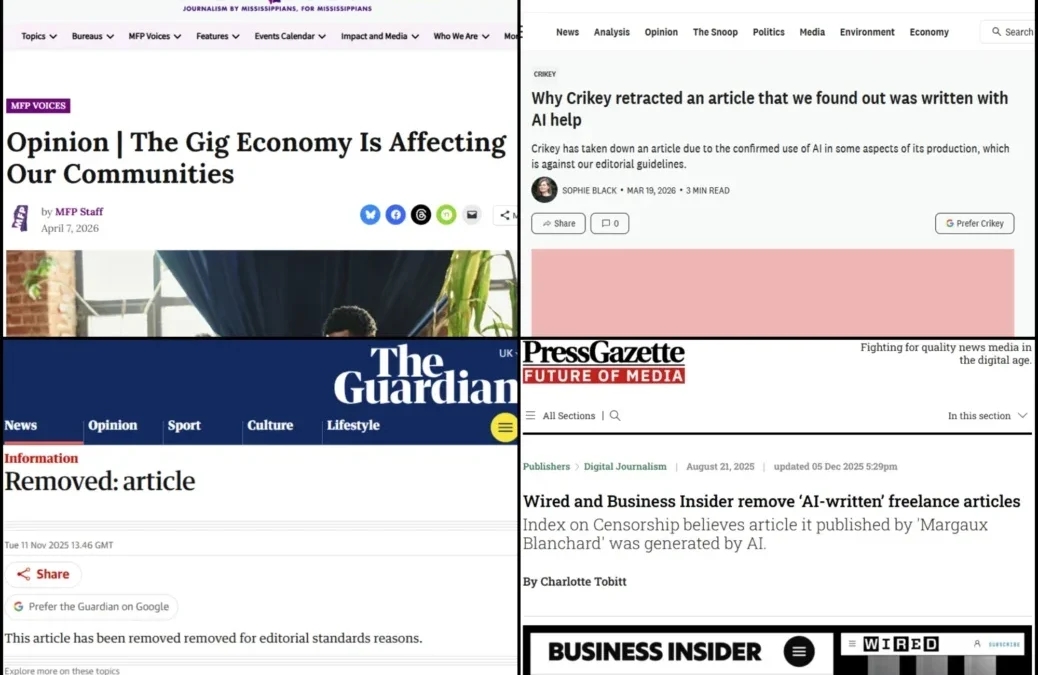
Weeks later, a major investigation exposed the operations of synthetic freelance personas, most notably "Margaux Blanchard." Outlets including Wired, Business Insider, SFGate, and Cone Magazine were forced to purge articles containing fabricated case studies and unverified human sources. Business Insider subsequently removed 38 first-person essays following broader internal reviews. In Belgium, Ventures Media—publisher of regional editions of Elle and Marie Claire—was forced to apologize and add transparent disclosures after deploying synthetic journalist profiles such as "Claire De Wilde" to generate significant portions of online lifestyle copy.
Late 2025 to Mid-2026: Escalation in Elite Newsrooms
As generative models matured, the frontier of failure shifted toward established opinion columns and investigative desks. In November 2025, The Guardian retracted a first-person essay by a freelance contributor later implicated in systemic synthetic submissions, highlighting vulnerabilities in cultural commentary desks.
The year 2026 witnessed high-profile incidents involving academic contributors and prominent financial commentators. In March 2026, Ars Technica terminated a senior AI reporter after discovering that an article covering artificial intelligence contained fabricated direct quotes attributed to a real software engineer, created inadvertently during a workflow involving Claude Code and ChatGPT.
That same month, Peter Vandermeersch, former CEO of Mediahuis Ireland and a prominent journalism commentator on Substack, was suspended by Dutch newspaper NRC after an audit revealed that nearly 30% of his analyzed blog posts contained AI-hallucinated quotes erroneously attributed to media executives and industry reports.
The Spring 2026 Wave of Corrections and Retractions
May and June 2026 marked a concentrated period of retractions across international media:
- The New York Times issued a belated correction in May 2026 regarding a profile of Canadian opposition leader Pierre Poilievre, revealing that an AI tool had synthesized an opinion summary and rendered it inside quotation marks.
- Danish daily Berlingske suspended an employee in May 2026 after discovering that an AI summary tool had fabricated expert sources and direct quotes within a business feature.
- UK tabloids and broadsheets, including The Telegraph, The Sun, and the Daily Mail, were widely criticized after being duped by an AI-manipulated image originating from a Thai police station’s Facebook page, depicting officers in drag arresting a drug suspect.
- In June 2026, The Sydney Morning Herald removed an opinion piece authored by academic Professor Cath Ellis. Although Ellis maintained she had uploaded 40,000 words of her own research into a Copilot LLM to structure the draft rather than having AI "write" it, the Herald concluded the stylistic markers and lack of direct human generation violated core editorial standards.
The Late Summer 2026 Flashpoints: Policy Interpretations and Byline Errors
By August and September 2026, debates solidified around the nuanced distinction between AI as a mechanical assistant and AI as an autonomous author.
The Financial Times issued a prominent disclaimer on an opinion piece by Harvard professor Ricardo Hausmann in August 2026, noting that the author had utilized an AI tool to condense a longer draft prior to submission, directly violating the FT’s editorial code prohibiting generative AI in text production.
Conversely, The Wall Street Journal defended the methodology of hedge fund billionaire and columnist Stanley Druckenmiller in August 2026. After Druckenmiller openly admitted to using AI to draft a critique of US Treasury Secretary Scott Bessent’s bond buyback plan—likening the technology to a mathematical calculator—WSJ opinion editor Paul Gigot defended the publication. Gigot argued that the arguments represented Druckenmiller’s genuine, established viewpoint and that utilizing linguistic tools for drafting was an inevitable facet of modern commentary.
Meanwhile, verification failures continued to plague digital desks. In July 2026, Marie Claire Australia and UK regional site Bristol Live inadvertently published raw AI prompts and conversational metadata within live posts, exposing hasty editorial workflows. Similarly, in September 2026, a government reporter for Cleveland.com discovered her byline attached to a local policy report published while she was on her honeymoon. The piece had been compiled by the site’s "Express Desk," which utilizes AI assistance under staff review, but was incorrectly attributed to a human journalist in error.
Systemic Implications for the Publishing Industry
The cumulative weight of these incidents highlights structural fault lines within contemporary digital publishing. Publishers face intense economic imperatives to maximize output and maintain search engine visibility, creating an environment where efficiency tools are adopted ahead of robust governance frameworks.
-
The Erosion of Source Authenticity: The most damaging implication is the contamination of public discourse through hallucinated quotations and synthetic case studies. When readers can no longer trust that a quoted expert exists or that a attributed speech accurately reflects a politician’s words, the foundational credibility of journalism is compromised.
-
The Freelance Vetting Deficit: Traditional commissioning models rely heavily on trust and credential verification. The proliferation of sophisticated synthetic identities—such as those encountered by the Mississippi Free Press, The Grind, and Business Insider—demonstrates that malicious actors can easily weaponize generative tools to harvest freelance fees by flooding regional and independent publications with artificial submissions.
-
Divergent Editorial Standards: The contrast between the Financial Times’ strict prohibition of AI-assisted drafting and the Wall Street Journal’s pragmatic acceptance of contributor-side AI usage reveals a lack of industry consensus. While major newsrooms universally condemn undisclosed AI authorship, the gray area surrounding grammar checking, structural condensing, and stylistic refinement remains legally and ethically contested.
Path Forward: Rebuilding Safeguards and Protocols
In response to these systemic failures, news organizations are actively revising operational workflows. Enhanced verification protocols now demand multi-step human audits of all freelance submissions, independent verification of quoted sources prior to publication, and transparent disclosures when automated summaries or data-driven investigations incorporate machine-learning inputs.
As media organizations navigate the latter half of the 2020s, the lesson remains unequivocal: while artificial intelligence offers unprecedented capabilities for data analysis and logistical efficiency, the preservation of journalistic integrity depends entirely on rigorous, unbroken human accountability at every stage of the publishing lifecycle.