T-Mobile has officially launched its highly anticipated T-Mix subscription framework, a strategic overhaul of its wireless service model that replaces rigid, pre-bundled packages with a modular "pick-your-perks" system. Starting in November, the carrier will roll out three distinct tiers—Standard, More, and Loaded—designed to move away from the traditional "one-size-fits-nobody" strategy that has dominated the telecommunications landscape for the past decade. This shift represents a significant departure from the bundled streaming and subscription services that previously characterized T-Mobile’s "Un-carrier" marketing strategy, signaling a transition toward consumer-led utility and individualized service customization.
The Anatomy of T-Mix: Pricing and Tier Structure
The T-Mix ecosystem is built upon a credit-based architecture known as "Picks." Subscribers are allocated a specific number of Picks based on their chosen plan, which can be redeemed for a diverse array of lifestyle and wireless services. All pricing structures listed below are contingent upon enrollment in AutoPay and exclude applicable taxes and regulatory fees.
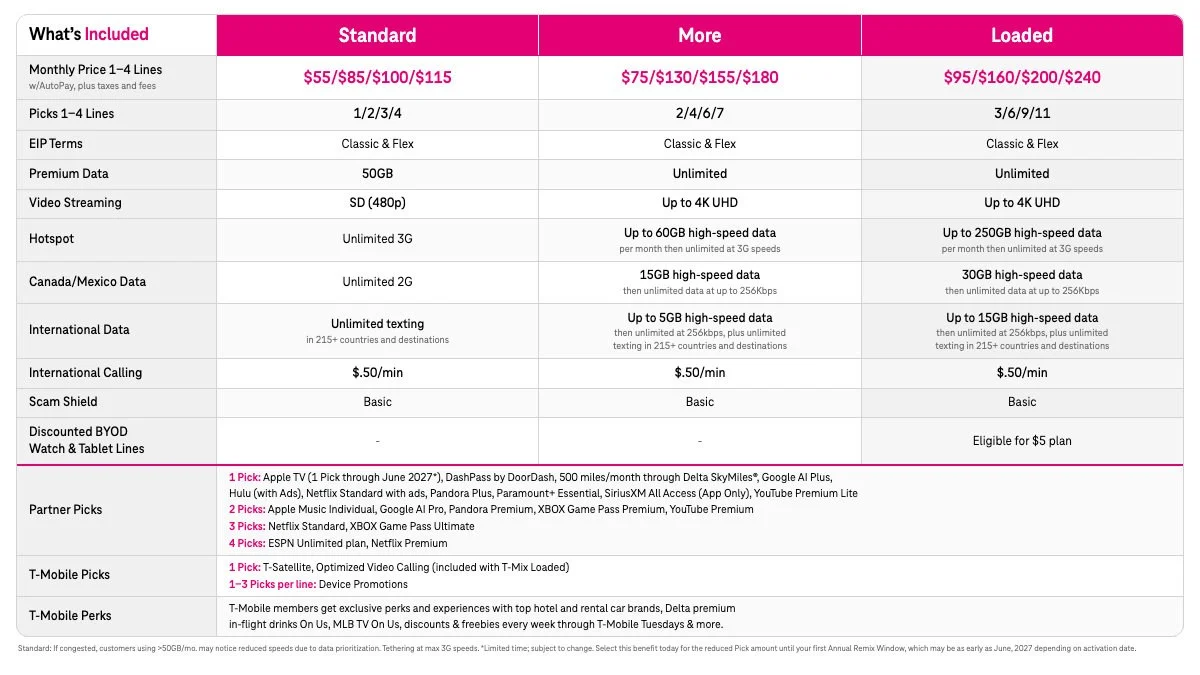
- T-Mix Standard: Priced at $55 per month for a single line, this entry-level tier includes one Pick. It is designed for the budget-conscious user who requires baseline connectivity.
- T-Mix More: Available for $75 per month, this tier provides two Picks, catering to the mid-market consumer seeking enhanced data performance and additional entertainment options.
- T-Mix Loaded: At $95 per month, this premium tier grants users three Picks. For family accounts, the Loaded plan offers an aggressive incentive: the first three lines each receive three Picks, with a cumulative cap of 11 Picks per account, allowing for extensive service customization across a household.
In keeping with T-Mobile’s historical focus on accessibility, the carrier has confirmed that these plans will feature discounted versions for key demographics, including customers aged 55 and older, military personnel, veterans, first responders, and college students, ensuring that the T-Mix model remains competitive across various socio-economic segments.
Chronology and Development of the T-Mix Initiative
The path to the official announcement of T-Mix has been marked by a period of industry speculation and internal structural adjustments at T-Mobile.
In early 2024, industry analysts observed a softening in the growth rate of traditional "all-inclusive" mobile bundles. Consumers, facing "subscription fatigue" from the proliferation of streaming services, began expressing a preference for greater autonomy. T-Mobile’s leadership recognized this shift, and by the third quarter of 2024, reports surfaced regarding a project codenamed "T-Mix."
By mid-October 2024, leaks regarding the specific tier names—Standard, More, and Loaded—began appearing in tech circles, suggesting an imminent launch. The official announcement today confirms that the carrier has spent the last several months finalizing agreements with a massive roster of partners, ranging from legacy entertainment providers like Netflix and Hulu to modern tech infrastructure partners such as Google Gemini and Xbox. The official rollout date in November coincides with the lead-up to the holiday shopping season, a tactical decision intended to capture users looking to refresh their mobile contracts before the end of the fiscal year.
The Ecosystem of Picks: A New Approach to Value
The core innovation of T-Mix lies in the flexibility of the Picks system. T-Mobile has curated a broad portfolio of benefits that can be categorized into two primary buckets: Partner Perks and Wireless Benefits.
Partner Perks include established entertainment giants such as Apple TV, DashPass, Hulu, Netflix, Pandora, and SiriusXM. The addition of new, high-value partners—specifically Apple Music, ESPN Unlimited, Delta SkyMiles, Google Gemini, Paramount+, Xbox Game Pass, and YouTube Premium—positions T-Mobile not just as a data provider, but as a lifestyle aggregator.
The inclusion of "Wireless Benefits" is perhaps the most technical aspect of the program. Users can allocate Picks to optimize their network experience, such as activating the new "Optimized Video Calls" feature. This feature utilizes network slicing technology—a core capability of T-Mobile’s 5G standalone architecture—to prioritize video conferencing traffic, ensuring higher stability and reduced latency for professional and personal communications. Additionally, users can utilize Picks toward T-Satellite services, an emerging technology providing connectivity in remote or dead-zone areas, and device promotions, which can be applied toward the purchase of new hardware.
The swap mechanism is designed with a hybrid approach: Partner Perks can be changed four times annually, utilizing three "change windows" plus an "Annual Remix" window to prevent excessive churning that could undermine partner contracts. Wireless Benefits, however, are dynamic and can be swapped at any time to reflect the user’s immediate connectivity needs.
Technical Specifications and Data Performance
The tiered structure of T-Mix also dictates the performance metrics of the mobile service:
- Standard: Users receive 50GB of premium data per month. Video streaming is capped at 480p, and mobile hotspot usage is restricted to 3G speeds.
- More: This tier upgrades the user to unlimited premium data with video streaming up to 4K resolution. Hotspot data is significantly increased, providing 60GB of high-speed access before throttling to 3G speeds.
- Loaded: The flagship offering provides unlimited premium data and 4K streaming, along with a robust 250GB of high-speed hotspot data.
International capabilities are equally segmented. While Standard offers only unlimited texting across more than 215 countries, More and Loaded provide 5GB and 15GB of high-speed data for international travel, respectively. In North America, the disparity remains clear: Standard is limited to 2G speeds in Canada and Mexico, whereas More and Loaded offer 15GB and 30GB of high-speed data, respectively, before reverting to 256Kbps unlimited connectivity.
Analysis: Market Implications and Strategic Rationale
Allan Samson, T-Mobile’s Chief Marketing Officer, articulated the strategy behind this move by describing the industry-standard approach as "one-size-fits-nobody." From an analytical perspective, T-Mobile is attempting to solve a specific problem in the current telecommunications market: the "bundling trap."
For years, carriers have bundled services that users may not utilize, effectively inflating the monthly cost of a plan with "value-add" features that have low utility for certain demographics. By allowing consumers to choose their own perks, T-Mobile is effectively shifting the burden of value optimization to the user. This creates a data-rich environment for T-Mobile; by tracking which "Picks" are most popular, the carrier can refine its future partnerships, dropping underutilized services and prioritizing those that drive high retention.
However, the model is not without risks. Managing a dynamic, fluctuating list of partners requires significant back-end integration and customer support capability. If the user interface for managing these Picks is not intuitive, the complexity of the "swap" windows could lead to customer frustration. Furthermore, the reliance on AutoPay for the advertised pricing remains a standard, albeit sometimes controversial, industry practice that keeps consumers locked into recurring billing cycles.
Future Outlook and Expansion
T-Mobile has stated that the current list of partners is not static. The carrier intends to introduce new partners and benefits periodically, essentially turning the T-Mix platform into a living catalog. This suggests that the carrier is positioning itself to be a primary utility provider, where the mobile phone contract acts as the central hub for a user’s entire digital life.
As of the current announcement, the industry is watching to see how competitors such as Verizon and AT&T respond. Should T-Mix prove successful in increasing Average Revenue Per User (ARPU) while simultaneously lowering churn, it is highly probable that the industry will see a broader pivot toward modular, pick-based subscription models. For now, T-Mobile has set a new benchmark in service customization, placing the power of choice squarely back into the hands of the subscriber. Whether this results in tangible cost savings for the average consumer, or simply adds another layer of complexity to the monthly bill, will be determined by how effectively users leverage their Picks to suit their specific digital habits.