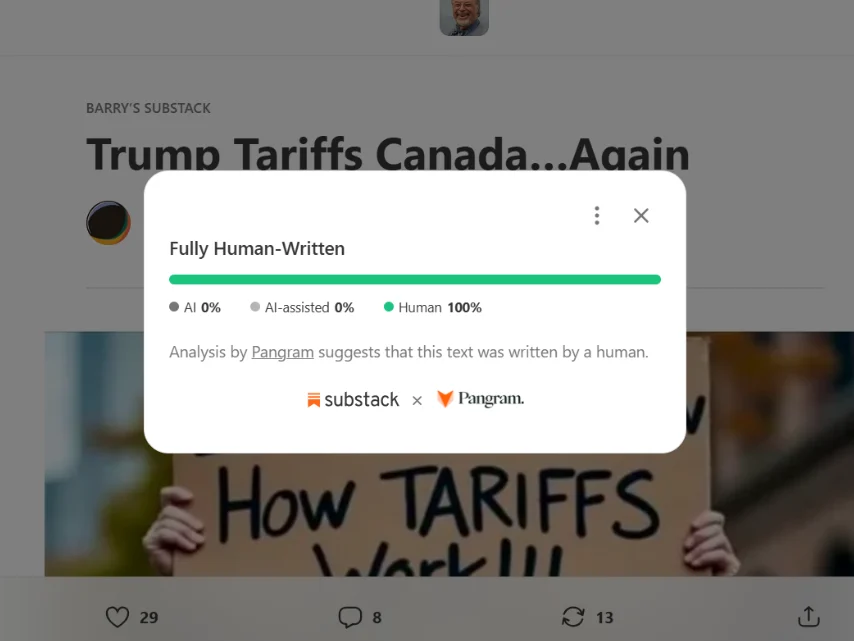
Substack, a leading platform for independent writers and creators, has announced a significant new initiative aimed at bolstering transparency and trust in digital content. In a strategic partnership with AI plagiarism checker Pangram, the platform has rolled out a novel "scan for AI text" feature. This tool, designed to identify the presence and percentage of AI-generated content within articles, became active for all Substack posts published after 4:30 PM on July 21, 2026. Readers can now access this functionality via a dedicated tile in the drop-down menu located in the top right corner of the web version of any eligible post, receiving an immediate assessment of AI content.
The Genesis of the Feature: A Response to an Evolving Digital Landscape
The introduction of this AI detection capability by Substack is not merely a technical update but a direct response to the rapidly evolving landscape of digital content creation, profoundly reshaped by advancements in artificial intelligence. Over the past few years, generative AI tools, exemplified by large language models (LLMs) like those that emerged in the early 2020s, have become increasingly sophisticated and accessible. These tools have democratized content creation to an unprecedented degree, enabling users to generate text, images, and even code with remarkable speed and coherence. While this has opened new avenues for productivity and creativity, it has simultaneously introduced complex challenges concerning authenticity, originality, and the very definition of human authorship.
Substack, which has carved out a niche as a sanctuary for long-form, human-centric writing and journalism, finds itself at the epicenter of this debate. The platform’s business model hinges on direct relationships between writers and their subscribers, built on trust and the perceived value of unique, human-crafted perspectives. As the volume of AI-generated content surged across the internet, concerns mounted that an influx of automated text could dilute the quality and integrity of the content offered on platforms like Substack, thereby eroding reader trust and devaluing the labor of human writers.
Chris Best, Substack’s co-founder and CEO, articulated the core motivation behind this move in an article announcing the feature. He emphasized that a lack of transparency regarding AI usage "undermines trust in authorship and threatens the livelihoods of writers." Best elaborated on the crucial distinction between reader expectation and reality, stating, "The problem is when there is a mismatch between a reader’s expectation and reality, especially when they unwittingly invest their attention in something with no human thought on the other end." This statement underscores Substack’s commitment to preserving the human element at the heart of its platform, viewing uncredited AI content as a potential deception that could betray the implicit contract between a writer and their paying audience.
Pangram’s Role and the Mechanics of AI Detection
The partnership with Pangram positions Substack at the forefront of content integrity efforts within the creator economy. While the exact proprietary algorithms employed by Pangram remain confidential, AI detection tools typically function by analyzing various linguistic patterns, stylistic fingerprints, and statistical anomalies within a text that deviate from typical human writing. These include metrics such as "perplexity" (how surprised a language model is by a sequence of words) and "burstiness" (the variation in sentence length and structure). AI-generated texts often exhibit lower perplexity and more uniform burstiness compared to human writing, which tends to be more unpredictable and diverse in its linguistic construction.
The "scan for AI text" feature presents readers with a percentage indicating the likelihood or proportion of AI-generated content within an article. This granular approach aims to provide a nuanced understanding rather than a binary "AI or human" judgment. However, the efficacy and precision of AI detection technologies are subjects of ongoing debate within the tech community. The "arms race" between AI content generators and detectors is continuous, with new models constantly being developed to bypass existing detection methods, and detectors simultaneously evolving to catch these newer patterns. This inherent challenge means that while tools like Pangram’s offer a valuable layer of scrutiny, they are not infallible and may occasionally produce false positives or negatives, a point that contributes to the ongoing controversy.
A Community Divided: Reactions from the Creator Ecosystem
The announcement of the AI detection feature immediately ignited a fervent discussion within the Substack community, particularly in the comments section of Chris Best’s explanatory post. The reactions reveal a deep philosophical divide regarding the role of AI in creative endeavors and the future of human authorship.
One prominent voice against the new feature was Substack writer Monica Herbet, who voiced her strong disapproval: "I use AI. I also bring the stories, memories, opinions, arguments, humor, lived experience, and final judgement. My readers seem perfectly capable of recognising that a real woman is present… The presence of AI does not prove the absence of a human." Herbet’s statement encapsulates the sentiment of many writers who view AI not as a replacement, but as a powerful assistive tool, akin to a sophisticated spell-checker, research assistant, or brainstorming partner. They argue that using AI for tasks like drafting outlines, refining language, or generating initial ideas does not diminish the ultimate human intellectual and creative input that shapes the final piece.
This perspective resonated with many other commenters. One user characterized the feature as "nothing but an imperfect purity test for writers," contending that it "discourages writers from using all the tools that are available for them to use." This critique highlights concerns that the detection tool might inadvertently penalize writers who leverage AI for efficiency or to overcome creative blocks, potentially stifling innovation rather than promoting authenticity. Another commenter expressed apprehension about what they perceived as "another layer of bureaucracy," advocating for reader autonomy: "Substack should let people develop their own inner guidance. That is what this next evolution of human is." This argument posits that readers should be empowered to discern authenticity themselves, fostering critical thinking rather than relying on automated scores.

Conversely, a significant segment of the community lauded Substack’s initiative, emphasizing the importance of preserving the integrity of human-generated content. One supporter remarked, "If people are using AI to entirely produce content, then AI needs to get the credit. Authors have editors and others who read their work, how is this different." This viewpoint draws a parallel between AI and traditional editorial assistance, arguing that if AI plays a substantial role in content generation, it warrants acknowledgment. Another commenter articulated a fundamental desire for human connection in their consumption of content: "I love Substack, I’m here every day because I enjoy the HUMAN content." For these readers, the allure of Substack lies precisely in its promise of direct engagement with unique human voices, and any perceived intrusion of automated content diminishes that core value proposition.
Broader Industry Context and Data: The AI Content Deluge
The debate on Substack reflects a larger, industry-wide reckoning with the proliferation of AI-generated content. Data from various research firms in late 2025 and early 2026 indicated a dramatic surge in automated content online. One report from the "Digital Content Institute" projected that by the end of 2026, over 40% of all new text-based content published online could have significant AI involvement, up from less than 5% in 2023. This exponential growth has fueled concerns about content saturation, the spread of misinformation, and the devaluation of human creative work.
Furthermore, studies on reader behavior have consistently shown a decline in trust in online information sources. A "Global Trust in Media" survey conducted in Q1 2026 revealed that only 35% of respondents expressed high trust in content found on social media and independent blogs, a significant drop from 55% in 2022. This erosion of trust is partly attributed to the difficulty in discerning credible, human-vetted information from algorithmically generated or manipulated content. Platforms like Substack, which rely on a premium subscription model, are particularly vulnerable to this decline in trust, as subscribers pay for a perceived quality and authenticity that AI content could undermine.
Other platforms and academic institutions are also grappling with similar challenges. Medium, for instance, introduced a policy requiring authors to disclose AI assistance if it constitutes a substantial portion of their work. Academic integrity offices worldwide have implemented AI detection software to combat plagiarism in student submissions, highlighting the pervasive nature of this issue across various domains of content creation. The overarching trend points towards an increasing demand for transparency and clear attribution in the age of AI.
Implications for Writers, Readers, and the Creator Economy
Substack’s new feature carries profound implications for all stakeholders in the creator economy.
For Writers: The most immediate impact is the added pressure to demonstrate authenticity. While intended to protect human authors, the feature might inadvertently create a "purity test" that could disadvantage writers who ethically use AI as an aid. There is a potential for misclassification, where highly polished or formulaic human writing might be flagged as AI-generated, or conversely, sophisticated AI text might evade detection. This could lead to a chilling effect, where writers might shy away from using AI tools even for legitimate, assistive purposes, fearing negative public perception or platform scrutiny. The feature could also inadvertently foster a new "human-only" niche, where content explicitly guaranteed as AI-free commands a higher premium.
For Readers: The "scan for AI text" feature offers an unprecedented level of transparency, empowering readers with more information to make informed choices about the content they consume. This could lead to a renewed appreciation for human-authored content and a more critical approach to online information. However, readers will also need to develop a nuanced understanding of what the percentage score truly means. A small percentage of AI content might simply reflect the use of an editing tool, while a high percentage could indicate full automation. Misinterpretation of these scores could lead to unfair judgments of writers.
For Substack and Other Platforms: By implementing this feature, Substack is making a bold statement about its commitment to human creativity and authenticity. This could strengthen its brand appeal to readers who prioritize human-generated content, potentially attracting new subscribers and solidifying its position in the creator economy. However, the platform also risks alienating a segment of its writer base that embraces AI as an integral part of their creative workflow. The challenge for Substack will be to balance this commitment to authenticity with fostering an environment that supports diverse writing practices, including those that ethically incorporate AI. This move also sets a precedent for other content platforms, potentially prompting them to adopt similar measures to address concerns about AI proliferation.
The Future of Authorship in the AI Era
Substack’s partnership with Pangram represents a pivotal moment in the ongoing discourse about authorship and integrity in the digital age. It underscores the growing tension between the undeniable utility of AI as a creative tool and the imperative to maintain transparency and trust in content. The "arms race" between AI generation and detection is likely to continue, pushing the boundaries of technology and challenging our definitions of originality and human contribution.
Ultimately, the long-term success of such features will depend on their accuracy, their ability to adapt to evolving AI capabilities, and how the community interprets and utilizes the information they provide. It prompts a critical re-evaluation of journalistic ethics and content creation standards, necessitating clearer guidelines on what constitutes acceptable AI assistance versus outright AI generation. The debate ignited by Substack’s move is far from over; it is an essential step in navigating the complex ethical and practical considerations that will define the future of human-AI collaboration in content creation.