The exponential growth of modern web applications has fundamentally transformed how organizations approach digital asset management. As platforms scale to serve millions of users globally, the volume of media files, documents, and code artifacts expands in tandem. This continuous upward trajectory in data consumption brings an inevitable financial and operational burden: escalating cloud infrastructure costs and increasingly complex vendor lock-in mechanics. Enterprises have long grappled with the triple challenge of maintaining high-performance delivery, ensuring robust data security, and keeping cloud storage budgets from spiraling out of control. In response to these pressing industry demands, a new wave of alternative cloud object storage solutions has emerged, aiming to disrupt the traditional dominance of hyperscale cloud providers. Among these market entrants is STRG, a modern cloud object storage platform designed specifically to provide an affordable, highly compatible alternative to legacy market leaders such as Amazon Web Services (AWS) Simple Storage Service (S3), Google Cloud Storage (GCS), and Microsoft Azure Blob Storage.
Background and Industry Context
For over a decade, the cloud storage market has been heavily consolidated around a select few hyperscale technology conglomerates. While these platforms established the foundational infrastructure of the modern internet, their pricing structures, egress fees, and auxiliary service charges have frequently drawn scrutiny from cost-conscious developers and corporate chief financial officers alike. Organizations migrating monolithic architectures to cloud-native microservices often discover that while initial storage costs appear nominal, unpredictable data retrieval fees, cross-region transfer costs, and complex API management layers can drastically inflate operational budgets.
The introduction of S3-compatible APIs over the years has paved the way for interoperable solutions, allowing developers to switch underlying storage providers without rewriting extensive application logic. However, many alternative providers have historically lacked the enterprise-grade feature set required for mission-critical applications—such as granular lifecycle policies, robust cross-origin resource sharing (CORS) rules, and immutable object locking mechanisms. STRG enters the market by bridging this gap, offering a fully S3-compatible interface coupled with advanced management controls designed to satisfy both independent developers and enterprise infrastructure teams. By aligning its API design with the de facto industry standard established by AWS, STRG minimizes friction for engineering teams looking to diversify their vendor portfolio or reduce their monthly cloud expenditures.
Core Architecture and Integration Flexibility
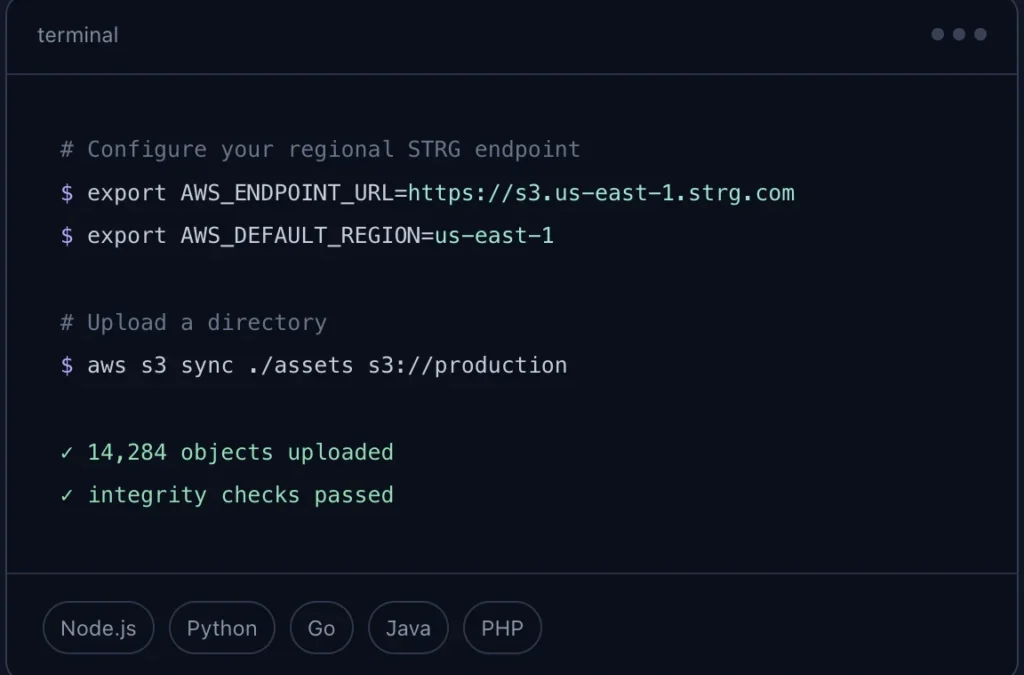
A primary barrier to adoption for any new cloud infrastructure service is the migration effort and the steep learning curve associated with proprietary tooling. STRG mitigates this operational hurdle by ensuring native compatibility with existing AWS command-line interfaces and Software Development Kits (SDKs). Once a user establishes an account, generates an API key, and provisions a storage bucket, administrative operations can be executed seamlessly through standard terminal commands.
For instance, systems administrators and DevOps engineers accustomed to the AWS ecosystem can configure their local environments with minimal adjustment:
Configure your STRG upload settings
aws configure –profile strg
Manage some assets!
aws s3 ls –profile strg –endpoint-url https://s3.eu-central-1.strg.com
aws s3 cp ./hello.txt s3://my-first-bucket/hello.txt –profile strg –endpoint-url https://s3.eu-central-1.strg.com
aws s3 ls s3://my-first-bucket/ –profile strg –endpoint-url https://s3.eu-central-1.strg.com
aws s3 cp s3://my-first-bucket/hello.txt ./hello-copy.txt –profile strg –endpoint-url https://s3.eu-central-1.strg.com
Beyond traditional command-line operations, modern web application development relies heavily on programmatic asset management within backend services. STRG supports this requirement through robust software libraries, including comprehensive JavaScript and TypeScript integrations. Developers can interact with their cloud buckets using familiar asynchronous patterns that mirror standard S3 client implementations:
import
S3Client,
PutObjectCommand,
ListObjectsV2Command,
GetObjectCommand,
from "@aws-sdk/client-s3";
const s3 = new S3Client(
endpoint: "https://s3.eu-central-1.strg.com",
region: "eu-central-1",
);
await s3.send(
new PutObjectCommand( Bucket: "my-first-bucket", Key: "hello.txt", Body: "Hello, STRG!" ),
);
const listing = await s3.send(new ListObjectsV2Command( Bucket: "my-first-bucket" ));
for (const object of listing.Contents ?? []) console.log(object.Key, object.Size);
const object = await s3.send(new GetObjectCommand( Bucket: "my-first-bucket", Key: "hello.txt" ));
console.log(await object.Body.transformToString());
This architectural choice ensures that engineering teams do not need to retrain staff or adopt unfamiliar paradigms to leverage the platform. The ability to drop STRG into existing codebases simply by updating endpoint configurations represents a significant efficiency gain for organizations seeking immediate cost relief without architectural redesigns.
Advanced Enterprise Features and Data Governance
Beyond basic object storage and retrieval capabilities, modern web applications require sophisticated data lifecycle management, compliance enforcement, and security controls. Legacy storage providers often gate these advanced capabilities behind expensive enterprise support tiers or complex configuration dashboards. STRG incorporates these essential operational controls directly into its core offering.
The platform provides customizable lifecycle policies that enable organizations to automatically transition infrequently accessed assets to lower-cost storage tiers or purge temporary data after a designated retention period. This automated optimization is critical for maintaining lean infrastructure budgets as application datasets grow organically over time. Additionally, robust CORS configuration options allow developers to securely manage resource sharing across disparate domain origins, safeguarding web applications against unauthorized cross-site scripting vulnerabilities.
Data integrity and security are further reinforced through object locking capabilities. For industries subject to stringent regulatory compliance frameworks—such as finance, healthcare, and legal services—immutable storage is a mandatory requirement. STRG’s object lock functionality prevents unauthorized deletion or modification of specified files, ensuring that audit logs, financial records, and compliance archives remain tamper-proof throughout their mandated retention lifecycles.
Artificial Intelligence Integration and Modern Agent Workflows
As artificial intelligence and autonomous software agents become increasingly integrated into the software development lifecycle, the demand for AI-accessible infrastructure has surged. Modern engineering workflows frequently utilize large language models (LLMs) and autonomous agents to perform routine system administration, code refactoring, and data auditing tasks. Recognizing this paradigm shift, STRG has incorporated native support for the Model Context Protocol (MCP), allowing AI agents to interact directly with cloud storage resources in a secure and controlled manner.
Integration with AI agent environments is streamlined through standard protocol configurations:
claude mcp add –transport http strg https://mcp.strg.com/mcp
Security remains a paramount concern when granting autonomous agents access to production infrastructure. STRG addresses potential security vulnerabilities by strictly adhering to the principle of least privilege. The operational scope and capabilities granted to an AI agent are directly bound to the specific permissions assigned to the underlying access key. Consequently, an autonomous agent is programmatically restricted from executing any operation—such as deleting critical buckets or modifying core infrastructure—that has not been explicitly authorized by system administrators. This design ensures that organizations can safely harness the productivity gains of AI-driven automation without compromising their overall security posture.
Market Implications and Economic Analysis
The introduction of specialized, high-performance object storage alternatives highlights a broader macroeconomic trend within the technology sector: the decentralization and diversification of cloud infrastructure. For years, the prevailing wisdom favored all-in-one deployments within a single hyperscale ecosystem. However, rising IT budgets, combined with regulatory pressures regarding data sovereignty and vendor concentration risk, have compelled CTOs and engineering directors to adopt multi-cloud and best-of-breed strategies.
By lowering the financial barrier to entry and eliminating the punitive egress and API request fees frequently charged by legacy providers, platforms like STRG alter the economic calculus of web application development. Smaller startups and mid-market enterprises can now scale their digital asset repositories globally without fearing sudden, unpredictable cost spikes at the end of each billing cycle. Furthermore, the emphasis on developer ergonomics—exemplified by drop-in AWS SDK compatibility and modern AI agent integrations—positions such platforms to capture market share among agile, forward-thinking engineering organizations.
Conclusion and Future Outlook
As digital transformation accelerates across all industry sectors, the volume of unstructured data generated by web applications will continue to multiply. Selecting the appropriate storage foundation during the initial architectural phase has thus become a critical determinant of long-term business viability and technical scalability. STRG’s combination of low-cost multi-region delivery, rigorous enterprise governance features, familiar S3-compatible tooling, and innovative AI agent integration makes it a compelling option for modern engineering teams. As the cloud storage market matures, the availability of competitive, specialized alternatives will likely drive further innovation and cost optimization across the entire digital infrastructure landscape, ultimately benefiting developers and enterprises worldwide.