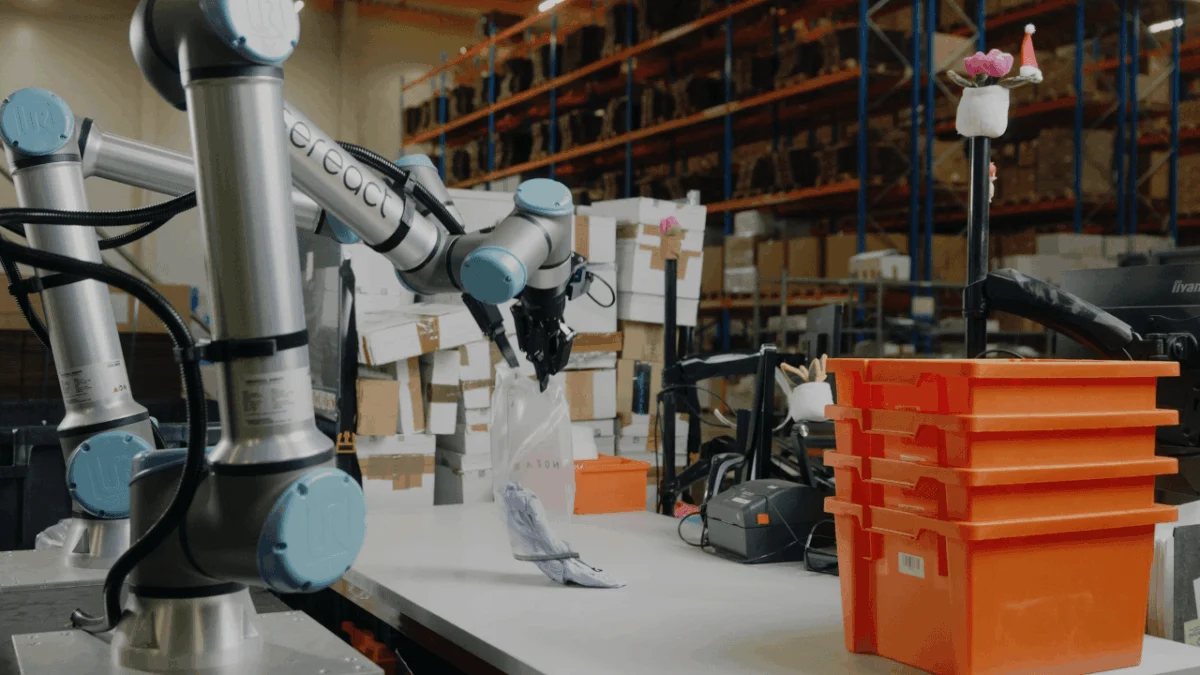
Sereact, a trailblazer in physical AI for warehouse robotics, has announced a significant expansion of its Series B funding round, now totaling $116 million. The latest boost comes from a strategic investment by Zalando, Europe’s premier technology platform for fashion and lifestyle. This infusion of capital underscores Sereact’s innovative approach to revolutionizing fulfillment operations and marks a pivotal moment for the company and the broader logistics automation sector. The total funding raised by Sereact to date now exceeds $145 million.
The initial Series B financing round, which commenced in April 2026, was spearheaded by Headline, with substantial contributions from investors including Bullhound Capital, Daphni, and Felix Capital. Returning investors Air Street Capital, Creandum, and Point Nine also participated, signaling strong confidence in Sereact’s trajectory. Zalando’s entry as a strategic investor amplifies the round’s significance, bringing not only financial backing but also invaluable industry expertise and a direct application for Sereact’s cutting-edge technology.
The Cortex Engine: Powering the Next Generation of Warehouse Robotics
At the heart of Sereact’s innovation lies its proprietary "Cortex" brain, a sophisticated physical AI system designed to power a diverse range of robotic applications. This includes advanced single-arm picking cells, highly efficient dual-arm return stations, versatile humanoid robots, and the Sereact Lens, a state-of-the-art 3D perception system crucial for inventory management and quality control. Founded in 2021 and headquartered in Stuttgart, Germany, Sereact has rapidly established a formidable client roster. Their technology is already deployed by industry leaders such as Daimler Truck, Mercedes-Benz, BMW, MS Direct, Ikea, Active Ants, DeltiLog, Rohlik Group, and Austrian Post, attesting to the broad applicability and proven effectiveness of their solutions across various sectors.
Zalando’s Strategic Rationale: Addressing E-commerce Fulfillment Challenges
Zalando, a Berlin-based e-commerce giant founded in 2008, operates an extensive platform connecting 62 million active customers with over 7,000 brands across 29 European markets. Their business model is heavily reliant on a sophisticated AI-powered data and infrastructure platform, making them acutely aware of the operational complexities inherent in large-scale online retail. Zalando’s decision to invest strategically in Sereact stems from a clear recognition of the transformative potential of Cortex technology, particularly in optimizing the critical areas of order packing and returns processing.
"When we spoke with Zalando, we identified a major strategic opportunity, especially in packing and returns handling," stated a Sereact representative, referencing the company’s founder, Gulde. "For an e-commerce company like Zalando, efficiently processing both outbound orders and returns is absolutely critical for customer satisfaction."
The fashion and lifestyle sector, in particular, grapples with high return rates. Germany, for instance, is noted for its elevated rate of fashion over-shipping, where customers often purchase multiple sizes or styles with the intention of returning the majority. Zalando itself reports that approximately 50% of items ordered are returned. This presents a substantial operational challenge, as returned items must be meticulously unpacked, inspected, folded, and processed – tasks that remain largely manual in many fulfillment centers. Furthermore, stringent European regulations prohibit the destruction of returned goods, necessitating efficient and cost-effective processing.
Sereact’s dual-arm robotic system offers a groundbreaking solution. It is engineered to automate the entire returns process, from opening boxes and removing items to meticulously folding garments. "We are currently the only company offering this level of automation," emphasized Gulde. This unique capability makes the investment particularly compelling for Zalando, addressing a significant pain point in their operations and offering a pathway to enhanced efficiency and customer experience.
The Automation Imperative: Why Warehouse Robotics is Finally Scaling
The narrative of warehouse robotics and automation has been a long-standing pillar of Industry 4.0 for decades. However, many startups have historically struggled to move beyond pilot projects, even successful ones, into widespread commercial deployment. Sereact’s success, and that of others in the field, signals a maturation of the technology and market readiness.
"The biggest difference now is that customers are expanding deployments," noted Gulde. The key differentiator, he explained, lies in the demonstrable value proposition of robotics, which must translate into tangible cost savings and operational improvements. The breakthrough, according to Gulde, has been the advancement in AI models. "After the transformer architecture emerged and ChatGPT demonstrated what was possible, we built what we called PickGPT in early 2023 – the first commercially available vision-language-action model."
These advanced AI models have dramatically enhanced a robot’s ability to interpret sensory input – what it sees and senses – and translate that into precise physical actions. Sereact has continued to refine these models, culminating in their latest iteration, Cortex 2.5. However, the effectiveness of these models is inextricably linked to the quality and quantity of data they are trained on. "Frontier research matters, but collecting real-world data matters even more," stated Gulde, highlighting the critical role of empirical data in driving practical AI advancements.
The Data Flywheel: Fueling Cortex’s Intelligence
Sereact’s technology is already making a significant impact, with over 200 systems operational across Europe and more than one billion real-world production picks successfully executed on the Cortex platform. Cortex functions as a universal AI operating system, adaptable to various hardware configurations, including single-arm picking cells, dual-arm returns stations, and humanoid robots. The intelligence embedded within Cortex creates a powerful "data flywheel." As robots are deployed with real customers, each successful operation contributes valuable real-world data back to the central Cortex brain, continuously enhancing its capabilities.
Gulde elaborated on this symbiotic relationship: "Large language models had a huge advantage because they had the internet as a training dataset. Physical AI doesn’t have that luxury." Sereact has addressed this by accumulating a massive dataset of over one billion picks. "Every successful pick, every edge case, and every new environment strengthens the model."
Unlike many robotics companies that rely heavily on simulations or controlled laboratory environments, Sereact emphasizes the importance of robots learning within their actual operating environments. "That’s why we deliberately started with a relatively simple task: single-arm warehouse picking," Gulde explained. "After deploying more than 200 robots and collecting hundreds of millions of picks, we expanded into increasingly complex use cases. Rather than trying to solve everything at once, we move from one use case to the next, allowing the model to generalize gradually." The long-term vision is to develop a general robotics brain capable of executing a wide array of tasks across diverse robot form factors.
Cost-effectiveness is another critical factor driving adoption. Sereact offers customers a price guarantee based on the per-return cost, asserting that their robotics solutions are approximately 30% more cost-effective than manual processing in most regions.
From Reactive to Proactive: The Evolution of Cortex
The vast dataset accumulated by Sereact is instrumental in developing the next generation of its robotics brain. The additional capital from the Series B round will be allocated towards scaling Cortex 2.0, the upcoming iteration of Sereact’s robotic brain, and further international expansion.
Cortex 2.0 represents a paradigm shift in robotic automation, moving from a "try-and-see" approach to a "plan-and-try" methodology. By leveraging a learned world model, it can anticipate physical outcomes, assess potential trajectories for risk and efficiency, and plan movements before the robot physically acts.
"Imagine you’re unpacking groceries. You have eggs, a bag of chips, and a bottle of water. You instinctively know not to put the heavy bottle on top of the eggs because you understand how the physical world works. Humans constantly predict the consequences of their actions," Gulde illustrated. Sereact robots can now emulate this predictive capability by internally simulating multiple possible futures, evaluating various action sequences, predicting likely outcomes, ranking these possibilities, and selecting the sequence with the highest probability of success.
Beyond the Hype: A Pragmatic Approach to Robotics
While the robotics industry often buzzes with excitement around advanced technologies like legged humanoid robots, Sereact maintains a more pragmatic stance. Gulde, who himself has experienced an injury from a walking humanoid robot, expresses caution regarding the hyped aspects of the field. He points out that legged humanoids are often expensive, technically fragile, and limited by battery constraints. "Walking, manipulating objects, balancing, and carrying loads simultaneously is technically very challenging," he stated.
For industrial customers, the primary concerns are reliability, a strong return on investment, and safety over a long operational lifespan of 10-15 years, rather than the aesthetic appeal of a robot. Gulde further elaborated on safety concerns: "I wouldn’t want a 100-150 kilogram humanoid operating around my dog if the software failed and the robot tipped over. That’s why our current systems combine dual robotic arms with mobile wheeled platforms. They’re safer, proven, can’t fall over, have larger batteries, and are much more practical."
The regulatory landscape in Europe also poses challenges for widespread humanoid robot deployment. Companies must adhere to EU’s CE marking and machinery safety requirements, and the regulatory framework for humanoid robots is still in its nascent stages. Gulde emphasized the potential repercussions of accidents: "If a serious accident happens anywhere in the industry, it could damage public confidence across the entire robotics sector."
The Global Ambition: Building a General Robotics Brain
Sereact has set its sights on global expansion, evidenced by the recent opening of its first US office in Boston in June. North American expansion is a significant priority for the company over the next year. "It’s a huge unified market, and we want to deploy many more robots there," Gulde commented.
The overarching ambition remains the development of a general robotics brain, but Sereact approaches this monumental goal with a realistic, milestone-based strategy. This year, the company has already launched its dual-arm returns-handling product and wheeled humanoid systems designed for retail replenishment and shelf management. "Those products were only possible because of all the data we gathered from earlier deployments," Gulde remarked.
Looking ahead, Sereact plans to scale these systems and then progress towards more intricate, contact-rich tasks such as assembly. While acknowledging that current AI models may not yet be fully equipped for such complex operations, Gulde is confident that with continued data acquisition and model refinement, these capabilities will be within reach. The strategic investment from Zalando, coupled with the company’s proven technological advancements and a clear vision for the future, positions Sereact as a leading force in shaping the automated landscape of warehouses and fulfillment centers worldwide.