The rapid transformation of search behavior from traditional keyword-driven query engines to conversational AI platforms has triggered an entirely new category of digital marketing software: Answer Engine Optimization (AEO). As enterprise marketing teams scramble to understand how tools like ChatGPT, Google Gemini, Anthropic Claude, Microsoft Copilot, and Perplexity construct responses and cite external brands, software vendors have rushed to fill the visibility gap. Among the early frontrunners in this emerging space are Profound and Scrunch, two specialized platforms that approach the challenge of AI tracking through distinct operational lenses.
Choosing between Profound and Scrunch rarely comes down to a simple count of tracked answer engines or raw data features. Instead, the purchasing decision typically hinges on where an organization’s existing workflow encounters friction. While both platforms measure how generative AI models discover, synthesize, and cite brand web assets, their underlying architectures are optimized for fundamentally different corporate needs. Profound leans heavily into market intelligence, audience segmentation, and automated content generation, whereas Scrunch focuses on technical site crawlability, developer handoffs, and edge-delivery optimization.
To help digital marketing leaders, Chief Marketing Officers, and agency directors navigate this emerging software landscape, this analysis examines the core differences between Profound and Scrunch, introduces HubSpot AEO as an integrated CRM-connected alternative, and establishes a methodological framework for evaluating AEO tooling as the market matures through 2026.
Methodology and Market Context
The evaluation of AEO platforms requires an objective framework that accounts for the probabilistic nature of generative artificial intelligence. Unlike traditional search engine optimization (SEO), where a specific keyword ranking can be verified definitively against a static index, AI answers are dynamic, context-dependent, and heavily influenced by real-time conversational prompting. A single query observation proves little; true brand visibility must be interpreted as a statistical trend derived from repeated, systematic checks across varied geographic regions and user personas.
This comparative analysis is synthesized from platform feature testing, public technical documentation, vendor pricing tiers, and verified enterprise user feedback aggregated from software review platforms such as G2 between 2025 and 2026. All platform specifications and plan limits reflect offerings available as of September 2026. The evaluation framework measures vendors across seven primary criteria: engine coverage capacity, prompt monitoring depth, reporting lenses, technical optimization mechanics, bot-traffic diagnostic capabilities, workflow actionability, and team-specific pricing structures.
Furthermore, implementation effort varies significantly depending on a brand’s infrastructure, content delivery network (CDN) configurations, and server log access. Consequently, deployment timelines and technical setup estimates are treated as directional rather than absolute.
Engine Coverage: Breadth vs. Depth of AI Platforms

Both Profound and Scrunch advertise expansive reach across major generative AI models, yet the actual engines included in a subscription depend heavily on the chosen pricing tier.
Profound’s self-serve options are limited; its standard trial samples ChatGPT, Gemini, and Google AI Overviews over a seven-day window, while comprehensive coverage extending up to nine distinct engines is restricted to custom enterprise agreements. Scrunch provides a broader baseline, offering four engines on its entry-level subscription, though its full nine-engine monitoring lineup also remains locked behind custom enterprise contracts. For comparison, HubSpot AEO monitors a foundational trio of engines—ChatGPT, Gemini, and Perplexity—consistently across all standard tiers.
Industry experts emphasize that raw engine count should not serve as the primary metric for software selection. Marketers must align platform coverage with the specific habits of their target audience. Enterprise IT buyers and corporate decision-makers frequently operate within Microsoft Copilot ecosystems; technical developers and researchers rely heavily on Perplexity and Claude; and mainstream consumers default to ChatGPT or Google AI Overviews. Consequently, audience alignment takes precedence, with total engine count serving merely as a secondary tiebreaker.
Reporting Lenses: Market Intelligence vs. Execution Mechanics
The fundamental divergence between Profound and Scrunch becomes most apparent when examining how each tool processes and presents visibility data to marketing teams.
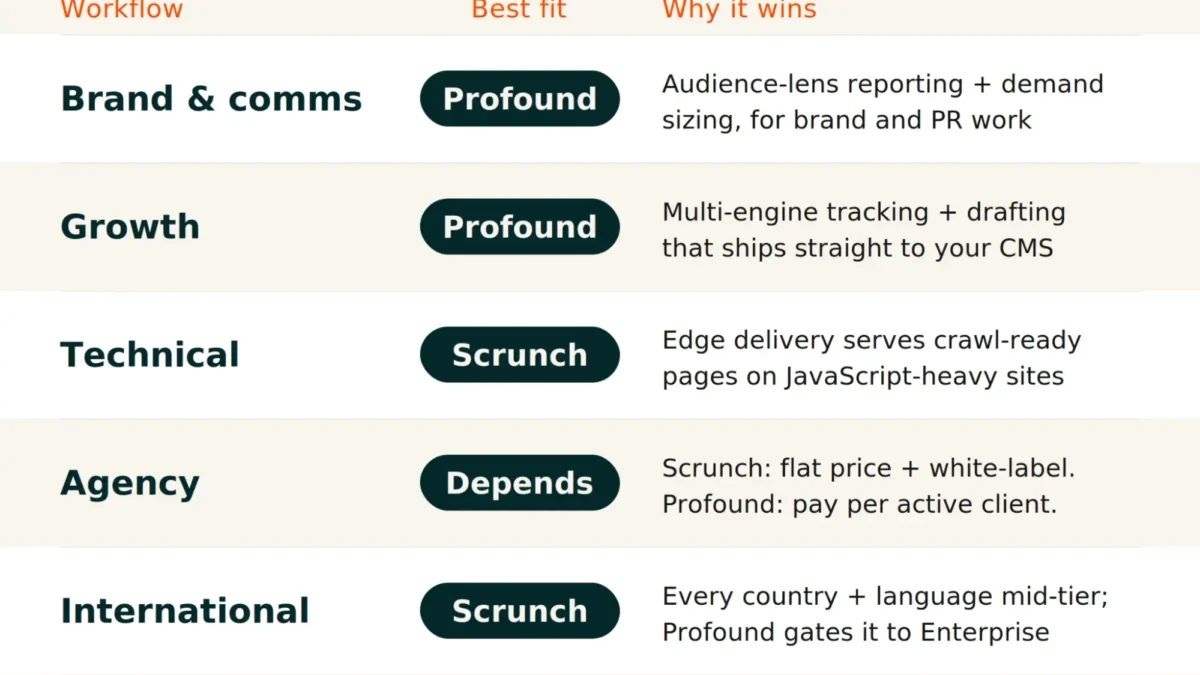
Profound operates primarily through a market-and-audience analytical lens. Its standout feature, Prompt Volumes, models AI search demand by analyzing licensed answer-engine conversations. Users can drill down from broad categories to individual keywords and the exact natural-language prompts utilized by consumers. Furthermore, Profound’s persona modeling overlays specific buyer roles onto Answer Engine Insights, illustrating how distinct artificial intelligence models describe a brand differently to a technical evaluator versus a corporate executive. For organizations already utilizing sophisticated market research instruments, Profound bridges the gap by incorporating generative AI demand into the broader strategic picture. The primary question Profound answers is strategic: Where is category demand moving, and how do different audience segments perceive our brand narrative?
Conversely, Scrunch processes the same underlying data through an operational execution lens. Every tracked prompt within Scrunch can be filtered dynamically by buyer funnel stage, targeted persona, conceptual topic, underlying AI platform, and custom metadata tags. This allows growth teams to pinpoint precisely where competitors are capturing citations at specific phases of the buyer journey. While Scrunch also models market demand via its AI Search Trends feature—which estimates weekly prompt volumes for semantic topic clusters using consumer panel data—it intentionally avoids per-prompt volume estimates, arguing that underlying AI query data remains insufficiently mature for granular attribution. The primary question Scrunch answers is tactical: At which specific stage of the marketing funnel are we losing ground, and which content assets require immediate revision?
Technical Optimization: Read-Only Diagnostics vs. Edge Intervention
Once reporting dashboards identify citation gaps, the workflow shifts to technical resolution. Here, the operational philosophies of Profound and Scrunch diverge sharply between diagnosis and active intervention.

Profound functions strictly as a diagnostic, read-only platform. Its Agent Analytics suite analyzes server logs—avoiding client-side JavaScript tracking tags entirely—to identify robots.txt access blocks and index pages that automated AI web crawlers fail to reach. The platform’s Technical Analysis module scores individual web pages on performance, speed, SEO compliance, and semantic wording, but leaves remediation entirely in the hands of the internal web development team using their native Content Management System (CMS). Profound provides comprehensive recommendations without altering infrastructure directly.
Scrunch, on the other hand, provides active edge intervention. Through its proprietary Agent Experience Platform (AXP), Scrunch integrates directly at the Content Delivery Network (CDN) edge. The system detects verified AI web bots in real time and serves them lightweight, structurally optimized versions of web pages, while human visitors continue to experience the standard site. While standard site audits surface crawlability issues across all plans, full edge delivery via AXP is reserved for higher-tier enterprise contracts. This technical approach prioritizes automated machine readability over traditional content rewrite workflows.
Bot-Traffic Tracking and Attribution
Because automated AI crawlers rarely execute the client-side JavaScript required by conventional web analytics suites like Google Analytics 4 (GA4), both Profound and Scrunch utilize server-side or CDN-level detection to capture traffic from generative agents.
Profound’s Agent Analytics reads server logs in real time, validating incoming bots against published IP address ranges to filter out spoofed user agents, and categorizes visits into routine indexing crawls versus on-demand retrieval queries. Scrunch similarly pulls CDN logs to segment bot traffic into training, indexer, and retrieval categories, designating retrieval hits as the closest proxy for live buyer intent. Both platforms facilitate referral attribution by connecting directly with GA4 to tie AI-driven sessions to web traffic, though Scrunch features a dedicated AI Referrals tab to streamline this persistent connection.
Workflow Actionability and the Path to Revenue
Actionability defines the complete operational journey from discovering a citation deficit to verifying its financial impact on the business. Both tools successfully navigate the initial stages of this pipeline—identifying gaps, prioritizing issues, and measuring bot traffic—but they handle downstream execution differently.
Profound excels in automated content creation. Its native agent architecture supports a complete brief-to-publish workflow within the platform. Users can query underlying reasoning models, generate on-brand drafts aligned with established AEO templates, and push completed assets directly into popular content management systems including WordPress, Contentful, Sanity, and Framer, subject to human editorial approval.
Scrunch excels in technical delivery and task handoff. While it identifies content gaps and generates writing briefs, actual copywriting must be completed externally in tools like ChatGPT. Scrunch’s strength lies in its automated edge delivery via AXP and its integration with modern conversational assistants through the Model Context Protocol (MCP), enabling teams to manage prompt tracking and brand configurations directly within chat interfaces.

Crucially, neither platform natively closes the loop to a customer relationship management (CRM) database. Both rely on web analytics for referral session data, leaving the task of connecting AI visibility directly to closed-won revenue as a custom integration requirement via REST APIs, SDKs, or business intelligence connectors like Looker Studio.
Agency and International Deployments
For marketing agencies and multinational enterprises managing multiple brands or regional markets, pricing structures and workspace architectures are decisive factors.
Scrunch utilizes a flat-fee bundling model. Its Agency Core plan, priced at $500 per month, includes three client brand workspaces, three pitch workspaces for prospect audits, and unlimited user seats. This structure allows account managers, internal team members, and external clients to collaborate without incurring per-seat overages, and supports fully white-labeled reporting outputs. Profound adopts a per-client scaling model, featuring an Agency Growth base fee of $99 per month covering five user seats and ten pitch workspaces, with each additional client workspace billed at $399 per month.
Regarding international reach, Scrunch supports prompt tracking across any global market and language. However, every localized query is counted as an independent prompt against the plan’s total allowance, and only the brand’s primary home market benefits from an expanded list of 88 supported countries. Profound’s standard trial is restricted to a single region and language, with multi-regional tracking configured exclusively through custom enterprise quotes.
Pricing Structures and Financial Value
Evaluating the true financial investment requires understanding how each vendor packages software capabilities. Profound operates primarily on a custom enterprise pricing model for brands, following a restricted 7-day trial that previews preset industry prompts. Its published self-serve pricing is limited to its agency tier ($99/mo base plus $399/mo per client workspace). Scrunch offers a transparent entry-level tier at $250 per month for four engines and 125 prompts, scaling upward based on prompt volume, team seats, and advanced technical features like AXP.
For growing brands, the primary financial evaluation typically involves comparing the entry-level Scrunch Core subscription against an enterprise quote from Profound, factoring in whether edge-delivery optimization is a mandatory operational requirement.
HubSpot AEO as an Integrated CRM Alternative

For organizations where the primary operational bottleneck is the disconnect between identifying visibility gaps and publishing optimized content within an existing CRM ecosystem, HubSpot AEO provides an alternative paradigm. Available either as a standalone product or bundled within HubSpot Marketing Hub Professional and Enterprise tiers, HubSpot AEO tracks visibility across ChatGPT, Gemini, and Perplexity.
The primary advantage of the HubSpot ecosystem is unified workflow continuity. Visibility data, AI-assisted content drafting, editorial publishing, and downstream CRM pipeline tracking reside within a single environment. Marketing teams can directly attribute AI search visibility and citation growth to actual closed-won deals without requiring complex third-party API integrations or manual data exports. However, teams requiring advanced edge delivery infrastructure or coverage exceeding the core three search engines may still need specialized point solutions.
Conclusion and Pilot Strategy
Selecting an AEO platform depends entirely on an organization’s internal technical capabilities and strategic priorities. Organizations seeking automated content generation, deep audience personas, and market intelligence will find Profound a natural fit. Conversely, teams constrained by technical crawlability issues, robots.txt blocks, and infrastructure delivery bottlenecks will benefit from Scrunch’s developer-focused edge optimization.
Before committing capital to an enterprise agreement, marketing leaders are advised to conduct a low-risk AEO pilot. By establishing a baseline using diagnostic tools like the HubSpot AI Search Grader, defining a targeted set of ten prompt variations across the buyer journey, and maintaining a disciplined weekly tracking cadence, organizations can accurately evaluate software utility and measure tangible visibility improvements in the evolving landscape of conversational search.