The quadrennial ritual of American electioneering concluded with a definitive, if unexpected, outcome that has once again placed the polling industry under intense scrutiny. As the dust settles on the 2026 midterm elections, a comprehensive analysis of the data reveals that while preelection surveys were successful in identifying the primary drivers of voter sentiment—namely a pervasive national malaise and deep-seated economic frustration—they consistently failed to capture the full breadth of the Democratic resurgence. With the final, unofficial tallies now being tabulated across the states, it is evident that the "Blue Wave" of 2026 was not only identified by pollsters but significantly underestimated in its magnitude.
The persistent question of whether public opinion research remains a reliable barometer for the electorate has taken on renewed urgency. For the past several months, voters and pundits alike have been fixated on two singular inquiries: who would capture the halls of power in Washington, and whether the polling industry would succumb to the same systemic errors that characterized the previous two election cycles. The results from November 11, 2026, suggest a nuanced answer: the directional signal provided by pollsters was accurate, but the mathematical precision required to map the exact margins of victory was lacking.
A Chronology of Sentiment and Surveying
The lead-up to the 2026 midterms was marked by a distinct atmosphere of volatility. Early in the autumn of 2026, surveys conducted by the Pew Research Center and other reputable firms began to highlight a growing disconnect between the incumbent administration’s messaging and the public’s lived experience.
By early October, the narrative was firmly established: the American public was in a sour mood. Data from October 8, 2026, underscored a deep dissatisfaction with the policies of President Donald Trump. Crucially, this frustration was not confined to opposition voters; it was increasingly evident among the very coalition that had propelled him to the White House in 2024. As voters grappled with inflation, supply chain fluctuations, and the cost of living, economic ratings plummeted.
Throughout late October, the "enthusiasm gap" became the defining metric for political analysts. Democratic voters, spurred by a desire to check executive power and address cost-of-living concerns, displayed significantly higher levels of civic engagement than their Republican counterparts. This engagement manifested in polling participation rates, where Democratic respondents were consistently more willing to engage with pollsters than those aligned with the GOP. By the time the final ballots were cast in early November, the stage was set for a political shift that many observers felt coming, but which the numbers had systematically minimized.
Quantifying the Disconnect
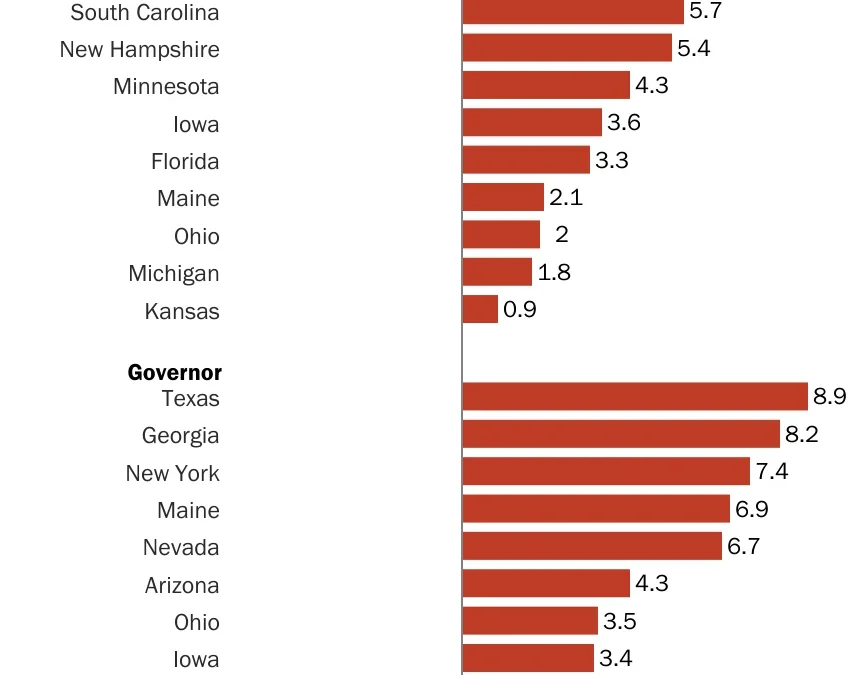
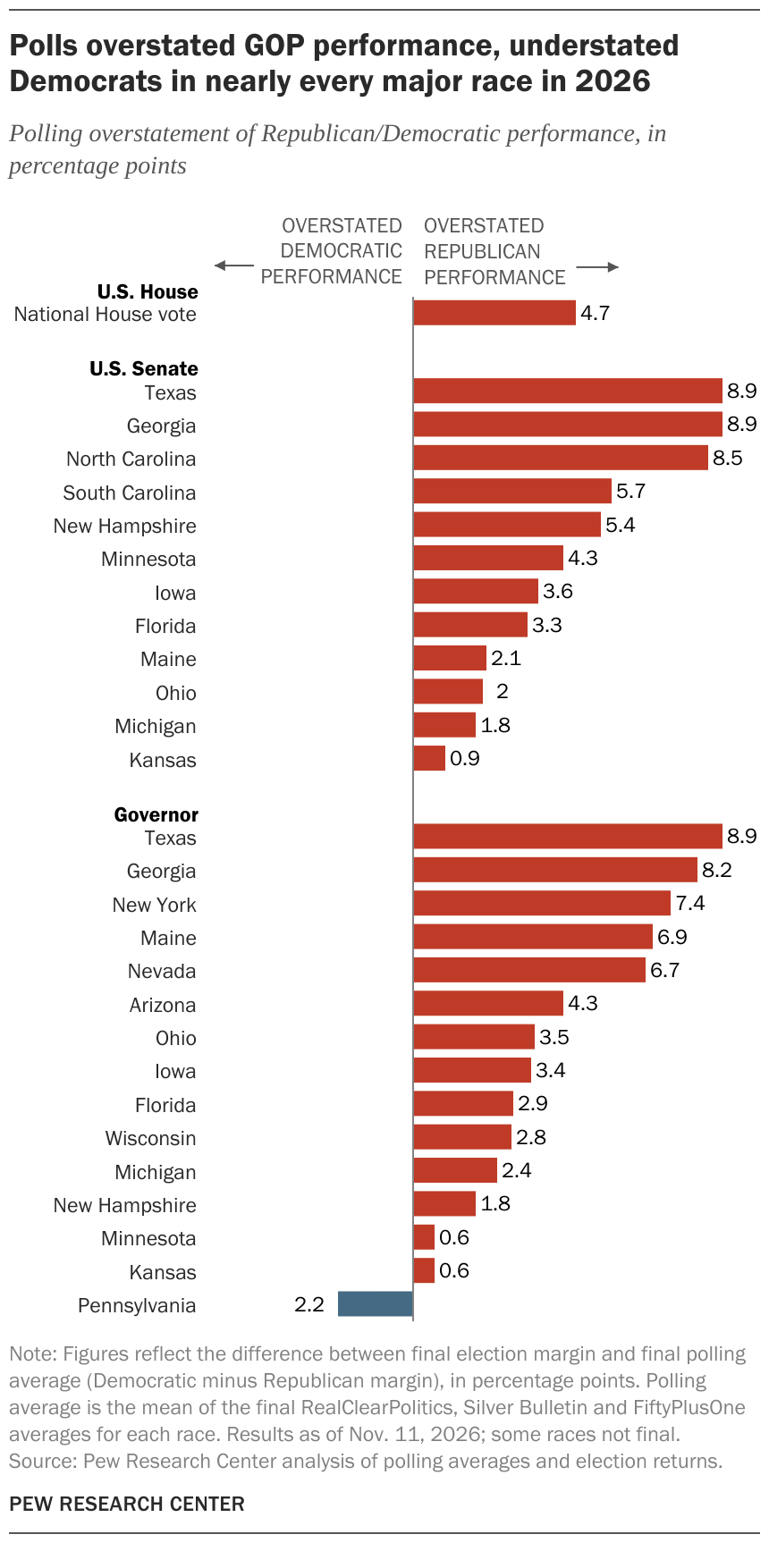
The statistical reality of the 2026 election is stark. An examination of 27 key statewide races—including pivotal Senate and gubernatorial contests—reveals a consistent trend: in 21 of these 27 races, the polling averages failed to account for the full strength of the Democratic performance. The mean margin of error, roughly 4 percentage points, represents a significant deviation that warrants a deep-dive investigation into modern sampling methodologies.
The most egregious discrepancies occurred in states like Texas and Georgia. In both jurisdictions, polls understated the Democratic margin by a staggering 8.9 percentage points. These errors were not isolated incidents but part of a broader pattern. In North Carolina, the Senate race saw a similar, though slightly smaller, underestimation of 8.5 points. Even in regions considered more competitive or traditionally leaning Republican, the undercount persisted, suggesting that the "shy" or "unresponsive" voter phenomenon, which has plagued pollsters for a decade, may be evolving in new, harder-to-predict ways.
The national House vote provides the most comprehensive look at the polling deficit. The generic ballot—the primary tool used to measure partisan sentiment across the 435 congressional districts—showed a Democratic lead of approximately 9 points in the RealClearPolitics average. However, the final vote tally, as of mid-November, shows a Democratic lead of nearly 14 points. This 5-point gap is not merely a statistical hiccup; it represents a fundamental failure in current modeling to capture the total turnout and preference of the electorate.
Methodological Challenges in a Polarized Era
Why did the polls miss the mark? Industry experts point to several systemic challenges that made 2026 a uniquely difficult year for data collection. First, the rapid shifts in voter turnout models have made it increasingly difficult to construct an accurate "likely voter" screen. In previous decades, pollsters could rely on historical turnout data to weight their samples. Today, however, the demographic composition of the electorate is shifting faster than historical models can adapt.
Furthermore, the industry’s ongoing struggle with "non-response bias" continues to be a hurdle. When specific segments of the population—particularly those in rural areas or those with low trust in institutions—refuse to participate in surveys, the resulting data is inherently skewed. Despite rigorous efforts by firms to weight their samples based on past voting behavior and party registration, these adjustments are only as good as the underlying assumptions. If those assumptions—such as the expected partisan turnout ratio—are flawed, the error cascades through the final report.
The 2026 midterms also brought a unique set of variables: a high-inflation environment, shifting perceptions of the incumbent president, and an electorate that seems increasingly immune to traditional outreach strategies. The American Association for Public Opinion Research (AAPOR) is expected to convene in the coming months to perform an exhaustive post-mortem, but the preliminary consensus is that the industry must move beyond simply "fixing" past errors and instead rethink how they identify and reach voters in a fragmented media landscape.
The Impact on Governance and Policy
The implications of this polling error extend far beyond the reputations of survey firms. When polls consistently underestimate one side of the political aisle, it creates a distorted perception of the national mood. This has real-world consequences for political strategy, donor behavior, and the legislative agenda.
For policymakers, the results are a signal of a profound realignment. The fact that the polling error was so consistent—nearly all in one direction—suggests that it was not a series of random flukes, but a systemic issue in how pollsters interact with the modern voter. For those in power, the mandate is clear: the public is demanding solutions to economic pressures that were not fully captured in the media’s pre-election narrative.
For the Democratic Party, the 2026 results represent a mandate to pivot from opposition to governance. Having secured a majority in the Senate and taken control of the House of Representatives, the party now faces the challenge of delivering on the promises that fueled their base’s high turnout. The "dark mood" identified by pre-election polls was not just a passing sentiment; it was a rallying cry that now requires actionable legislative policy.
The Path Forward for Public Opinion Research
As we look toward the next cycle, the polling industry finds itself at a crossroads. The era of the "standard" telephone or digital survey is being challenged by the reality of a hyper-polarized, skeptical public. The 2026 experience serves as a cautionary tale: statistical models, no matter how sophisticated, cannot fully replicate the human element of an election.
The path forward will likely involve a return to basics: higher-quality, multi-modal research, and a more transparent admission of the limitations of polling. It is no longer enough to report a margin; pollsters must provide context regarding the uncertainty of their findings. The goal should not be to predict the winner with 100% certainty, but to provide a clear-eyed view of the societal forces at play.
In the final analysis, the 2026 election will be remembered as the year that the "Blue Wave" caught the polling industry off guard. While the polls were successful in identifying the "who" and the "why"—the intense dissatisfaction with the status quo—they failed to accurately capture the "how much." As the new Congress prepares to take office, the lesson is clear: in an era of rapid political change, the most valuable data is that which acknowledges its own limitations. The industry will now spend months digging through the raw numbers, hoping to calibrate their instruments for the next great test of American democracy. The 2026 midterms have passed, but the debate over how we measure the public will continue, as vital and unsettled as ever.