A new comprehensive study from the Pew Research Center has provided a sobering, granular look at the current sentiment regarding the potential for peaceful coexistence between Israel and an independent Palestinian state. Through rigorous, face-to-face polling conducted between late March and early May 2026, the report captures the voices of over 2,000 adults across Israel, the West Bank, and East Jerusalem. By employing an open-ended methodology, the research transcends simple binary polling to uncover the deeply entrenched anxieties, historical grievances, and conditional hopes that define the current era of the Israeli-Palestinian conflict.
The Methodology of Sentiment Analysis
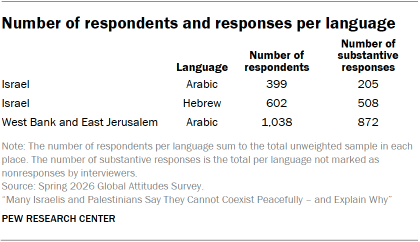
The study, directed by Gallup, reached 1,001 Israeli adults and 1,038 Palestinian adults. Recognizing that traditional multiple-choice questions often fail to capture the nuance of deeply personal geopolitical beliefs, researchers asked participants a central question: "Do you think a way can be found for Israel and an independent Palestinian state to coexist peacefully with each other, or not?"
Those who offered a substantive answer—whether "Yes," "No," or the qualified "It depends"—were invited to explain their reasoning. The resulting corpus of over 1,500 responses in Hebrew and Arabic provides a rare qualitative window into the public psyche. To maintain scientific integrity, the Center utilized a team of researchers who translated, coded, and analyzed these responses, establishing a thematic codebook that categorizes arguments ranging from the "inevitability of peace" to "fundamental incompatibility."
Historical Context and Timeline of Tension
The data collection period in the spring of 2026 occurs against a backdrop of prolonged regional instability. The preceding years were marked by a cycle of violence that fundamentally altered the political discourse in the region. A brief retrospective of the timeline leading to these findings highlights the weight of public sentiment:

- October 2023: The launch of a large-scale conflict following attacks in southern Israel triggered a massive military response in Gaza, leading to widespread destruction and humanitarian crises.
- 2024–2025: The period was defined by failed diplomatic mediation, deepening societal trauma, and the entrenchment of hardline political factions on both sides.
- March–May 2026: The survey period, characterized by a fragile geopolitical climate and an almost total collapse of trust in bilateral negotiations or international diplomatic frameworks.
This context is crucial for interpreting the "No" responses, which frequently cited the October 7th events, the subsequent war in Gaza, and the ongoing occupation as insurmountable barriers to a peaceful future.
Analyzing the "Yes" and "No" Paradigms
The researchers identified starkly different clusters of thought among those who believe peace is possible versus those who view it as an impossibility.
For respondents who expressed optimism or a belief in the possibility of coexistence, the themes were largely pragmatic. The "Inevitability of Peace" category emerged as a dominant sentiment, with many respondents arguing that because neither population is going anywhere, both must eventually find a way to minimize harm. This is often framed as a "realist" perspective—a recognition that the geography of the land necessitates a long-term, albeit difficult, accommodation. Others focused on "Diplomatic Solutions," emphasizing the necessity of statehood for Palestinians and secure borders for Israel, though these responses were frequently qualified with "if" statements, highlighting the necessity of political will and leadership changes.
Conversely, the "No" camp articulated a sense of profound, systemic disillusionment. The coding revealed high frequencies of terms related to "fundamental incompatibility." This goes beyond mere political disagreement; it encompasses a perceived clash of religious, cultural, and national identities that many respondents believe cannot be reconciled. A significant portion of these responses cited the occupation of the West Bank, citing specific grievances such as settlement expansion, checkpoints, and the daily material hardships faced by Palestinians. Simultaneously, many Israeli respondents cited the threat to their national security, noting that any proposed Palestinian state could serve as a platform for further violence.
Quantitative Realities and Item Nonresponse
The report underscores a significant challenge in measuring public opinion: the prevalence of "item nonresponse." In Israel, 20% of respondents declined to answer the initial question. Notably, this figure rose to 46% among Arab citizens of Israel, a demographic reality that suggests either a profound sense of alienation from the political process or a fear of expressing controversial views in a charged climate. In the West Bank and East Jerusalem, the nonresponse rate was 10%, with an additional 6% offering a substantive answer but refusing to elaborate. These statistics serve as a silent data point, indicating that for a substantial portion of the population, the question of peaceful coexistence is either too painful to contemplate or too fraught to discuss openly.
Implications for Future Diplomacy
The findings present a daunting challenge for international diplomats and policymakers. The data suggests that any future peace initiative will not merely be a matter of "land for peace" or border adjustments; it will require addressing a deep-seated crisis of trust and a fundamental questioning of the "other’s" right to exist.
The prevalence of "distrust" as a coded theme—where the other side is explicitly labeled as "liars," "traitors," or "enemies"—suggests that the psychological barrier to peace is currently higher than the logistical one. Furthermore, the reliance on external actors for peace—noted in the "Conditional" category—indicates that neither the Israeli nor the Palestinian public feels empowered to drive the peace process from the bottom up.
Official Perspectives and External Analysis
While the Pew report itself remains neutral, the implications have been noted by various political analysts. Observers point out that the survey results mirror the current state of regional leadership, where both Israeli and Palestinian political spheres have shifted away from the rhetoric of the Oslo Accords era.
International stakeholders, including representatives from the United Nations and various European diplomatic missions, have previously noted that the "shrinking space" for moderate voices makes a two-state solution increasingly difficult to visualize for the average citizen. The Pew data validates this concern, as the qualitative responses show that even those who support coexistence often do so with extreme skepticism regarding the sincerity or capability of the leadership on the opposite side.
Conclusion: The Path Ahead
The Pew Research Center’s findings serve as a diagnostic tool for a region in trauma. By documenting the "why" behind the "yes" and "no," the report moves beyond the binary of simple polling and into the realm of human experience. The recurring themes of fear, historical memory, and the struggle for national identity illustrate that any sustainable peace will require more than a signed treaty; it will require a generational effort to dismantle the narrative of mutual destruction that has become the defining characteristic of the 21st-century experience for both Israelis and Palestinians. As the data shows, until the fundamental issues of security, land, and mutual recognition are addressed in a way that resonates with the public, the path to coexistence will remain, in the words of many respondents, a distant and conditional hope.