The widespread integration of artificial intelligence into corporate strategies has reached a critical inflection point, exposing a profound divide between tool adoption and actual business performance. According to the newly released 2026 State of AI in Marketing research, an overwhelming 98% of marketing teams now utilize artificial intelligence in some capacity. However, a mere 10% of these organizations report achieving transformational results from their implementations. This disconnect has forced industry leaders to re-examine how they evaluate technological success, shifting the focus away from mere tool accumulation toward a more rigorous concept known as AI maturity.
AI maturity measures the consistency with which a customer-facing team transforms artificial intelligence capabilities into measurable, repeatable business outcomes. Rather than counting the number of software subscriptions, experimental pilots, or generative models deployed across a department, maturity evaluates whether AI operations are embedded within documented workflows, supported by pristine customer data, subjected to rigorous human oversight, and directly tied to key performance indicators such as marketing-qualified leads (MQLs), customer acquisition cost (CAC), and overall revenue growth.
The Evolution of GTM Technology Adoption
The journey toward enterprise-wide artificial intelligence integration has evolved rapidly over the past half-decade. In the initial phase of generative AI expansion, organizations rushed to secure software licenses, driven largely by fear of missing out and enthusiasm for novel capabilities. Departments experimented with standalone text and image generators, treating artificial intelligence as a novelty rather than a core infrastructure component.
By 2024 and 2025, adoption became ubiquitous, but organizations quickly realized that running isolated pilots did not translate to balance sheet improvements. A team could execute dozens of separate experiments, yet remain at the lowest operational tier if none of those trials connected to a centralized customer relationship management system, lacked a designated project owner, or failed to document a clear before-and-after performance metric.
Data from recent enterprise studies highlights this disparity. While marketing functions have largely spearheaded go-to-market (GTM) adoption—with 42% of marketers currently classified as operating at advanced maturity levels—sales and customer service divisions trail behind at 27% and 23%, respectively. This divergence underscores the specialized nature of operational workflows and the varying degrees of data readiness across departments.
The Four Stages of AI Maturity
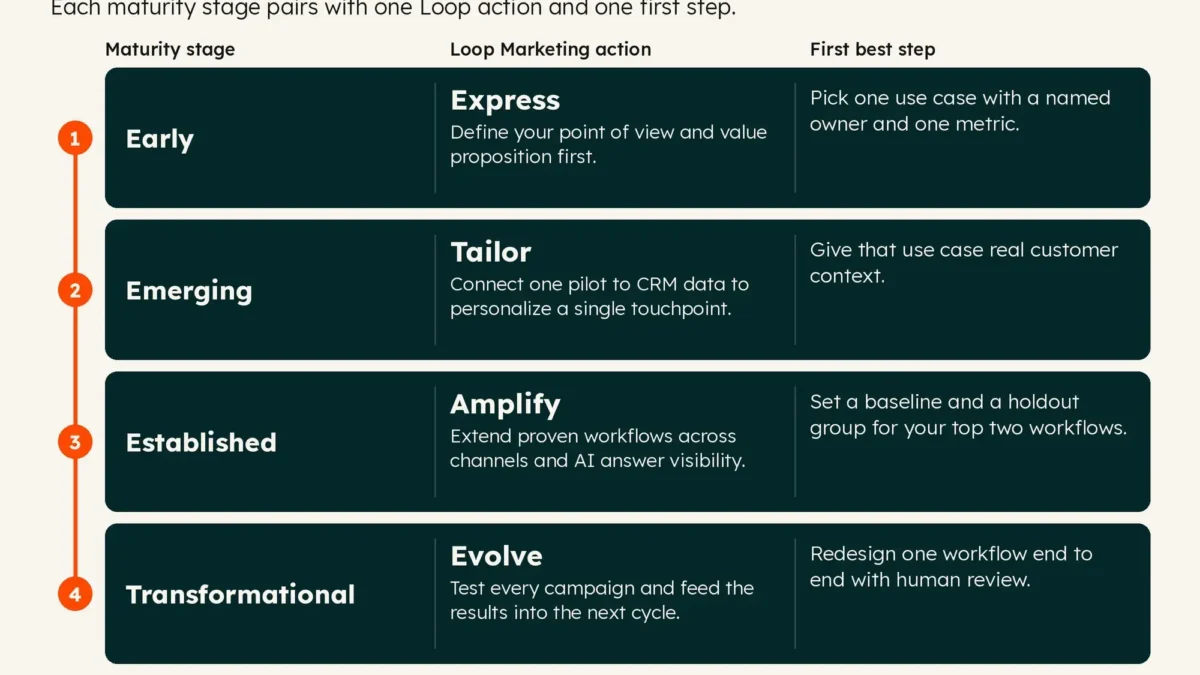
To help organizations diagnose their current operational standing, industry analysts have established a four-tier framework categorizing AI adoption patterns: Early, Emerging, Established, and Transformational.

At the Early stage, organizations rely on ad hoc experimentation. Individual contributors use unauthorized or personal tools without centralized oversight, workflows are undocumented, and success is measured anecdotally rather than quantitatively.
The Emerging stage is characterized by departmental awareness and the rollout of formal pilot programs. Teams begin standardizing specific applications, such as content drafting or basic email optimization, but data silos persist and integration with core revenue systems remains weak.
In the Established stage, artificial intelligence becomes operationalized. Workflows are documented, cross-functional data sources are unified, and leadership enforces governance and privacy protocols. AI outputs are systematically measured against performance indicators such as lead generation velocity and cost efficiency.
Finally, the Transformational stage represents full enterprise integration. Organizations at this peak level redesign their core operational workflows around autonomous capabilities and human-in-the-loop oversight. According to research benchmarks, 96% of Transformational adopters report meeting or exceeding their MQL targets, while being approximately 3.5 times more likely to outperform customer acquisition cost goals compared to their less mature peers. Furthermore, roughly 72% of all surveyed marketers agree that mature AI utilization simplifies the process of hitting revenue goals, though industry experts emphasize that these self-reported figures serve primarily as directional benchmarks.
Assessing and Benchmarking Organizational Readiness
Evaluating an organization’s true maturity requires moving past subjective self-assessments and gathering concrete evidence across multiple dimensions, including use case viability, data accessibility, workflow integration, governance, and quantifiable outcomes.
Industry analysts recommend that marketing operations or revenue operations leaders spearhead these assessments, working in tandem with executive sponsors, information technology security teams, and sales counterparts. Given the rapid pace of technological development—highlighted by recent data showing that 44% of global organizations are now scaling artificial intelligence enterprise-wide—experts advise conducting formal maturity assessments on a quarterly basis throughout the first year, transitioning to bi-annual reviews thereafter.
To quantify maturity, operations leaders utilize a multi-dimensional scoring index that evaluates specific operational artifacts. Teams must be able to produce documented workflows, verified data lineage, assigned administrative ownership, and verified performance metrics for every deployed capability. Under strict governance frameworks, an organization’s overall maturity score is capped by its lowest-performing dimension. For example, a department that scores exceptionally high on tool deployment and use cases but fails to implement proper data security or governance faces significant risk exposure, rendering its advanced operational tier invalid until foundational compliance is achieved.
Combating AI Sprawl and Shadow IT

As enterprise enthusiasm for artificial intelligence continues to expand, organizations increasingly struggle with unauthorized software usage, commonly referred to as shadow AI. This phenomenon typically occurs when employees lack access to approved, enterprise-grade tools that adequately address their operational needs, prompting them to utilize consumer-tier platforms that may expose proprietary customer data to external security risks.
To counter software sprawl, operational leaders must maintain a centralized inventory of all active tools, establish an approved software catalog, and assign clear departmental ownership to every use case. Recent enterprise cost analyses indicate that approximately one in five organizations now find operating expenses related to artificial intelligence software and API calls to be a significant constraint on broader utilization, making tool consolidation and waste reduction an urgent priority for financial controllers.
Data Readiness and Responsible Governance
The ultimate ceiling for artificial intelligence performance is dictated by data quality. Cross-functional studies consistently demonstrate a strong correlation between superior data hygiene and commercial success; companies that combine advanced artificial intelligence deployment with excellent data management report higher rates of revenue target achievement.
Data readiness relies on foundational hygiene practices, including accurate record deduplication, standardized field definitions, explicit customer consent management, role-based access controls, and the appointment of designated data stewards. Unified customer relationship management platforms provide the necessary architecture by centralizing customer interactions while maintaining comprehensive audit logs of actions executed by human personnel, automated workflows, and algorithmic agents.
Trust, privacy, and security remain paramount concerns for operational leaders. Approximately 29% of marketing professionals cite data privacy and security compliance as their primary personal challenge when deploying automated systems. Organizations operating within regulated jurisdictions must strictly adhere to regional privacy frameworks, such as the General Data Protection Regulation (GDPR) in the European Union and the United Kingdom, necessitating close collaboration between marketing operations and corporate legal counsel.
Strategic Implications and Future Outlook
The widening performance gap between the broad majority of organizations experimenting with artificial intelligence and the elite fraction achieving transformational outcomes underscores a fundamental shift in modern business strategy. Merely procuring software licenses or authorizing isolated pilot projects no longer provides a competitive advantage.
High-performing enterprises distinguish themselves through a deliberate commitment to workflow redesign, cross-functional data integration, rigorous risk mitigation, and executive-level sponsorship. As autonomous agents and advanced machine learning models become standard components of the go-to-market stack, organizations must systematically evaluate their operational maturity, address underlying data constraints, and align technological deployment with measurable commercial outcomes. Only through disciplined, metric-driven execution can enterprises bridge the gap between ubiquitous adoption and true business transformation.