The evolution of CSS over the past several years has been nothing short of transformative for web developers. With the introduction of powerful native features like container queries, the :has() relational pseudo-class, and native CSS nesting, the industry has seen a massive shift toward offloading logic from JavaScript into the styling layer. This transition is frequently framed as a victory for performance and code maintainability, as it often results in a significantly reduced lines-of-code count within a codebase. However, a growing body of evidence and developer experience suggests that while these modern features provide elegant solutions for isolated components, they can introduce substantial complexity when integrated into existing, mature applications.
The core of the issue lies in the distinction between local simplicity and system-wide complexity. When a developer replaces a JavaScript-based mechanism—such as a ResizeObserver—with a few lines of CSS, the immediate visual result is a cleaner PR with a high ratio of removed code to added code. Yet, this "red-line" victory often masks hidden dependencies. A component does not exist in a vacuum; it functions as a roommate to the browser’s layout engine, the CSS cascade, and legacy JavaScript logic. When these elements interact unexpectedly, the result is often the introduction of "ghost bugs"—intermittent layout shifts, vanishing elements, or performance degradation that are difficult to trace back to the newly implemented CSS.
The Anatomy of a Modern CSS Migration
To understand the technical implications of this trend, one must examine the chronology of these migrations. In early 2026, industry discourse began to shift as developers moved from the initial excitement of these features to the practical reality of maintaining them in production. The essay "Modern Frontend Complexity: Essential or Accidental?" by Igor Roztropiński served as a lightning rod for this conversation. Roztropiński argued that despite the maturation of browser capabilities, the complexity of modern front-end development has not necessarily decreased—it has merely changed form.
The discussion on various programming forums highlighted a deep divide. Some developers argue that modern CSS allows for a much cleaner declarative approach that removes the need for brittle, framework-dependent JavaScript. Others caution that the "less is more" mantra is misleading. As one prominent developer noted, "We aren’t doing less; we are just doing less in JavaScript." This shift requires a paradigm change in how developers audit their code, shifting the focus from individual file size to the broader impact on the DOM and the rendering pipeline.

Scenario 1: Dual Ownership and Logic Fragmentation
The most common point of failure in these migrations occurs when "old" code refuses to leave. A classic example involves a component that switches layouts based on width. In a legacy setup, a JavaScript ResizeObserver might toggle a class, while the corresponding CSS handles the visual changes. During a migration, a developer might implement a new @container query, delete the old CSS class, but fail to remove the JavaScript observer in a separate file.
The result is a hybrid state where two separate entities—one in JS and one in CSS—are effectively competing for control. If the two breakpoints are not perfectly aligned, the component enters a "limbo" state where its internal layout and title font sizes become inconsistent. This creates a maintenance nightmare: a future developer attempting to adjust the breakpoint may only find one of the two controlling mechanisms, leading to partial, buggy behavior that is nearly impossible to debug without a deep understanding of the entire system.
Scenario 2: Unintended Layout Side Effects
The introduction of container-type: inline-size has been particularly revolutionary, but it comes with significant baggage. While intended to allow children to query their parent’s width, the property also triggers style and inline-size containment. This, in turn, establishes a new Block Formatting Context (BFC).
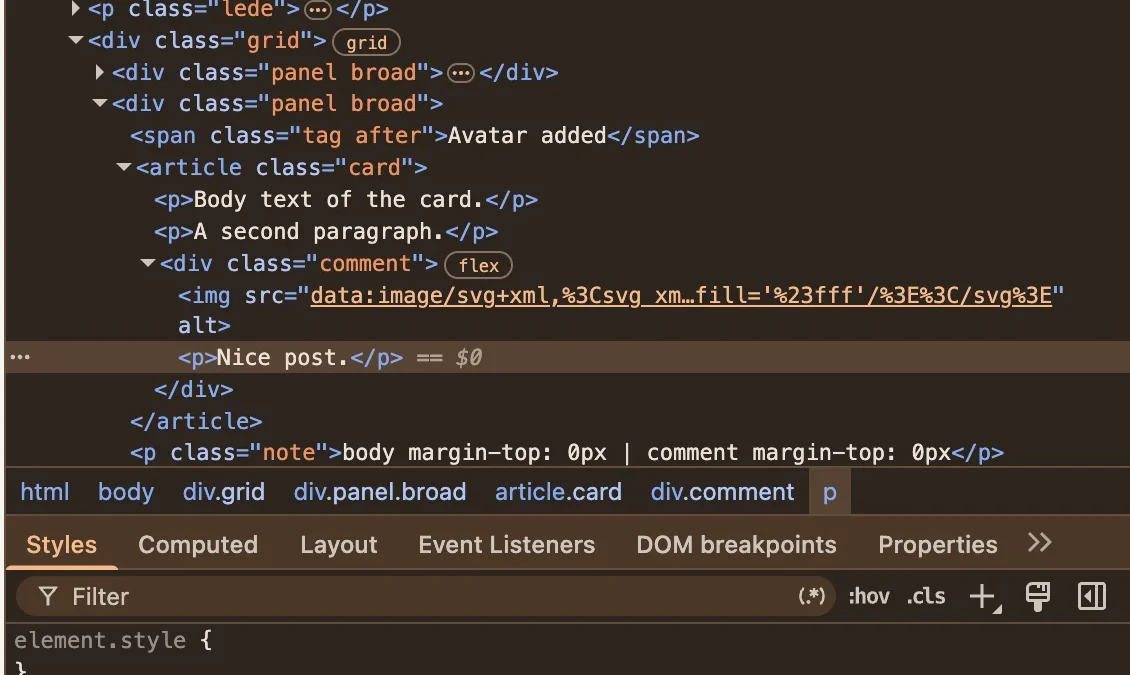
This is where the "hidden" costs emerge. A BFC changes how the browser calculates margins, floats, and overflow. Specifically, margins that previously collapsed through the parent element will now remain trapped inside it. Similarly, elements that were intended to flow around a float will suddenly be shoved to the side, potentially causing layout collapse. In several documented cases, developers found that adding a single line of CSS—intended to enable a container query—caused entire UI cards to vanish from the screen because they no longer had an explicit width to rely on.
Data-Driven Performance Analysis
The assumption that moving logic to CSS inherently improves performance is not always supported by empirical evidence. Performance testing conducted in late 2026 revealed nuanced results regarding the usage of the :has() selector. While :has() is a powerful tool, it can be computationally expensive if not used with caution.

In a controlled test involving 5,000 rows of data, toggling a CSS class on a row-by-row basis showed that while a simple :has() rule on a single element is relatively inexpensive (adding approximately 1.4ms to a frame), the cumulative effect of multiple, overlapping :has() selectors can be severe. In one scenario, combining two seemingly "harmless" rules forced the browser to restyle 5,001 elements every time a single row was toggled. This effectively mimicked the overhead of a poorly optimized JavaScript loop, yet it was hidden behind the declarative nature of the CSS.
The primary takeaway is that the browser’s rendering engine still has to perform the work, regardless of whether the instruction is written in JavaScript or CSS. Developers must move toward a performance-conscious mindset where the property being modified—such as using transform or opacity instead of width or left—remains the primary driver of optimization, regardless of the implementation language.
Strategic Implications for Engineering Teams
For organizations aiming to maintain high-quality, scalable front-end systems, the move toward modern CSS should not be viewed as a "drop-in" replacement for existing logic. Instead, it must be treated as a significant architectural refactor.
- Audit Dependencies: Before implementation, identify every piece of logic that currently controls the component’s behavior.
- Cascade Awareness: Recognize that CSS layers and specificity are not just academic concepts; they are the primary defense against unexpected style overrides in complex applications.
- Performance Profiling: Utilize browser DevTools to monitor the "Style and Layout" impact of new CSS rules, especially when using high-cost selectors like
:has(). - Documentation: Explicitly note the removal of old logic in PR descriptions to ensure that "ghost" scripts or styles are not left behind.
The industry is currently at a turning point. We have access to tools that would have been considered science fiction a decade ago. However, the true mark of a senior developer in the current climate is the ability to discern when a modern CSS feature is a genuine improvement and when it is a source of future, hard-to-track technical debt.
While the allure of a clean, minimalist codebase is strong, the responsibility of the engineer is to ensure that the "system" remains stable, performant, and predictable. Migration is not merely about deleting lines of code; it is about verifying the integrity of the entire web application. Moving forward, teams should implement strict checklists to ensure that every new CSS tenant is properly introduced to the existing household, preventing the fragmentation and complexity that often follow a hasty refactor. By maintaining this level of rigor, developers can harness the full power of modern CSS while avoiding the pitfalls that have plagued recent high-profile migrations.