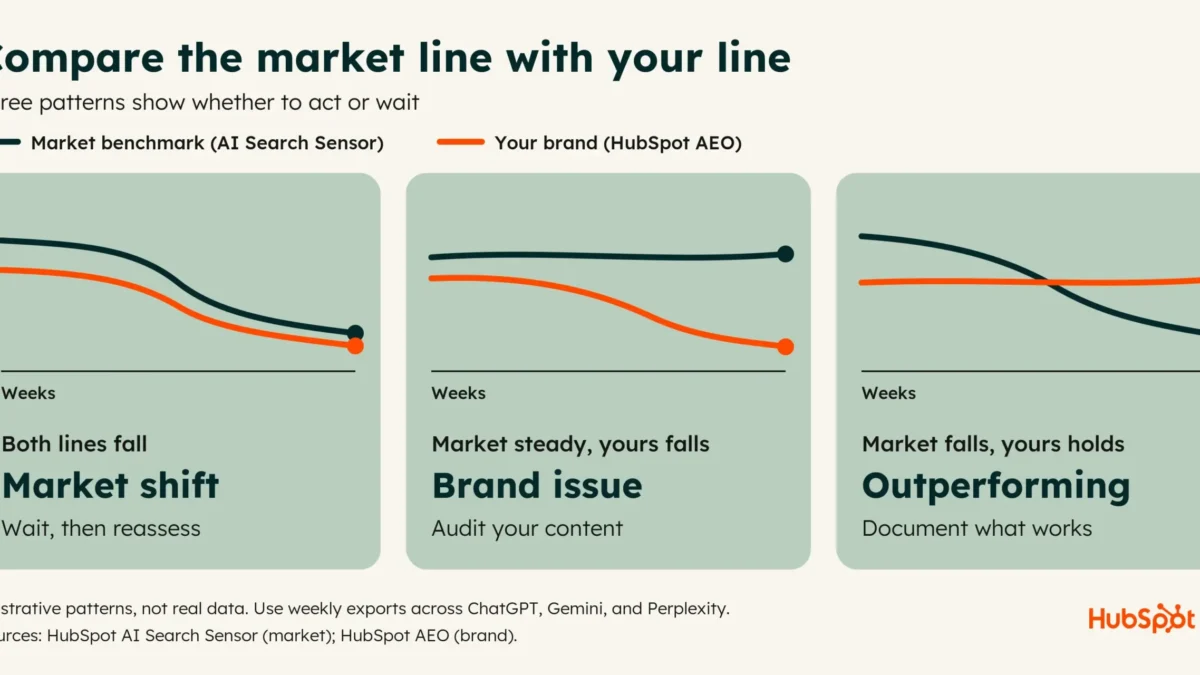
As the digital discovery landscape shifts rapidly away from traditional blue links toward conversational answer engines, digital marketing and brand leadership teams face a profound diagnostic challenge. When a brand experiences a sudden drop or surge in AI search visibility across major platforms like OpenAI’s ChatGPT, Google Gemini, and Perplexity, determining the root cause has historically been a guessing game. Without a structured framework, every negative performance dip is mistakenly attributed to internal content failures, while every positive traffic spike is prematurely celebrated as an isolated marketing win.
To solve this accountability gap, the digital marketing industry has increasingly turned to Answer Engine Optimization (AEO) benchmarking. AEO benchmarking measures a brand’s AI search visibility, citation frequency, and sentiment against direct competitors and broader macroeconomic or industry-wide trends. By leveraging a structured comparative approach, marketing teams can definitively isolate whether fluctuations in brand visibility stem from broader shifts in how artificial intelligence engines process queries or from brand-specific content deficiencies.
The Evolution of Search and the Accountability Gap
The transition from traditional Search Engine Optimization (SEO) to AEO represents one of the most fundamental structural changes in digital marketing history. For decades, SEO professionals relied on keyword rankings, click-through rates, and organic traffic metrics to evaluate digital performance. However, the rise of generative AI search and conversational agents has disrupted this paradigm.
Today, organic traffic can decline even while traditional keyword rankings remain stable, primarily because answer engines frequently deliver comprehensive answers directly to the user, bypassing the need to click through to external websites. This dynamic has created a severe accountability gap within corporate marketing departments. When leadership asks why referral traffic or brand mentions have dipped within AI assistants, marketing teams lacking empirical benchmarks are often unable to separate external algorithmic volatility from internal strategy execution.
Industry experts emphasize that treating every unexplained change as a binary puzzle is critical for modern brands. Every metric shift must be analyzed through two distinct lenses: what happened to the broader market, and what happened to the specific brand. Benchmarking answers the former, allowing optimization teams to accurately diagnose and address the latter.
The Two-Tier AEO Measurement Model
To navigate these complexities, advanced analytics frameworks recommend a two-tier AEO measurement model that pairs market-wide benchmarks with brand-level performance data. Relying on a single tier inevitably misleads marketing teams in both directions. Brand-only data cannot reveal whether an industry-wide decline is affecting all competitors simultaneously, while market-only data cannot indicate whether a specific company is successfully outpacing its peers.

The first tier involves monitoring external market trends through specialized diagnostic dashboards, such as public AI search sensors and beta analytics tools that track multi-engine visibility across industries. The second tier involves analyzing internal key performance indicators, including proprietary brand mention rates, specific product accuracy, and targeted topic coverage. Comparing these two distinct tiers prior to altering strategic tactics prevents organizations from committing one of the most expensive errors in modern marketing: attempting to fix a content or technical problem that belongs to the market as a whole.
Practical case studies underscore the power of this two-tier methodology. Recent analyses of localized AI search campaigns revealed that certain brands experienced significant visibility deficits in specific European markets despite maintaining robust domestic search performance. By identifying these regional gaps through external benchmarks, marketing teams executed targeted localization strategies—such as optimizing third-party forum presence and localized digital PR—resulting in dramatic visibility recoveries within a single month.
Core Metrics: Citations, Share of Voice, and Sentiment
Effective AEO benchmarking requires tracking a precise suite of quantitative and qualitative metrics across multiple generative AI engines. Industry analysts categorize these measurements into several core diagnostic pillars:
Citation Rate and Share of Voice: Citation rate measures how frequently a brand’s domain or content is explicitly referenced within an AI-generated response. Share of voice calculates a brand’s total visibility relative to its primary competitors within a defined category. If a consumer market features one hundred brand mentions across key competitor queries and twenty-five reference a specific company, that company’s share of voice stands at 25 percent. This metric is frequently the strongest indicator of why certain brands consistently dominate modern consumer buying conversations while others remain invisible.
Sentiment and Brand Health: Beyond simple visibility, sentiment analysis evaluates whether answer engines describe a brand, its leadership, and its product offerings in a favorable, neutral, or critical light. Declining sentiment accompanied by steady visibility signals a brand perception issue rather than a discovery problem, necessitating reputation management or public relations interventions rather than technical SEO adjustments.
Citation and Source Attribution: Source attribution tracks precisely where AI engines source their foundational information regarding a brand. Research indicates that in many professional sectors—such as financial services—authoritative third-party comparison portals and community-driven platforms out-cite major corporate institutions combined. When third-party publishers overwhelmingly shape category-level answers, a brand’s owned blog or website cannot move the needle on its own, necessitating an off-site digital PR strategy.
Methodological Rigor: Prompt Cohorts, Cadence, and Sampling
Establishing a reliable AEO benchmark depends heavily on deliberate methodological design choices, including the selection of prompt cohorts, tracking cadence, and engine coverage.

A prompt cohort consists of a fixed, standardized set of queries executed consistently over time. Ad hoc query testing—where marketers input random questions on an ad-hoc basis—fails to establish reliable baselines because week-to-week variables cannot be controlled. Industry guidelines recommend curating a cohort of fifty to one hundred prompts organized carefully by topic clusters and user intent types, spanning broad category queries, comparison questions, and direct brand inquiries.
Cadence and consistency are equally paramount. Running identical prompt cohorts on a weekly schedule matches the natural reporting cadence of modern AI traffic and citation databases. Furthermore, researchers emphasize the importance of accounting for statistical noise and algorithmic variance. Because generative AI outputs can fluctuate naturally between individual runs, single-point-in-time snapshots can easily mislead decision-makers. Analysts strongly recommend evaluating performance across rolling thirty- to sixty-day windows and incorporating uncertainty estimates to account for natural platform volatility.
Diagnosing Market Shifts Versus Brand-Specific Issues
When monitoring weekly performance reports, marketing executives must determine whether observed volatility reflects a macro-level algorithm update or a localized brand failure. By cross-referencing daily mention rates, citation behaviors, and AI-referred traffic against rolling baseline averages, teams can categorize market conditions.
In scenarios where an entire industry sector experiences a synchronized visibility decline during a week marked by elevated market volatility, organizations are advised to hold off on disruptive content rewrites, collect additional longitudinal data, and report the event as a broad market shift. Conversely, if a brand’s visibility drops during a calm market period while a direct competitor’s share of voice climbs, the underlying cause is firmly brand-specific, thereby justifying an immediate content and optimization audit. This disciplined approach prevents teams from expending valuable resources trying to solve phantom problems.
Actionable Frameworks and Strategic Recommendations
Translating AEO benchmarking data into a cohesive enterprise action plan requires sorting findings into two distinct operational categories: evidence-supported actions and hypotheses requiring empirical testing.
Actions supported by clear, longitudinal evidence include optimizing content formats that consistently earn high citation shares, closing identified topic gaps relative to top-tier competitors, and securing authoritative placements on third-party domains frequently cited by answer engines. Conversely, conclusions drawn from isolated weekly data points—such as sudden shifts in how an engine formats or prefers a particular style of answer—should be treated as hypotheses. Marketing teams should test these hypotheses on a limited subset of web pages and monitor cohort performance over multiple weeks before scaling changes across the entire digital ecosystem.
When reporting performance to corporate leadership, professionals should consistently lead with the two-tier comparison model: detailing market movements, internal brand trajectories, and the resulting performance gaps. By explicitly delineating proven empirical evidence from active hypotheses, marketing teams cultivate deeper organizational trust and demonstrate sophisticated control over the rapidly evolving AI search ecosystem.