The landscape of American public life is increasingly defined by a complex interplay between the information individuals consume and their broader participation in society. A comprehensive new analysis from the Pew Research Center, conducted under the auspices of the Pew-Knight Initiative, reveals that the news sources Americans rely on are not merely windows into the world, but are closely correlated with specific patterns of civic, political, and religious involvement. By segmenting the U.S. population into four distinct engagement groups—Mobilizers, Connectors, Spectators, and Outsiders—researchers have identified that the audiences of major news outlets often diverge significantly from the national average in how they contribute to, or disengage from, their communities.
The Anatomy of Engagement: Defining the Four Archetypes
To understand these dynamics, researchers utilized a cluster analysis based on 19 distinct measures of participation. These metrics encompass voting records, volunteering, religious service attendance, and the frequency of news consumption. The resulting classification provides a framework for understanding the modern American electorate.
At the most active end of the spectrum are the Mobilizers. Comprising roughly 9% of the adult population, this group is characterized by high levels of activity across all tracked dimensions. They are the most likely to vote, participate in community organizing, attend religious services, and follow the news cycle with religious consistency.
The second group, the Connectors, makes up 28% of the population. These individuals are highly involved in their communities, often engaging in volunteerism, donating to causes, and participating in local groups. However, they are notably less focused on the political sphere than the Mobilizers, prioritizing social and community-based activity over partisan maneuvering.
The third group, the Spectators, accounts for 31% of the U.S. adult population. As the name suggests, this demographic follows the news at high rates—frequently consuming information across digital and traditional platforms—but they are significantly less likely to participate in direct civic or political actions. They serve as an informed, yet passive, segment of the public.

Finally, the Outsiders, also representing 31% of the population, are the least engaged across all metrics. They report lower levels of interest in the news, voting, and community-based activities, reflecting a broader sense of detachment from the traditional institutions of civic life.
The News-Engagement Correlation: A Data-Driven Overview
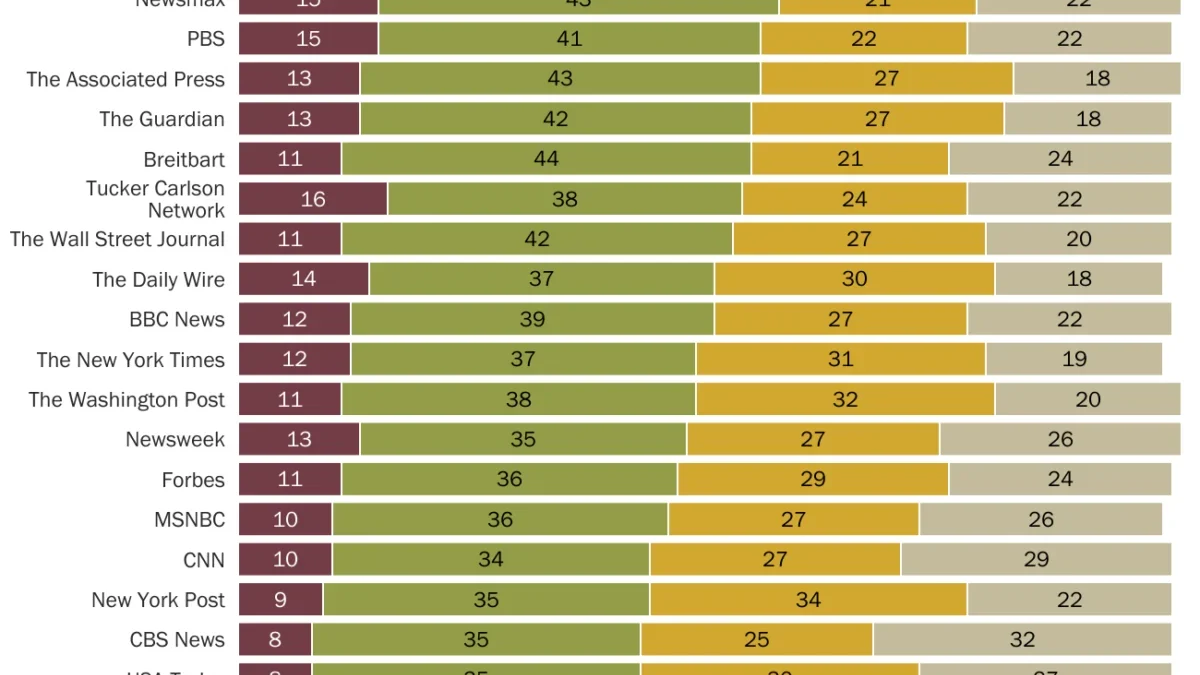
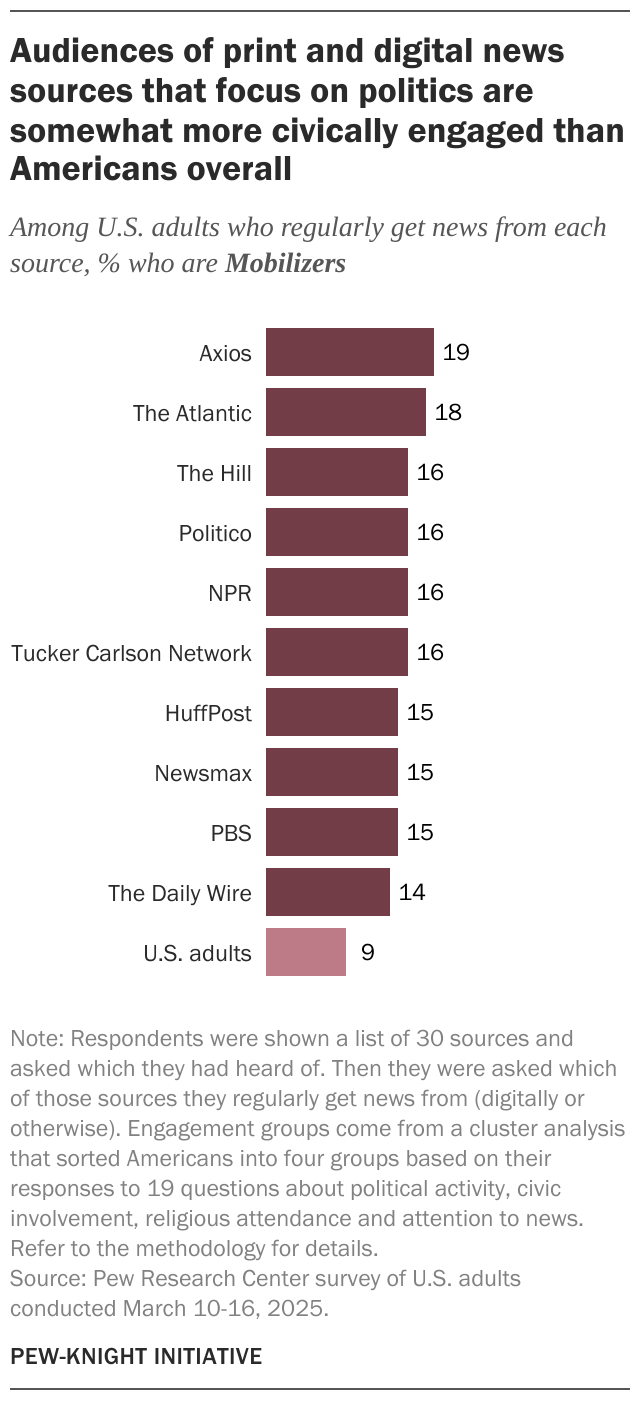
The data suggests that news consumption is not a neutral act. Outlets that prioritize intensive political reporting tend to attract disproportionate numbers of the most engaged citizens. For example, digital-first outlets that specialize in granular political analysis—such as Axios, The Atlantic, and Politico—boast audiences where the share of Mobilizers is significantly higher than the 9% seen in the general public.
Axios, in particular, counts 19% of its regular audience as Mobilizers, more than doubling the national average. Similarly, The Atlantic (18%), The Hill (16%), and Politico (16%) show a strong gravitational pull for the most politically active segment of the population. This trend extends to public media as well, with NPR (16%) and PBS (15%) drawing similarly high concentrations of high-engagement users.

Conversely, television news—particularly legacy broadcast networks—tends to mirror the national population more closely in its demographic makeup. However, even here, nuances emerge. While the major broadcast networks like ABC, CBS, and NBC attract a diverse array of viewers, they also serve as the primary news source for many Outsiders. In this regard, television serves as a bridge, reaching those who might otherwise be disconnected from the more niche or subscription-heavy digital political publications.
The Role of Language and Geography in News Consumption
The analysis highlights significant findings regarding the consumption habits of Hispanic Americans. Outlets such as Telemundo and Univision exhibit a distinct engagement profile, with 38% of their regular audiences classified as Outsiders. This finding is deeply intertwined with broader sociological trends; the study notes that Hispanic Americans are statistically more likely to be categorized as Spectators compared to their White or Black counterparts.
This suggests that media consumption patterns are not only a product of individual political ideology but are also influenced by cultural and linguistic preferences that shape how different communities access information. The high representation of Spectators within Spanish-language media suggests a cohort that is highly attentive to the news, yet perhaps feels less represented or less empowered to engage in the specific types of political and civic activities measured in the survey.

Chronology of Research and Methodology
The findings are based on two extensive surveys conducted by the Pew Research Center throughout 2025. The first, fielded in March 2025, surveyed 9,482 U.S. adults to establish the baseline of news consumption habits. By providing a list of 30 prominent news sources, researchers were able to quantify the regularity with which Americans access various platforms.
The second phase involved a more targeted survey of 5,195 adults between September and December 2025. This phase was designed to map these individuals onto the four engagement groups. By linking these datasets, the researchers created a high-resolution map of the intersection between media usage and societal participation. The use of the American Trends Panel (ATP) ensures that these findings are representative of the full U.S. adult population, providing a reliable baseline for understanding the current state of American civic life.
Implications for Media Literacy and Democracy
The fact that the most civically engaged Americans are overrepresented in the audiences of many news sources carries significant implications for the health of democratic discourse. If political news is primarily consumed by those who are already highly engaged, the potential for news to serve as a mobilizing force for the disengaged—the Outsiders—may be limited.

Furthermore, the data suggests that we are witnessing a "siloing" effect, where the information environment is tailored to the existing habits and engagement levels of the audience. For organizations looking to bridge the gap in civic participation, these results offer a roadmap. They indicate that "one size fits all" reporting may not be effective. Instead, understanding the specific engagement profiles of different audience segments could allow media outlets to craft content that resonates with the unique needs and barriers of each group—whether that means providing more actionable information for Connectors or more accessible entry points for those currently labeled as Outsiders.
Official Perspective and Future Outlook
The Pew-Knight Initiative, a collaboration between the Pew Research Center and the John S. and James L. Knight Foundation, emphasizes that these findings are intended to inform, not to advocate. By shedding light on the "how" and "where" of American engagement, the project aims to help institutions, educators, and news organizations better understand the challenges facing modern communities.
As the media landscape continues to evolve, the distinction between active participants and passive observers in our democracy will likely remain a critical area of study. The correlation between where one gets their news and how one lives their life is a stark reminder that the information diet of the American public is a vital component of the broader civic infrastructure.
As we move forward, the challenge for the news industry will be to reconcile these findings with the goal of fostering a more informed and participatory public. Whether this involves diversifying the platforms where political information is presented or re-evaluating the tone and accessibility of political reporting, the data provides a clear starting point: the first step in increasing civic engagement may be a better understanding of the audiences that currently define our media ecosystem.
Ultimately, the research underscores a fundamental truth about contemporary society: our news habits and our civic behaviors are inextricably linked. Whether one is a Mobilizer, a Connector, a Spectator, or an Outsider, the path to a more engaged public life likely runs through a more nuanced understanding of the information environments we inhabit every day.