A federal judge issued a preliminary injunction on September 24, 2026, mandating that the Trump administration immediately restore White House press credentials to reporters from CNN, MS NOW, and Politico. The order marks a significant development in a high-stakes legal confrontation that began last week when the administration revoked access for the three outlets, citing what the White House described as a pattern of "unfair and negative coverage." The court’s decision offers a temporary reprieve for the affected journalists, though the underlying dispute regarding the limits of executive power over media access remains unresolved.
Chronology of the Dispute
The conflict escalated rapidly in mid-September 2026. On September 17, White House officials informed representatives from CNN, MS NOW, and Politico that their permanent press passes—which allow for daily entry into the West Wing and participation in press briefings—would be suspended effective immediately. The administration’s move followed a series of contentious exchanges between the press corps and the White House press secretary.
By September 19, the three news organizations filed a joint lawsuit in the U.S. District Court for the District of Columbia. The plaintiffs argued that the revocation of credentials without due process violated their First and Fifth Amendment rights, contending that the White House grounds constitute a public forum where the government cannot discriminate based on the content or tone of reporting. The administration countered that the President possesses broad discretionary authority to grant or deny access to the White House complex, framing the decision as a response to what they characterized as "activist journalism."
Following the court’s September 24 ruling, the administration is now legally obligated to facilitate the return of the reporters to the grounds while the case proceeds toward a full merits trial. The White House press office has not yet confirmed whether it will appeal the injunction, though legal analysts anticipate a lengthy appeals process that could eventually reach the Supreme Court.
Polarization and Public Trust in Media
The legal battle arrives at a moment of profound division in the American media landscape. According to a June 2026 survey conducted by the Pew-Knight Initiative, 44% of U.S. adults believe that the press has become less free during the second Trump administration. This sentiment is not evenly distributed across the political spectrum; the survey highlights a significant partisan divide, with 72% of Democrats reporting a decline in press freedom, compared to just 15% of Republicans.
The divide is mirrored by deeply entrenched distrust toward mainstream outlets. Data from March 2025 indicates that a majority of Republicans express distrust in CNN, with significant segments of the GOP electorate also viewing MS NOW and Politico with skepticism. President Trump’s rhetoric has frequently tapped into this base, characterizing these outlets as "the enemy of the people" and pointing to "two years of unfair and negative coverage" as the primary justification for restricting their access.
For many observers, the current tension is the culmination of a decade-long degradation in the relationship between the executive branch and the press. The shift toward digital-first media and the rise of partisan news consumption have made the traditional "press pool" a focal point for political theater. When the administration restricts access, it is not merely a logistical hurdle for reporters; it is a symbolic gesture aimed at voters who believe the media acts as an institutional antagonist to the administration’s agenda.
Corporate Consolidation and Editorial Oversight
The landscape of the media industry is further complicated by recent corporate developments. Paramount has reached a settlement in a sprawling antitrust lawsuit involving multiple states, clearing the way for its acquisition of Warner Bros. Discovery. This merger will consolidate two of the nation’s largest news organizations, CNN and CBS News, under a single corporate parent.

As part of the settlement agreement, Paramount has committed to establishing an independent editorial board. This board is intended to serve as a firewall between the corporate interests of the newly merged entity and the newsrooms of CNN and CBS. The creation of such a board is a rare concession in an industry increasingly dominated by massive media conglomerates.
The timing of this merger is significant, as these two networks serve as primary news sources for nearly half of all Americans. According to a 2025 Center survey, one-third of U.S. adults regularly consume content from CNN, while 30% rely on CBS News. The prospect of these two entities operating under a single editorial framework—coupled with the administration’s recent efforts to restrict access for at least one of them—has raised concerns about the centralization of information and the susceptibility of the press to political and corporate pressure.
Analysis of Press Freedom Concerns
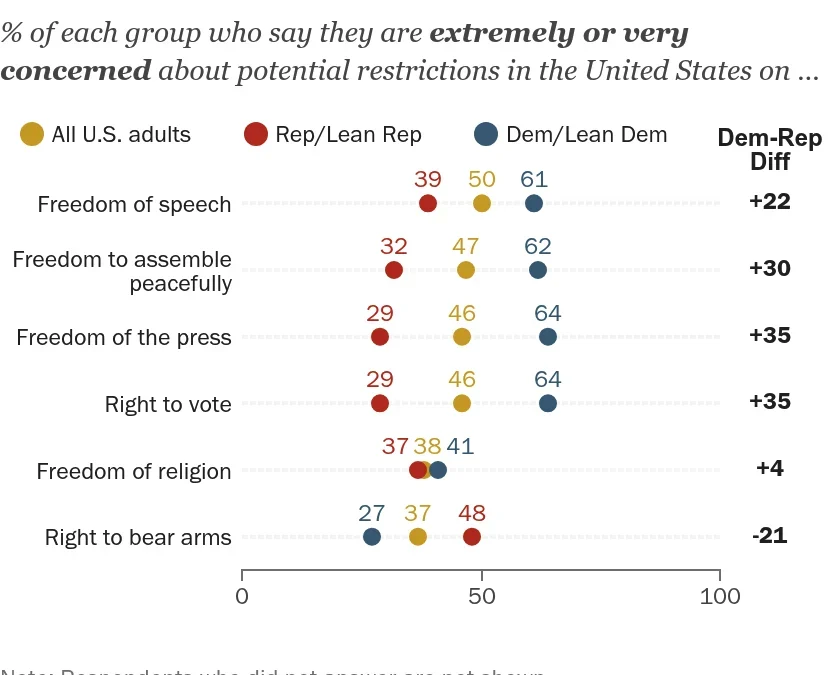
The broader concern regarding the state of American democracy is reflected in recent polling data. When asked about their fears regarding the erosion of civil liberties, 46% of U.S. adults indicated they are "extremely or very concerned" about potential restrictions on press freedom. This level of concern is statistically identical to anxiety surrounding the right to vote (46%) and is slightly lower than concerns about freedom of speech (50%) and the right to peaceful assembly (47%).
The data reveals a striking divergence in how Americans prioritize these rights based on their political affiliation. Democrats are significantly more likely to voice alarm over threats to press freedom, with 64% expressing high concern compared to just 29% of Republicans. Conversely, when the focus shifts to the right to bear arms, the trend reverses: 48% of Republicans are deeply concerned about potential restrictions, while only 27% of Democrats share that view.
Legal scholars suggest that the administration’s decision to ban specific outlets may ultimately trigger a broader judicial review of what constitutes a "protected" press environment. If the courts uphold the idea that the White House has the right to pick and choose who enters the press briefing room based on their perceived bias, it could set a precedent that fundamentally alters the nature of political journalism in the United States.
Broader Implications for Governance
The implications of this conflict extend beyond the immediate legal victory for the news outlets. By using the White House grounds as a battlefield, both the administration and the media are signaling that the traditional norms of presidential communication are undergoing a permanent shift. The role of the press as a check on executive power relies on access, but as that access becomes a point of contention, the ability of the public to receive neutral, on-the-ground reporting is increasingly jeopardized.
Furthermore, the administration’s strategy of leveraging "distrust" as a policy tool creates a self-reinforcing cycle. When the administration restricts access, the outlets report on the restriction, which the administration then frames as further evidence of "unfair coverage," potentially deepening the divide among the electorate.
As the litigation moves forward, the focus will likely shift to the specific criteria the White House uses to grant credentials. If the court establishes a framework that requires the administration to prove that a reporter’s behavior—rather than their reporting—is the basis for a ban, the impact on press freedom could be stabilized. However, if the court defers to the executive branch’s broad authority, it may embolden the administration to continue its efforts to curate the pool of journalists who have direct access to the President and his staff.
In the coming weeks, the media industry will be watching closely to see if the restoration of credentials leads to a cooling of tensions or if the White House will find new, perhaps more indirect, methods to limit the influence of the outlets it deems unfriendly. For now, the legal system has affirmed the role of these organizations in the White House, providing a temporary stay of execution for the press’s role in covering the highest office in the land.