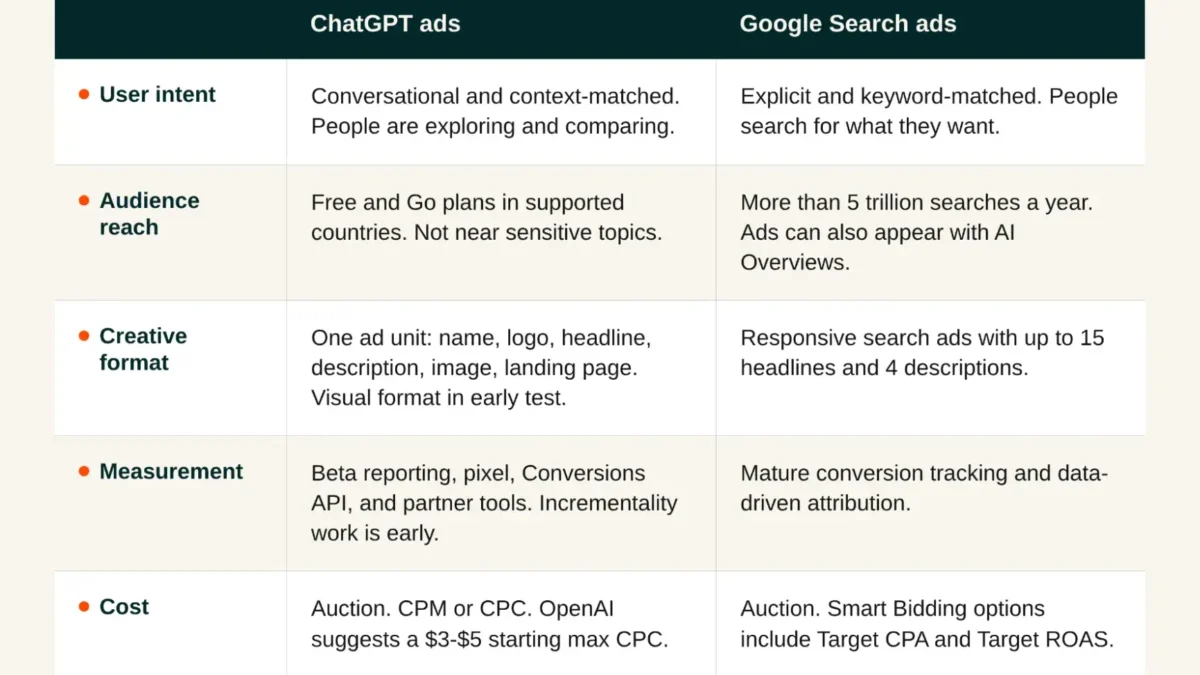
The digital advertising landscape is undergoing its most profound structural shift in decades. For over twenty years, search engine marketing has been defined by a singular paradigm: Google’s keyword auction. Advertisers bid on exact or phrase-match terms, capturing high-intent users at the exact moment they type a query into a search bar. However, the rapid mainstream adoption of generative artificial intelligence has fundamentally altered consumer habits. With millions of users now turning to conversational AI platforms like ChatGPT for research, decision-making, and recommendations, OpenAI has introduced native advertising infrastructure. This development has forced marketing executives and enterprise media planners worldwide to re-evaluate their digital budgets and confront a critical strategic dilemma: how to balance expenditure between traditional Google Search Ads and emerging ChatGPT Ads.
To understand the weight of this decision, digital marketers must look beyond surface-level metrics and examine the structural mechanics of how these two digital titans operate. While both platforms are designed to place commercial messages in front of active information-seekers, their underlying mechanics, user intents, creative frameworks, and attribution models diverge significantly. Making informed budget reallocations requires a rigorous, data-driven analysis of these differences, especially as OpenAI’s self-serve advertising beta continues to expand globally.
The Evolution of Search and the Arrival of Conversational Advertising

Google’s dominance over digital advertising has historically been anchored in its sheer volume. Processing trillions of searches annually, Google Search Ads have served as the bedrock of performance marketing. Advertisers have long relied on keyword matching to target consumers at the bottom of the funnel—those explicitly looking to purchase a specific product or service.
In contrast, OpenAI’s entry into the advertising ecosystem represents a shift toward contextual, conversational discovery. Initially launching ads on ChatGPT’s Free and Go plans, OpenAI structured its ad placements to appear subtly below relevant conversational answers, clearly labeled as sponsored content. These units feature standard direct-response components: an advertiser’s name, logo, headline, short description, landing page URL, and accompanying imagery. Furthermore, OpenAI introduced specialized visual formats designed for use cases like image generation, rolling out initial tests to select U.S. advertisers.
From a privacy and user-experience standpoint, the integration of ads into an AI chatbot has naturally sparked industry-wide debate. To mitigate consumer skepticism, OpenAI has maintained strict operational boundaries. The company asserts that sponsored placements do not influence or alter the underlying generative answers provided to users. Furthermore, advertisers are strictly barred from accessing individual user chat histories, receiving only aggregated performance totals such as views and clicks. To preserve a brand-safe environment, OpenAI explicitly prohibits the delivery of ads adjacent to sensitive queries involving mental health, general healthcare, and politics.
Understanding the Mechanics: Contextual Hints vs. Exact-Match Keywords

The fundamental divergence between Google Search Ads and ChatGPT Ads lies in user intent and targeting architecture. On Google, advertisers bid on precise keywords, ensuring their ads appear on search engine results pages (SERPs) when those exact terms are triggered. Conversely, ChatGPT relies on "context hints" provided by advertisers. These hints do not function as exact-match keywords; rather, they serve as descriptive signposts that help OpenAI’s contextual matching engine determine whether a specific ad aligns with the flow and intent of an ongoing user conversation.
This structural difference mirrors a shift in the buyer journey. Google Search acts as a digital storefront for shoppers who arrive knowing precisely what they want to buy. ChatGPT, conversely, functions more like a digital personal shopper. Research highlights this behavioral nuance: economic studies from OpenAI and academic partners indicate that nearly half of all user messages on conversational AI platforms are exploratory "asking" messages, where individuals seek advice, comparisons, or educational guidance before making a commercial decision.
Audience Reach and Demographic Limitations
When comparing the macro-reach of both platforms, advertisers must account for stark differences in scale and audience accessibility. Google remains the most visited web property globally, processing tens of billions of searches daily across more than 200 international markets, frequently integrating ads above, below, or directly within AI Overviews.

ChatGPT boasts a massive weekly active user base numbering in the hundreds of millions. However, the reachable audience for advertisers on the platform is subject to several deliberate restrictions. ChatGPT ads are exclusively served to users on Free and Go plans. They are withheld from enterprise-tier subscribers using Business, Plus, or Pro plans, and are entirely blocked for users under the age of eighteen, as well as those located in unsupported regions. Consequently, B2B brands whose primary target audiences utilize ChatGPT through corporate work accounts may find their reachable addressable market significantly constrained compared to traditional search channels.
Creative Formats and Copywriting Flexibility
Creative execution represents another critical point of divergence. Google Search Ads—particularly Responsive Search Ads—offer extensive flexibility, allowing marketers to input up to fifteen distinct headlines and four descriptions. Google’s algorithms then dynamically test various combinations to optimize performance based on real-time user signals.
OpenAI’s current ad unit features a more streamlined layout, consisting of a standardized headline, short descriptive text, brand logo, landing page destination, and single image or visual asset. While this simplicity reduces the complexity of asset production, it places a heavy premium on immediate clarity and relevance. Because ChatGPT ads are integrated into conversational threads, successful ad creatives must seamlessly complement the tone of the user’s ongoing interaction rather than feeling like disruptive, conventional banner placements.

Attribution, Measurement, and CRM Integration
Effective media planning relies entirely on robust attribution. Google Ads benefits from over two decades of refinement in conversion tracking, automated bidding strategies (such as Target CPA and Maximize Conversion Value), and multi-touch attribution models that distribute conversion credit across multiple user touchpoints.
ChatGPT’s measurement infrastructure, while developing rapidly, is in an earlier stage of maturity. OpenAI supports standard third-party tracking via persistent static UTM parameters, pixel implementations, and conversion APIs. Early case studies published by measurement vendors and platform partners indicate promising early returns for select enterprise brands. For instance, brands utilizing early ChatGPT ad inventory have reported competitive customer acquisition costs and high percentages of net-new customer discovery relative to traditional search benchmarks. However, because these figures stem from early beta deployments, media buyers are advised to treat them as directional indicators rather than guaranteed performance baselines.
To accurately evaluate performance across both channels, sophisticated marketing teams are increasingly relying on centralized customer relationship management (CRM) platforms. By integrating ad accounts into unified marketing hubs—such as HubSpot’s ecosystem—organizations can automate UTM parameter assignment, monitor multi-touch attribution paths, and push offline conversion events back into ad servers. This operational setup allows marketers to measure success by cost per qualified lead (CPQL) and downstream revenue rather than superficial click-through rates.

Financial Models and Auction Dynamics
Both platforms utilize dynamic auction models to price and distribute inventory, meaning neither offers fixed-rate pricing. Google relies on a complex keyword-based auction system heavily influenced by quality scores and historical click-through rates. OpenAI employs a relevance-weighted, second-price auction mechanism where ad delivery is determined by a combination of the advertiser’s maximum bid and the contextual relevance of the creative to the active chat session.
Because pricing on ChatGPT is dictated by real-time auction competition for conversational contexts, costs will naturally fluctuate as more enterprise advertisers enter the beta ecosystem. Consequently, digital strategists must avoid evaluating channels based purely on cost-per-click (CPC) parity, focusing instead on efficiency metrics tied directly to business pipeline growth.
Strategic Implications and the Hybrid Testing Framework

Rather than viewing the emergence of ChatGPT Ads as an existential threat to Google Search Ads, progressive media planners are viewing it as an expansion of the modern search ecosystem. The optimal strategy for most brands involves a measured, dual-channel approach.
To determine the ideal budget allocation, marketing teams can deploy a structured hybrid test:
- Establish clear baseline performance metrics and cost-per-acquisition targets using established Google Search campaigns.
- Allocate a controlled, non-disruptive test budget to the OpenAI Ads Manager, focusing initial ChatGPT campaigns on high-intent consideration and comparison queries.
- Standardize naming conventions and UTM parameters across both environments to ensure unified tracking within the organization’s CRM.
- Evaluate outcomes after a statistically significant testing window based entirely on downstream pipeline contribution, lead qualification rates, and customer acquisition costs.
The Bottom Line
ChatGPT Ads and Google Search Ads serve fundamentally different functions within the consumer journey. Google captures explicit, bottom-funnel intent rooted in exact keywords, while ChatGPT captures exploratory, conversational discovery rooted in context and situational advice. Rather than choosing a single victor, modern marketing organizations that successfully integrate both channels—backed by disciplined CRM attribution and rigorous multi-touch measurement—will be best positioned to capture high-intent buyers across the entire digital landscape.