The rapid evolution of Large Language Model (LLM) architectures has created a significant challenge for developers and knowledge workers: discerning whether incremental model updates provide tangible improvements or merely represent marketing nomenclature. Marie Haynes, a prominent SEO researcher and developer of the "Marie’s Brain" AI co-pilot, recently conducted a comprehensive, blind, multi-model evaluation to determine the efficacy of Google’s latest Gemini iterations. By utilizing her proprietary Open Knowledge Format (OKF) library—a curated database of search and AI research—Haynes compared the performance of Gemini 3.8 Flash, Gemini 4 Hydrogen, and the newly released Gemini 4 Neon. The findings, derived from a series of real-world SEO inquiries, suggest that model selection significantly influences output quality, cost efficiency, and technical accessibility.
The Chronology of the Evaluation
The testing process began several months ago, following the development of "Marie’s Brain," a private AI agent designed to synthesize high-level SEO and algorithmic research. Initially powered by established models, the system was upgraded to Google’s Gemini 4 Hydrogen model to leverage potential performance gains. However, concerns regarding whether the newer model offered superior practical value prompted a rigorous validation study.
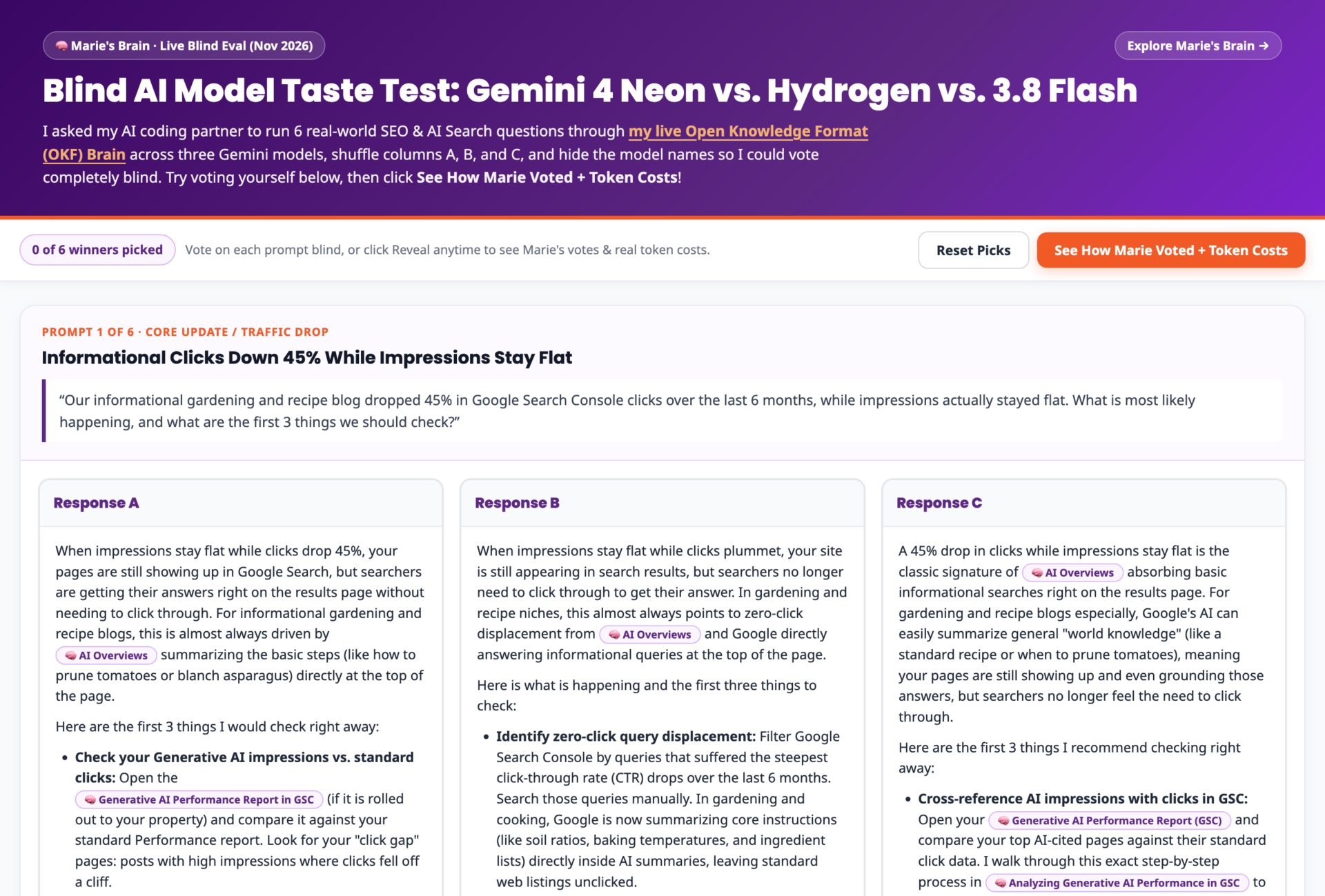
The evaluation process was structured as a "blind taste test" to eliminate brand bias. Six complex SEO and AI search questions were posed to three distinct models. To ensure data integrity, the system shuffled the output columns (labeled A, B, and C) for each prompt. The evaluation criteria centered on clarity, accuracy, and the ability to synthesize technical concepts without unnecessary jargon. The initial phase of the test uncovered a significant "prompt problem." The system, configured for "Detailed" mode without a word ceiling, allowed the models to engage in excessive research loops. Gemini 4 Hydrogen, in particular, displayed a tendency to over-process information, reading an average of 21 OKF files per inquiry. This resulted in responses exceeding 1,600 words, high latency, and an unsustainable cost per turn of $0.44. Furthermore, the outputs were saturated with internal Google engineering terminology, such as "MAGIT" and "FastSearch," which proved counterproductive for the intended audience of business owners and SEO professionals.
Methodological Adjustments and Re-testing
To rectify these issues before the final assessment, the development team implemented three critical infrastructure adjustments. First, the prompt engineering was refined to enforce a "Concise" mode, effectively capping output length. Second, the system was optimized to prioritize actionable, domain-specific insights over broad, technical-heavy explanations. Finally, the research retrieval parameters were tightened to focus on the most relevant OKF documents, reducing the computational overhead and latency associated with the initial, over-eager research cycles.

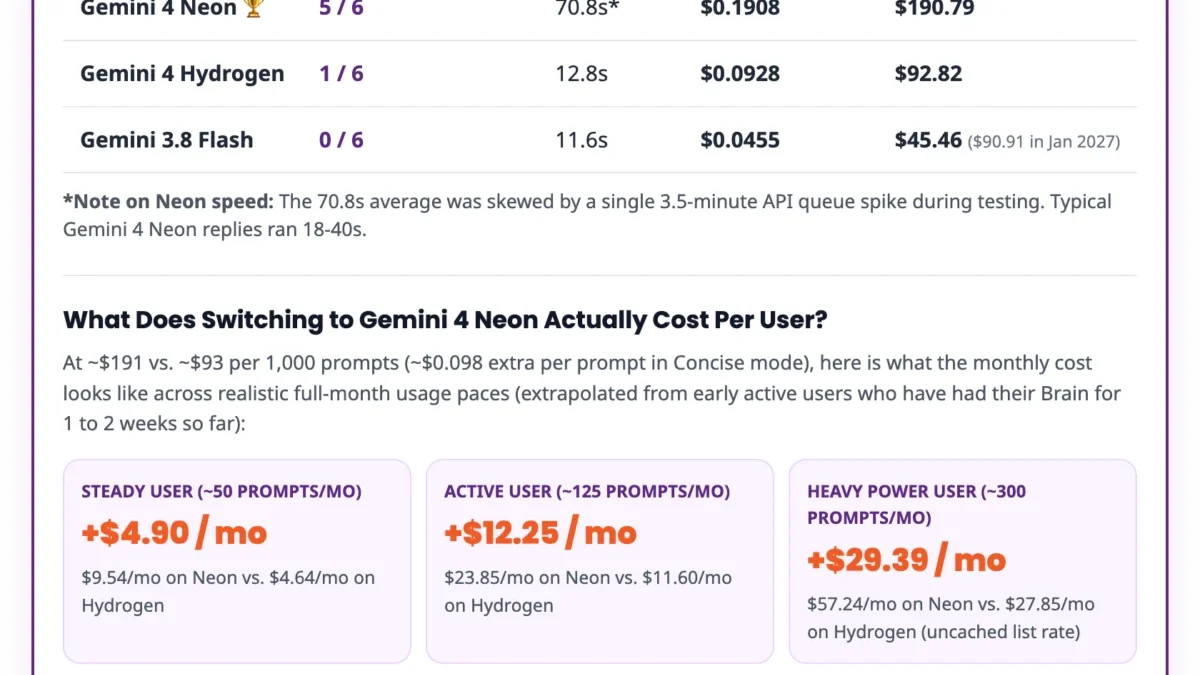
With these parameters in place, the team re-ran the six core queries, covering critical industry topics such as the impact of AI Overviews on traffic, the strategic decision to delete versus rewrite informational content, the optimization of "Main Content" in commercial buyer’s guides, the management of thin location pages, and the integration of llms.txt for agentic readiness. The results were decisive: Gemini 4 Neon outperformed its counterparts in five out of six instances, demonstrating a superior capability for human-like reasoning and concise communication.
Comparative Performance and Data Analysis
The empirical data gathered during the testing phase offers a clear perspective on the cost-to-performance ratio of the models involved. While Gemini 3.8 Flash remains the most economical option, the qualitative superiority of Gemini 4 Neon in professional research contexts appears to justify the increased expenditure for power users.
The following data summarizes the performance metrics observed during the live tests, utilizing real Gemini API usageMetadata:
Model Performance and Cost Metrics
| Model | Average Latency | Average Output Length | Estimated Cost per Turn | Monthly Cost (1k Turns) |
|---|---|---|---|---|
| Gemini 3.8 Flash | 11.6 seconds | 292 words | $0.0455 | $45.46 |
| Gemini 4 Hydrogen | 12.8 seconds | 239 words | $0.0928 | $92.82 |
| Gemini 4 Neon | 70.8 seconds | 275 words | $0.1908 | $190.79 |
It is important to note that the latency figure for Gemini 4 Neon was impacted by a specific API queue spike during testing, with typical response times for the model ranging between 18 and 40 seconds. Despite the higher nominal cost per turn, the integration of implicit context caching—which leverages the 55,000-token OKF Master Index—mitigates long-term costs in multi-turn conversations. By reusing input tokens across the session, the actual financial impact for users is significantly lower than the "uncached" list rates suggest.
Implications for the AI Industry
The results of this study highlight several broader implications for developers building specialized AI tools. First, the "newer is better" assumption is frequently invalidated by specific use cases. While Gemini 4 Hydrogen offered technological advancement, its verbose, jargon-heavy outputs were less effective for the end-user than those of Gemini 4 Neon. This underscores the importance of domain-specific fine-tuning and prompt refinement.
Second, the study highlights the necessity of "context-aware" AI. By grounding the models in a curated, high-quality library like the OKF, the developer ensured that all three models had access to the same information. Therefore, the discrepancy in scoring was purely a function of the model’s reasoning capabilities and its ability to communicate complex information in a structured, accessible format.
Third, the economic implications are significant for small-to-medium enterprises (SMEs) integrating AI into their operations. While the jump from $93 to $191 per 1,000 turns is numerically significant, the increase of roughly 10 cents per prompt is a manageable cost for businesses that rely on high-accuracy research. The shift from generic, high-volume AI responses to high-quality, "agentic" thinking is a necessary evolution for tools designed to provide expert-level advisory services.
Conclusion and Future Outlook
The evaluation conducted by the Marie’s Brain project serves as a practical blueprint for testing and deploying LLMs in specialized environments. By prioritizing user-centric metrics—such as the readability of technical advice and the reduction of irrelevant "noise"—the study demonstrates that the true value of an AI co-pilot lies not in its raw parameter count, but in its ability to synthesize large datasets into actionable intelligence.
As AI models continue to evolve, the distinction between high-performance "reasoning" models and high-speed "utility" models will become increasingly pronounced. For organizations managing complex search strategies or technical SEO, the findings suggest that a hybrid approach—selecting the model based on the complexity of the inquiry—may provide the optimal balance of cost and quality. Future developments in this field will likely continue to focus on lowering the latency of reasoning models, potentially bridging the gap between the speed of the 3.8 Flash series and the cognitive depth of the 4 Neon series. The data confirms that while compute costs remain a primary concern, the investment in higher-quality model reasoning yields substantial dividends in the form of time saved and the accuracy of strategic decision-making.