A significant majority of Americans, by a three-to-one margin, believe that China, not the United States, holds a more advanced position in the burgeoning field of artificial intelligence development. This perception, revealed in a comprehensive new Pew Research Center survey, highlights a notable shift in public opinion regarding the global technological race, even as a substantial portion of U.S. adults remain uncertain about which nation truly leads. The survey, conducted among 3,488 adults from June 22 to 28, 2026, delves into American perspectives on global AI development, the strategic importance of U.S. leadership, and the potential impact of AI on international economic disparities.
The findings underscore a complex landscape where geopolitical competition converges with public sentiment and socio-economic anxieties. While 36% of Americans identify China as the more advanced nation in AI, only 12% attribute that lead to the United States. An additional 18% consider both countries to be roughly equally advanced, but a sizable 33% admit they are unsure, reflecting perhaps a lack of comprehensive understanding or conflicting information on the intricate technological rivalry. This uncertainty itself is a noteworthy data point, suggesting that despite widespread discussion of AI, a clear picture of global leadership has yet to coalesce in the public consciousness.
The Geopolitical AI Race: A New Cold War Frontier
The perception of China’s lead comes at a critical juncture as the United States and China are locked in an increasingly intense competition for AI dominance. This rivalry is not merely about technological superiority; it encompasses national security, economic prosperity, and the future of global influence. Artificial intelligence is widely recognized as a foundational technology, capable of transforming industries, revolutionizing warfare, and reshaping societal structures. Consequently, securing a leadership position in AI is seen by both Washington and Beijing as paramount to their respective long-term strategic interests.

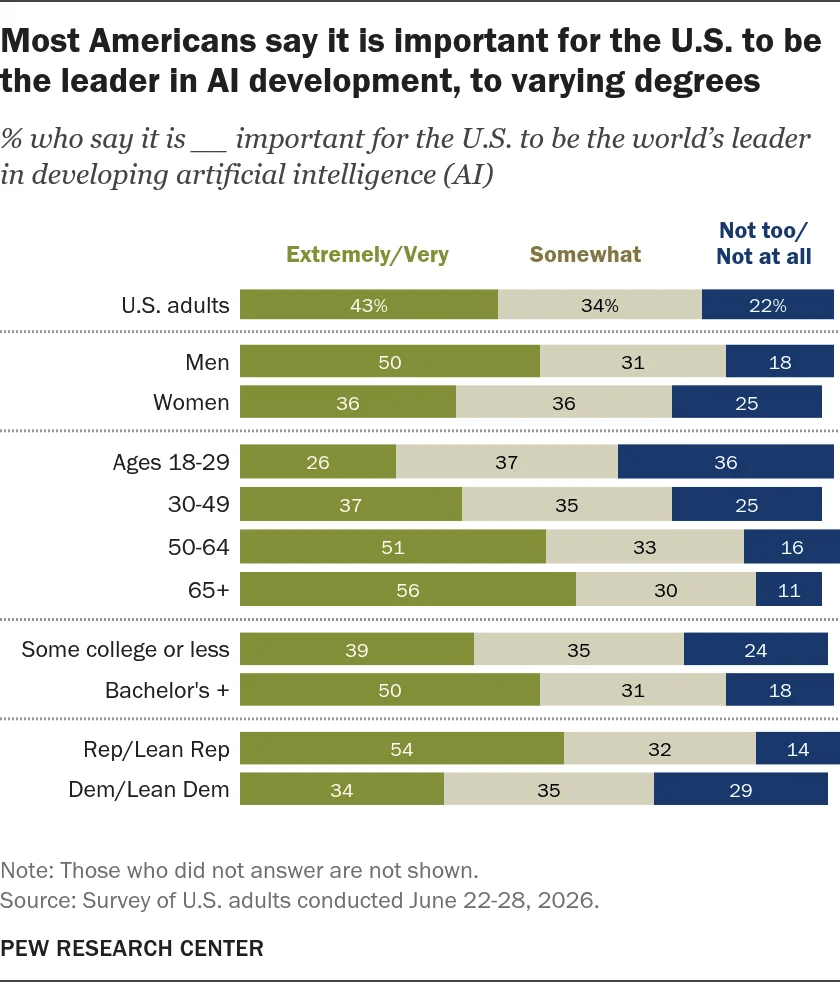
The strategic importance of AI leadership is strongly felt by a significant portion of the American public. The Pew survey indicates that 43% of Americans consider it "extremely or very important" for the U.S. to be the world’s leader in AI development. Another 34% deem it "somewhat important," bringing the total who view U.S. leadership as at least somewhat important to a commanding 77%. Conversely, only 22% believe U.S. leadership in AI is "not too" or "not at all important." This sentiment reflects a broader understanding that technological leadership translates directly into geopolitical leverage and economic advantage. Analysts and policymakers frequently point to AI’s dual-use nature, with applications ranging from advanced medical diagnostics and climate modeling to autonomous weapons systems and sophisticated surveillance technologies. The ability to innovate and control these technologies is therefore seen as a key determinant of a nation’s power in the 21st century.
A Brief Chronology of AI Ambition and Rivalry
The roots of the modern AI race can be traced back decades, but its current intensity is a relatively recent phenomenon.
- Mid-20th Century: Early conceptualizations and foundational research in AI begin, notably with the Dartmouth Workshop in 1956, which coined the term "artificial intelligence."
- Late 20th – Early 21st Century: Periods of "AI winters" are followed by renewed interest. Breakthroughs in machine learning, particularly deep learning, begin to emerge in the 2000s, fueled by increasing computational power and vast datasets.
- 2010s: The Dawn of Modern AI: The proliferation of big data, cloud computing, and advanced algorithms leads to rapid advancements. Companies like Google, Facebook, and Amazon (in the U.S.) and Baidu, Alibaba, and Tencent (in China) invest heavily, driving innovation in areas like natural language processing, computer vision, and recommendation systems.
- 2017: China’s National AI Strategy: Beijing unveils its "New Generation Artificial Intelligence Development Plan," explicitly outlining a national strategy to become the world’s primary AI innovation center by 2030. This ambitious plan involves massive state-backed investments, talent cultivation programs, and a top-down approach to integrate AI across various sectors. The plan aims for China to achieve parity with leading AI countries by 2020, make major breakthroughs by 2025, and achieve global leadership by 2030.
- 2019: U.S. Responds with "American AI Initiative": In response to China’s explicit ambitions, the Trump administration launches the "American AI Initiative," a national strategy to ensure U.S. leadership in AI. This initiative focuses on prioritizing AI R&D, developing an AI workforce, removing barriers to AI innovation, and protecting U.S. AI technology.
- 2020-2024: Escalation of Tech Competition: The U.S. intensifies efforts to restrict China’s access to critical AI technologies, particularly advanced semiconductors and chip manufacturing equipment, citing national security concerns. The Biden administration largely continues and expands these policies, emphasizing the need to "out-compete China" in critical technologies.
- July 2024: World Artificial Intelligence Conference (WAIC), Shanghai: As depicted in the image accompanying the Pew report, China continues to host major international AI events like WAIC, showcasing its advancements and fostering collaborations, further solidifying its image as a global player in the field. Such events serve as platforms for demonstrating technological prowess and attracting investment and talent.
- 2025-2026: Ongoing Policy and Investment: Both nations continue to pour resources into AI research, talent development, and infrastructure. The Biden administration, for instance, has issued executive orders on AI safety and security, and stressed the importance of keeping advanced AI capabilities out of the hands of adversaries.
Demographic Divides in AI Perceptions
The Pew survey also uncovers interesting demographic disparities in how Americans view the AI race. Men are notably more likely than women to believe the U.S. should lead in AI development (50% of men vs. 36% of women say it’s extremely or very important). This gap could be attributed to varying levels of engagement with technology news, differing career paths, or broader societal roles that influence perceived national priorities.

Similarly, older adults exhibit a stronger conviction about the importance of U.S. AI leadership. Those aged 65 and older are more than twice as likely as 18- to 29-year-olds to deem U.S. leadership extremely or very important (56% vs. 26%). This generational divide may reflect a historical perspective among older Americans, who may recall previous geopolitical technology races (e.g., the Space Race during the Cold War) where national leadership was a clear determinant of global power. Younger generations, perhaps more accustomed to a globally interconnected technological landscape, may hold different views on the necessity of unilateral national leadership.
Educational attainment also plays a role, with Americans holding a bachelor’s degree or higher being more likely to emphasize U.S. leadership (50%) compared to those with some college education or less (39%). Higher education often correlates with greater awareness of complex geopolitical and technological trends, fostering a more informed perspective on strategic national interests.
Politically, a distinct partisan gap emerges. A significant 54% of Republicans and Republican-leaning independents say U.S. AI leadership is extremely or very important, compared with just 34% of Democrats and Democratic-leaning independents. This aligns with broader partisan stances on national strength, technological competitiveness, and foreign policy. Former President Donald Trump, a Republican, explicitly declared that the U.S. "must have the most powerful AI systems in the world" and is "in a race to achieve global dominance in artificial intelligence." While former President Joe Biden, a Democrat, also stressed "keeping AI technology away from adversaries like China to prevent them from using it for cyberattacks or military augmentation," the rhetoric and perceived urgency often differ between the two major parties. The bipartisan consensus on the importance of AI leadership exists, but the intensity and approach can vary significantly.
Interestingly, there are also nuances based on AI chatbot usage. Americans who use AI chatbots are slightly more likely to believe the U.S. is leading (16%) compared to non-users (9%). However, an equally large share (36% for both groups) still believes China is more advanced. Non-users are generally more unsure about AI development, suggesting that direct engagement with AI tools might provide a clearer, albeit still complex, understanding of the current technological landscape. Those who interact with AI daily might have a more grounded, or perhaps more critical, perspective on the capabilities and limitations of currently available AI, which largely originates from U.S.-based companies. Yet, the overall perception of China’s lead persists, even among this more engaged segment.
AI’s Potential to Widen Global Inequality

Beyond the geopolitical rivalry, the Pew survey reveals a strong concern among Americans about the socio-economic implications of AI. A majority of 51% of U.S. adults believe that AI will increase the gap between rich and poor countries globally. This concern dwarfs the 7% who think AI will decrease the gap and the 16% who anticipate it will make little difference. A quarter of respondents remain unsure.
This apprehension is well-founded and echoed by numerous international bodies and experts. The United Nations, for instance, has repeatedly highlighted concerns about unequal access to AI technologies across the world, fearing that the benefits of AI will be concentrated in a few developed nations, further marginalizing poorer countries. Several factors contribute to this concern:
- Digital Divide: Developing countries often lack the foundational digital infrastructure, reliable internet access, and widespread digital literacy necessary to effectively develop, deploy, and utilize advanced AI systems.
- Resource Concentration: Building sophisticated AI requires immense computational power, vast datasets, and highly specialized talent, resources primarily concentrated in wealthy nations and large corporations.
- Economic Disruption: AI-driven automation could displace jobs in industries prevalent in developing countries, such as manufacturing and customer service, without creating sufficient new opportunities to compensate.
- Data Colonialism: There are concerns that data, the lifeblood of AI, from developing countries could be collected and leveraged by foreign tech giants without fair compensation or benefit-sharing, further entrenching economic disparities.
- Ethical Governance Gaps: The rapid pace of AI development often outstrips regulatory frameworks, and poorer nations may lack the resources and expertise to develop robust ethical guidelines and oversight mechanisms for AI, making them more vulnerable to potential harms.
The survey shows that this concern about inequality is more pronounced among certain demographic groups. Democrats are more likely than Republicans to say AI will increase inequality (60% vs. 45%), aligning with the Democratic party’s broader emphasis on social and economic equity. Similarly, Americans with a bachelor’s degree or higher are more likely than those without one to foresee a widening gap between countries (62% vs. 46%), possibly due to greater exposure to academic discussions and policy debates on global development and technological impacts. Even among AI chatbot users, a majority (55%) predict increased inequality, suggesting that direct experience with AI does not alleviate this fundamental concern.
Official Responses and Broader Implications
The findings of this Pew Research Center report serve as a critical barometer of public sentiment amidst a dynamic technological and geopolitical landscape. U.S. policymakers, across the political spectrum, generally acknowledge the imperative of maintaining a competitive edge in AI. The challenge lies in translating this consensus into effective strategies that address both the perceived lead of rivals and the potential for increased global inequality.

On the U.S. side, strategies involve increased funding for AI research and development through agencies like the National Science Foundation (NSF) and the Defense Advanced Research Projects Agency (DARPA), initiatives to attract and retain top AI talent, and export controls designed to slow China’s progress in critical AI components. There’s also a growing emphasis on international partnerships with allies to pool resources and set global standards for ethical AI development.
China, conversely, continues to execute its national AI strategy with determination. Its approach leverages state-owned enterprises, vast domestic markets, and a centralized planning system to direct resources towards strategic AI sectors. Beijing’s focus remains on achieving self-sufficiency in critical technologies and integrating AI into every facet of its economy and society, from smart cities to advanced military applications.
The implications of this global AI race are profound. A future where one nation undeniably dominates AI could reshape the global balance of power, influencing everything from economic leadership to military capabilities and cultural soft power. Furthermore, the ethical and societal considerations of AI’s development and deployment, particularly its potential to exacerbate existing inequalities, demand urgent international attention and collaborative solutions. As the Pew survey highlights, Americans are acutely aware of these challenges, signaling a public ready for robust policy responses that ensure U.S. leadership while also mitigating AI’s potentially divisive global impacts. The path forward for both the United States and the international community will require not only technological innovation but also thoughtful governance and a commitment to equitable development.